
Introduction
Upper lip lines, often called perioral wrinkles or lipstick lines, are among the most noticeable signs of facial aging. These fine vertical lines develop around the upper lip and may become more visible when smiling, talking, drinking, or applying lipstick. Although they are a natural part of aging, many clients now look for ways to soften their appearance without undergoing surgery.
This has created growing demand for non-surgical aesthetic treatments that can improve skin texture, support collagen remodeling, and refresh the appearance of the perioral area. For professional beauty clinics and aesthetic practices, energy-based beauty devices provide a practical way to build customized treatment programs around these concerns.
There is no single treatment that is ideal for every client. Depending on wrinkle depth, skin condition, age, sensitivity, downtime expectations, and treatment goals, professionals may consider radiofrequency, microneedling, fractional laser resurfacing, or combinations of different technologies. A review of perioral rejuvenation treatments similarly emphasizes individualized and combination approaches rather than one universal solution.
Background: Why Do Upper Lip Lines Develop?
Upper lip lines can result from several factors working together.
The natural aging process gradually reduces collagen and elastin within the skin. As dermal support decreases, the skin becomes thinner and less resilient. Repeated facial movement then has a greater influence on the formation of visible lines.
The upper lip is particularly active. Speaking, smiling, eating, drinking through a straw, and other repetitive movements can repeatedly fold the same area of skin. Over time, lines that initially appear only during movement may become visible even when the face is relaxed.
Sun exposure is another important factor. Long-term ultraviolet exposure can contribute to collagen degradation and changes in skin texture, making fine lines more noticeable. Lifestyle factors such as smoking can also contribute to perioral aging.
The appearance of upper lip lines can therefore involve more than a simple surface problem. In a professional setting, treatment planning should consider skin quality, wrinkle depth, pigmentation, laxity, and the overall condition of the perioral area.
This is where professional aesthetic equipment becomes particularly valuable. Rather than relying only on topical skincare, professional devices can deliver controlled forms of energy or mechanical stimulation to target specific layers of the skin.
Technology and Mechanism: How Can Non-Surgical Devices Help?
1. Radiofrequency for Collagen Remodeling
Radiofrequency (RF) technology is widely used in professional aesthetic treatments because it delivers controlled electromagnetic energy into tissue and generates thermal effects.
When appropriately applied, RF heating can stimulate the skin's remodeling response. The treatment is designed to improve the appearance of skin laxity and texture over time rather than simply producing a temporary surface effect.
For upper lip lines, RF can be particularly interesting when fine wrinkles are accompanied by reduced skin firmness. Professional RF platforms can offer adjustable energy levels and treatment parameters, allowing operators to adapt the procedure to different areas and skin conditions.
Research comparing fractional radiofrequency with fractional Er laser treatments found that both modalities improved facial wrinkles, while fractional RF showed particularly favorable results in perioral, nasolabial, and jawline areas in that study.
This does not mean RF is automatically the right choice for every client. Instead, it demonstrates why treatment selection should consider the anatomical area being treated.
2. Radiofrequency Microneedling
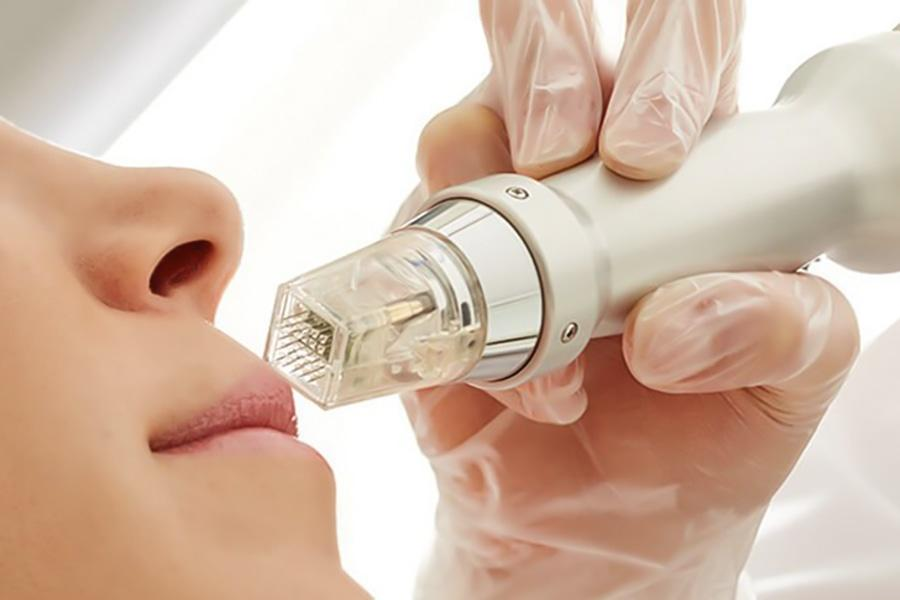
Radiofrequency microneedling combines two mechanisms: controlled microneedling and RF energy delivery.
Microneedles create precisely controlled micro-injuries, while RF energy can be delivered at targeted depths. This combination is intended to stimulate a wound-healing and collagen-remodeling response within the skin.
For professional clinics, one advantage is treatment customization. Needle depth, energy level, pulse duration, and treatment pattern can be adjusted according to the treatment area and individual skin characteristics.
A 2026 systematic review of RF microneedling for facial rejuvenation analyzed 22 studies involving 558 participants and reported improvements in skin texture and tightening, with commonly reported adverse effects including temporary redness and swelling.
A separate review of RF microneedling technology notes that treatment depth should reflect anatomical differences across facial areas and specifically identifies relatively shallow treatment parameters for perioral skin.
This highlights an important point for professional practice: the perioral area is not simply a smaller version of the cheek. Device settings and operator technique need to reflect the anatomy of the treatment zone.
3. Fractional Laser Resurfacing
Fractional laser treatments work by creating controlled microscopic treatment zones within the skin. Depending on the technology, the laser can produce thermal remodeling with different degrees of resurfacing and downtime.
For clients whose primary concern is skin texture and fine-to-moderate wrinkles, fractional laser technology can be incorporated into a professional rejuvenation program.
The treatment approach needs to be selected carefully because different lasers produce different levels of tissue interaction. Ablative technologies may provide more intensive resurfacing but generally involve greater recovery requirements, while non-ablative options may provide a more gradual approach with less downtime.
For clinics, this creates an opportunity to offer treatment pathways based on client priorities rather than using one device for every case.
4. Microneedling Without RF
Traditional microneedling uses controlled mechanical stimulation to create microchannels in the skin. The resulting wound-healing response can support collagen remodeling and improve the appearance of fine lines and uneven texture.
Compared with RF microneedling, traditional microneedling does not add thermal energy. This can make it a useful option when the treatment objective is primarily mechanical collagen stimulation.
Professional microneedling devices also provide greater control and consistency than improvised home techniques. For professional operators, needle configuration, depth, speed, treatment pattern, hygiene procedures, and skin assessment can all be incorporated into a standardized protocol.
[Insert Image 1: Professional RF or RF Microneedling Treatment for Perioral Lines]
Suggested visual placement: Use a professional clinic treatment image here to visually connect the technology section with real-world aesthetic practice.
Advantages and Comparison: Which Non-Surgical Approach Fits Different Needs?
When a client asks for the “best” treatment for upper lip lines, the more useful professional question is: Which technology best matches the client's skin condition and treatment goals?
| Technology | Main Focus | Suitable Professional Scenario | Key Consideration |
|---|---|---|---|
| RF | Firmness and collagen remodeling | Fine lines with mild skin laxity | Controlled thermal delivery |
| RF Microneedling | Texture, firmness and collagen remodeling | More noticeable wrinkles and uneven texture | Requires trained professional operation |
| Fractional Laser | Resurfacing and skin texture | Clients seeking stronger resurfacing | Downtime varies by technology |
| Microneedling | Mechanical collagen stimulation | Fine lines and texture concerns | Does not use RF heat |
| Combination Approach | Multiple skin concerns | Complex or multi-factor aging | Requires individualized planning |
Clinical literature supports the idea that no single modality should automatically be considered superior for every perioral wrinkle case. Treatment choice depends on the desired outcome, expected downtime, skin characteristics, and the specific technology being used.
For example, a client with early fine lines may require a different approach from a client with deeper static wrinkles and noticeable loss of skin firmness.
A professional consultation can therefore begin with several questions:
- Are the lines visible only during facial movement or also at rest?
- Is skin laxity present?
- Is the main concern texture, wrinkle depth, or overall rejuvenation?
- How much downtime is acceptable?
- Is the client looking for gradual improvement or a more intensive resurfacing approach?
- Are there pigmentation or sensitivity concerns that influence device selection?
These questions allow the operator to build a more appropriate treatment plan.
Why Professional Equipment Matters
Home beauty devices and professional aesthetic systems serve different purposes.
Consumer devices are generally designed for convenient personal use, often with lower energy levels and simplified controls. Professional systems, by contrast, are designed for trained operators who can assess the skin and select treatment parameters according to the individual client.
For delicate areas such as the upper lip, this distinction matters.
Professional equipment may provide adjustable energy, treatment modes, applicators, cooling functions, intensity controls, and other features designed to support more customized treatment protocols. The operator can also combine device treatments with professional cleansing, preparation, post-treatment care, and follow-up assessment.
The value of professional equipment is therefore not simply higher energy. It is the combination of controlled technology, trained operation, standardized protocols, and individualized treatment planning.
Modern RF microneedling literature also emphasizes the importance of treatment parameters such as depth, temperature, pulse width, and cooling, although reporting of these parameters is not always consistent across studies.
Applications and Client Needs
Fine Upper Lip Lines
For clients with early fine lines, a professional RF or microneedling program may focus on improving skin quality and supporting gradual collagen remodeling.
The goal is not to eliminate every natural expression line, but to create a smoother and more refined appearance.
Moderate Perioral Wrinkles
When lines become more visible at rest, a stronger professional treatment strategy may be considered. RF microneedling or fractional resurfacing can become part of a structured rejuvenation program depending on the client's skin condition and tolerance for downtime.
Mature Skin With Reduced Firmness
For mature clients, upper lip lines may occur together with reduced skin elasticity. In these cases, addressing overall skin quality rather than treating individual lines in isolation may produce a more coherent aesthetic result.
RF-based technologies can be useful within broader facial rejuvenation programs because their purpose extends beyond a single wrinkle.
Clinics Building Customized Treatment Programs
For aesthetic clinics, the opportunity goes beyond treating one concern.
A multifunctional professional device can potentially support protocols for facial rejuvenation, fine lines, skin texture, firmness, and other common aesthetic concerns, depending on the device technology and regulatory indications.
This allows clinics to design treatment menus around client needs rather than around individual machines.
Professional Treatment Workflow
A professional upper-lip-line treatment program can generally follow a structured workflow.
Step 1: Skin Assessment
The operator evaluates wrinkle depth, skin texture, firmness, pigmentation, sensitivity, and previous aesthetic treatments.
Step 2: Treatment Planning
The technology, treatment area, energy parameters, and session strategy are selected according to the client's condition and the device's intended use.
Step 3: Skin Preparation
The treatment area is properly cleansed and prepared according to the clinic's protocol.
Step 4: Controlled Device Treatment
The professional applies the selected device using an appropriate technique. Particular attention should be given to the anatomy and sensitivity of the perioral region.
Step 5: Post-Treatment Care
The skin is monitored and appropriate post-treatment care is provided. Clients should also receive professional aftercare instructions, including guidance regarding sun exposure and skincare.
Step 6: Follow-Up
Because collagen remodeling is generally gradual, follow-up assessment can help determine whether additional sessions or a different treatment approach is appropriate.
Conclusion
The best non-surgical treatment for upper lip lines is not necessarily the most aggressive treatment or the newest device. It is the approach that appropriately matches the client's skin condition, wrinkle pattern, treatment objectives, and tolerance for downtime.
Professional technologies such as RF, RF microneedling, fractional laser resurfacing, and traditional microneedling each offer different mechanisms for improving the appearance of fine lines and skin texture. Evidence from clinical literature supports the use of these technologies for facial rejuvenation, while also highlighting the importance of individualized treatment planning.
For beauty clinics and aesthetic practices, professional equipment provides more than a treatment tool. It creates a platform for controlled energy delivery, customized protocols, professional assessment, and long-term client care.
As demand for non-surgical facial rejuvenation continues to grow, clinics that combine appropriate technology with skilled operation can provide treatment experiences designed around the individual rather than applying a one-size-fits-all solution
Founded in 2008, Guangzhou GLM Beauty Spa Equipment Factory specializes in research, development, manufacture and selling of beauty and slimming machines. Our production base is located in Guangzhou City, Guangdong Province, China. Since our foundation, we have introduced advanced technologies and equipment, to assure high quality and high performance of our products. With professional marketing guide and excellent after-sales service, our products have been exported to over 20 countries and regions, including Southeast Asia, the Middle East, Europe and the United States, won worldwide praises and gained a good reputation