
Introduction
As clients become more informed about aesthetic technology, they are no longer simply asking for “anti-aging treatments.” They want to know which technology is right for their skin, what results they can expect, and how quickly those results may appear.
Two technologies frequently discussed in professional aesthetics are High-Intensity Focused Ultrasound (HIFU) and microneedling. Both can support skin rejuvenation and collagen remodeling, but they work in fundamentally different ways.
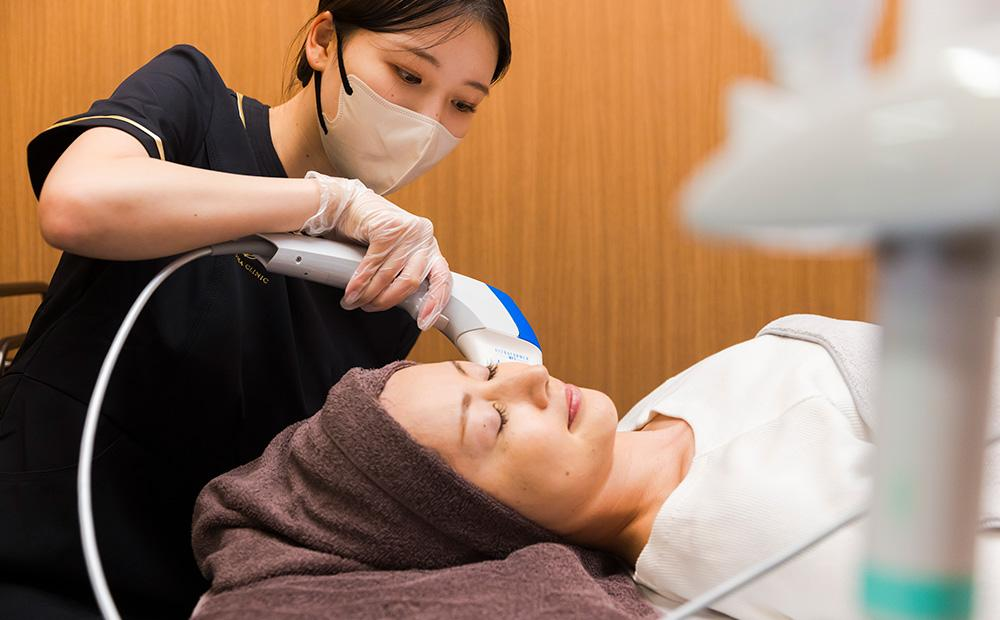
HIFU uses focused ultrasound energy to create controlled thermal effects at selected tissue depths without intentionally puncturing the skin. Focused ultrasound systems for aesthetic use are classified by the FDA as devices that use focused ultrasound to create localized tissue effects for aesthetic purposes.
Microneedling, by contrast, uses fine needles to create controlled micro-injuries in the skin. Motorized professional devices can allow practitioners to adjust parameters such as needle depth and speed, depending on the device and treatment protocol.
So, which one delivers better results?
The answer depends on what “better” means for the client.
For deeper skin tightening, lifting and contour-focused treatments, HIFU may have a stronger role. For skin texture, acne-scar appearance and surface-level remodeling, microneedling can be particularly valuable.
For professional beauty clinics, understanding this distinction is more important than simply choosing the technology with the strongest marketing claims.
Background: Why Are HIFU and Microneedling Often Compared?
HIFU and microneedling are often placed in the same category because both are associated with collagen remodeling and skin rejuvenation.
However, a client may use the same words—“tightening,” “anti-aging,” or “rejuvenation”—to describe very different concerns.
For example, one client may be concerned about:
- A less-defined jawline
- Mild facial laxity
- Sagging around the lower face
- Loss of firmness
- Neck skin laxity
Another client may primarily want to improve:
- Acne-scar appearance
- Enlarged pores
- Uneven skin texture
- Fine lines
- Overall skin smoothness
These concerns should not automatically be treated with the same technology.
A professional consultation therefore needs to consider treatment depth, skin condition, desired outcome, tolerance for downtime, treatment frequency and practitioner expertise.
This is where professional aesthetic equipment becomes particularly important. Modern systems allow practitioners to select appropriate handpieces, depths, energy levels and treatment patterns instead of applying a one-size-fits-all approach.
Technology and Mechanism: How Does HIFU Work?
HIFU stands for High-Intensity Focused Ultrasound.
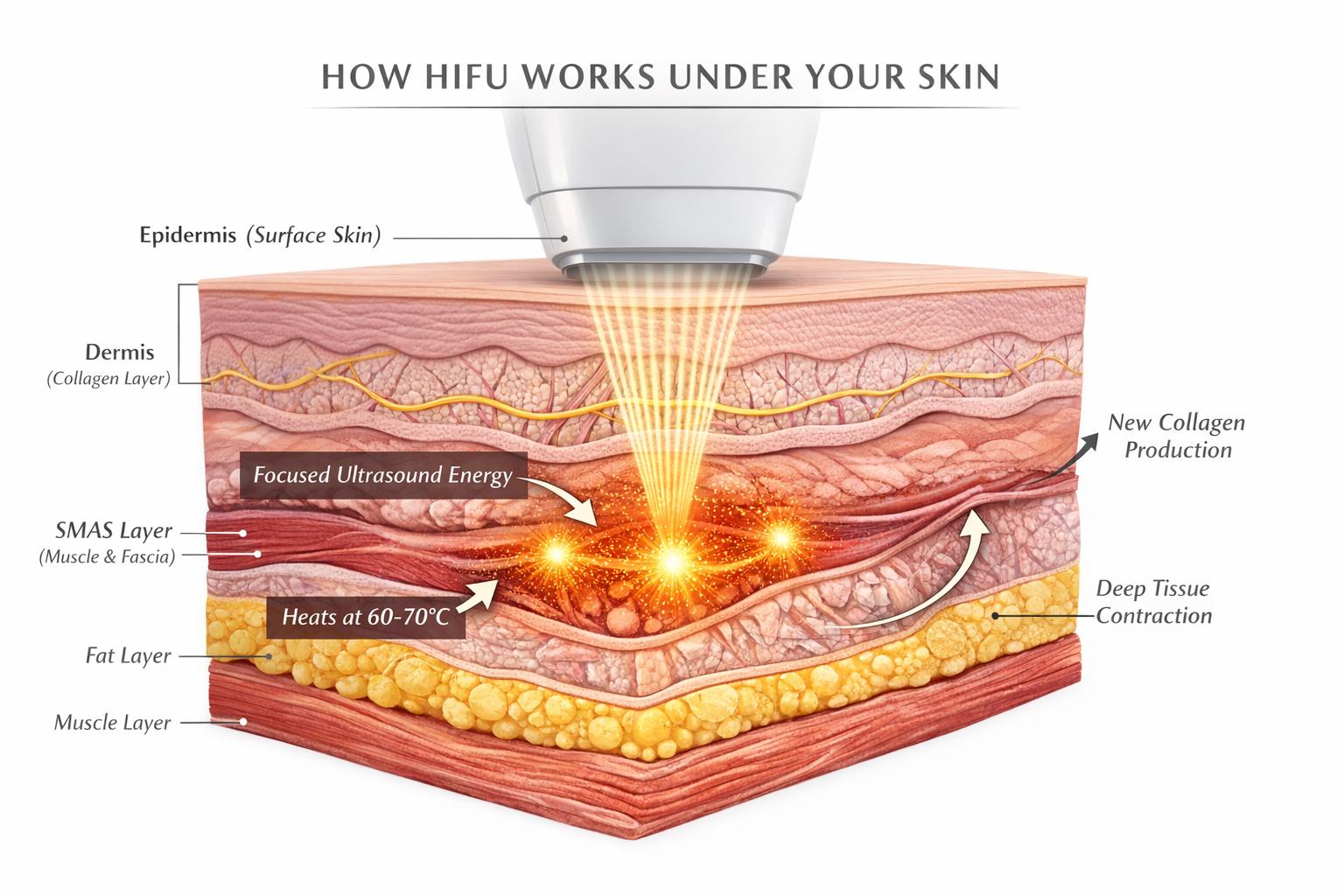
Instead of mechanically opening the skin, HIFU delivers concentrated ultrasound energy to a selected focal point beneath the skin surface. The objective is to create a controlled thermal effect in targeted tissue while minimizing unnecessary exposure to surrounding areas.
The key characteristic of HIFU is therefore focused energy delivery at depth.
Depending on the equipment and cartridge configuration, professional HIFU systems may be designed for different treatment depths. This gives practitioners greater flexibility when working on areas such as the face, jawline, cheeks and neck.
The resulting thermal stimulation can support the body's natural remodeling processes, including collagen contraction and longer-term collagen remodeling.
Importantly, HIFU should not be positioned as an instant surgical facelift. Results generally develop progressively, and individual outcomes vary according to factors such as age, skin condition, tissue characteristics and treatment parameters.
From a clinic perspective, the major advantage is the ability to provide a non-invasive, technology-driven tightening treatment without making the skin surface the primary target
Why HIFU Is Valuable for Professional Clinics
Professional HIFU equipment can provide several operational advantages:
- Adjustable treatment depths
- Dedicated facial and body treatment cartridges
- Controlled energy delivery
- Non-invasive treatment approach
- Minimal visible surface disruption
- Ability to build structured treatment protocols
For clinics positioning themselves around advanced skin-tightening services, these features can help create a differentiated treatment offering.
Technology and Mechanism: How Does Microneedling Work?
Microneedling takes a different approach.
Instead of focusing ultrasound energy at a specific point beneath the skin, microneedling uses multiple fine needles to create controlled micro-injuries.
These microscopic injuries trigger a wound-healing response. As the skin repairs itself, remodeling processes can contribute to improvements in the appearance of texture, scars and fine lines.
Professional motorized microneedling systems can provide adjustable needle penetration and controlled movement. According to the FDA, authorized microneedling devices have specific cleared uses, including improving the appearance of facial acne scars, facial wrinkles and abdominal scars in certain patients.
This makes microneedling particularly relevant when the treatment objective is not simply tightening but skin remodeling and texture improvement.
The procedure does, however, intentionally penetrate the skin. Consequently, professional training, appropriate hygiene, device selection and single-use needle cartridges are important considerations. The FDA specifically advises that microneedling should be performed by appropriately trained providers and that needle cartridges should not be reused between patients.
For professional operators, this distinction is essential: microneedling is not simply another facial massage technology. It is a procedure that requires appropriate protocols and responsible operation.
HIFU vs Microneedling: The Key Differences
| Factor | HIFU | Microneedling |
|---|---|---|
| Main technology | Focused ultrasound | Mechanical microneedling |
| Primary treatment approach | Energy-based | Micro-injury-based |
| Skin penetration | No intentional needle penetration | Yes |
| Main positioning | Tightening, lifting and contour support | Texture and skin remodeling |
| Common concerns | Laxity, firmness, jawline definition | Scars, pores, fine lines, texture |
| Surface disruption | Minimal | Controlled skin penetration |
| Downtime profile | Generally limited visible disruption | Temporary redness and recovery may occur |
| Treatment customization | Depth, energy and treatment pattern | Needle depth, speed and treatment pattern |
| Best suited for | Clients prioritizing tightening | Clients prioritizing texture and remodeling |
| Professional equipment value | Precise energy delivery and depth selection | Controlled penetration and treatment consistency |
Neither technology is universally “better.”
Instead, they solve different aesthetic problems.
Which Treatment Delivers Better Results?
If Skin Tightening Is the Main Goal: HIFU Has the Advantage
When the primary concern is facial laxity or loss of definition, HIFU can be a logical technology choice.
For example, a client with mild jawline laxity may not primarily need resurfacing. Their concern may be that the lower face looks less defined than before.
In this situation, a professional HIFU treatment can focus on controlled ultrasound energy at selected depths to support tightening and remodeling.
Typical clinic applications may include:
- Jawline
- Lower face
- Cheeks
- Submental area
- Neck
- Selected body areas, depending on device design and regulatory indications
The selling point is not simply “more energy.” It is controlled energy delivered for a specific treatment objective.
If Skin Texture Is the Main Goal: Microneedling May Be More Appropriate
Consider a different client with enlarged pores, uneven texture and the appearance of acne scars.
Here, improving the surface quality of the skin may be more important than achieving a lifting effect.
Microneedling can create controlled micro-injuries that initiate a wound-healing response and support skin remodeling.
This makes it particularly attractive for clinics offering treatments focused on:
- Acne-scar appearance
- Fine lines
- Uneven texture
- Enlarged pores
- General skin rejuvenation
The FDA notes that patients may require more than one microneedling procedure to achieve the desired aesthetic improvement, reinforcing the importance of realistic treatment planning rather than promising an immediate transformation.
What About Professional HIFU vs Home Devices?
For aesthetic clinics, another important distinction is between professional treatment systems and consumer-oriented devices.
Professional systems are designed around controlled operation, treatment protocols and practitioner assessment. Depending on the platform, they may offer multiple cartridges or handpieces designed for different treatment depths and anatomical areas.
This gives trained operators greater flexibility.
A professional clinic can assess the client's concerns first and then determine:
- Which area should be treated
- Which technology is appropriate
- What treatment depth is required
- Which handpiece or cartridge should be used
- What energy or penetration parameters are appropriate
- Whether the client is suitable for the procedure
- Whether a single treatment or a treatment course makes more sense
This is particularly valuable for clinics that want to build repeatable treatment protocols rather than simply sell individual beauty sessions.
At the same time, professional equipment does not eliminate the need for training or appropriate clinical judgment. A more sophisticated machine is valuable only when the operator understands how to use it responsibly.
Can HIFU and Microneedling Be Used Together?
In some professional aesthetic settings, different technologies may be incorporated into a broader treatment strategy.
The logic is straightforward:
HIFU focuses more strongly on deeper tightening and contour support, while microneedling focuses more strongly on controlled skin remodeling and texture.
Therefore, clients with multiple concerns may potentially benefit from a treatment plan that addresses different aspects of skin aging.
However, these procedures should not simply be performed one after another without considering treatment depth, skin condition, recovery and device-specific protocols.
The FDA has also highlighted safety concerns associated with certain uses of RF microneedling, including reported burns, scarring, fat loss and nerve damage. Although conventional microneedling and RF microneedling are not identical technologies, the broader lesson for professional clinics is clear: advanced energy-based treatments require appropriate training, device-specific protocols and careful patient selection.
Applications and Client Needs
For beauty salons, aesthetic clinics and professional treatment centers, technology selection should begin with the client's actual concern.
Client Type 1: Mild Facial Laxity
Primary concern: Skin feels less firm and the jawline is becoming less defined.
Potential technology focus: HIFU.
The treatment positioning should emphasize tightening, lifting and contour support rather than surface exfoliation.
Client Type 2: Uneven Texture and Acne-Scar Appearance
Primary concern: Visible texture irregularities and acne-scar appearance.
Potential technology focus: Microneedling.
The treatment positioning can focus on controlled skin remodeling and texture improvement.
Client Type 3: Fine Lines + Reduced Firmness
This client may have overlapping concerns.
Instead of asking which technology is universally superior, the practitioner should determine which concern is the priority and develop an appropriate treatment plan.
Client Type 4: Clients Seeking Minimal Visible Downtime
HIFU may be attractive when the client's primary goal is tightening and they prefer minimal visible surface disruption.
Microneedling, meanwhile, intentionally creates skin micro-injuries, so temporary redness and recovery can be part of the treatment experience.
The final choice should always be based on the specific device, treatment protocol, client suitability and practitioner assessment.
What Should Clinics Consider When Choosing Equipment?
For professional buyers, the comparison should go beyond the treatment name.
When evaluating HIFU or microneedling equipment, consider:
1. Treatment Customization
Look for systems that allow appropriate adjustment of treatment parameters rather than offering only fixed settings.
2. Handpiece and Cartridge Options
Multiple treatment depths or interchangeable components can increase the versatility of a professional platform.
3. Operator Ergonomics
A comfortable handpiece can make a meaningful difference during repeated clinical use.
4. Interface and Usability
A clear interface can help operators manage treatment parameters more efficiently and consistently.
5. Safety Features
Professional equipment should incorporate appropriate control and safety mechanisms, with operation following the manufacturer's instructions and applicable local requirements.
6. Training and After-Sales Support
Equipment value is not limited to hardware. Training, technical support, spare parts and protocol guidance can influence the long-term usability of a machine.
For manufacturers and distributors, these factors can also become important differentiators when presenting professional aesthetic equipment to international clinic buyers.
HIFU or Microneedling: Which One Should a Clinic Choose?
There is no single winner.
A more useful way to think about the comparison is:
HIFU = deeper tightening and contour-focused treatment
Microneedling = controlled skin remodeling and texture-focused treatment
If the client is primarily concerned about laxity, jawline definition and firmness, HIFU may be the more suitable technology.
If the client is primarily concerned about acne-scar appearance, pores, fine lines and uneven texture, microneedling may provide a better match.
For clinics, this distinction creates an opportunity to build a more complete aesthetic service portfolio. Rather than treating HIFU and microneedling as competing technologies, professional operators can view them as different tools for different treatment objectives.
Conclusion
HIFU and microneedling represent two different approaches to modern aesthetic skin treatment.
HIFU uses focused ultrasound to create controlled effects at selected tissue depths, making it particularly relevant to professional skin-tightening and contour-focused services. Microneedling uses controlled needle penetration to stimulate a wound-healing response and support skin remodeling, making it particularly relevant to texture, fine lines and acne-scar appearance.
The better treatment is therefore not determined by the technology alone.
The best result comes from matching the technology to the client's concern, selecting appropriate professional equipment, and applying the treatment according to a well-designed protocol.
For aesthetic clinics, investing in professional equipment is ultimately about more than owning a machine. It is about having the control, versatility and operational consistency needed to deliver targeted treatments across different client needs.
When technology, practitioner expertise and treatment strategy work together, HIFU and microneedling can each play a valuable role in a modern professional aesthetics portfolio
Founded in 2008, Guangzhou GLM Beauty Spa Equipment Factory specializes in research, development, manufacture and selling of beauty and slimming machines. Our production base is located in Guangzhou City, Guangdong Province, China. Since our foundation, we have introduced advanced technologies and equipment, to assure high quality and high performance of our products. With professional marketing guide and excellent after-sales service, our products have been exported to over 20 countries and regions, including Southeast Asia, the Middle East, Europe and the United States, won worldwide praises and gained a good reputation