1. Introduction: Building a Beauty Business in 2026
Starting a beauty business in 2026 is about more than finding a suitable location and purchasing attractive equipment. Successful beauty entrepreneurs need a clear business model, a defined target audience, appropriate professional technology, qualified operators, and a realistic financial plan.
The beauty industry offers several business opportunities, including facial treatment studios, professional skincare salons, aesthetic clinics, body contouring centers, and multi-service beauty establishments. Each model requires a different investment level, service strategy, and approach to customer acquisition.
For new entrepreneurs, the most important decision is not how many beauty machines to purchase, but which treatments customers are willing to pay for repeatedly. A well-selected professional beauty machine can help a business expand its service menu, standardize treatment procedures, improve operational efficiency, and develop higher-value service packages.
However, equipment alone does not guarantee profitability. Long-term success depends on matching technology with customer demand, following applicable regulations, training staff, and managing costs carefully.
This guide explains how to start a beauty business in 2026, estimate startup costs, select professional beauty equipment, understand licensing requirements, and evaluate return on investment (ROI).
2. Background and Business Planning: Define Your Market Before Investing
Choose the Right Beauty Business Model
Before renting a property or ordering equipment, decide what type of business you want to operate.
A facial skincare studio may focus on cleansing, hydration, exfoliation, and skin maintenance. A professional aesthetic clinic may offer more advanced energy-based treatments, subject to local licensing and scope-of-practice requirements. A body contouring center may specialize in non-invasive body treatments, while a full-service beauty salon may combine facial care, body treatments, and other services.
Your business model determines your initial investment, space requirements, staffing needs, and equipment priorities.
For first-time owners, starting with a focused treatment menu can be more manageable than immediately offering every available service. It allows you to test demand, build expertise, and invest in additional technology as customer bookings grow.
Identify Your Target Customers
Define your primary customer group before choosing treatments. Potential audiences include working professionals seeking convenient skincare, clients interested in regular facial maintenance, customers looking for non-invasive body treatments, and clients seeking personalized aesthetic services.
Research local competitors, their service menus, price ranges, customer reviews, and positioning. Identify gaps in the market rather than simply copying popular salons.
For example, if nearby salons mainly offer basic facials, a professionally equipped hydration and skin analysis service may help differentiate your business. If local customers frequently ask about body contouring, a dedicated treatment program may be worth evaluating.
Customer interviews, competitor research, and small-scale promotional campaigns can help validate demand before you commit substantial capital.
Estimate Your Startup Costs
Beauty business startup costs vary significantly by country, city, premises, business model, and equipment selection. A 2026 guide from LendingTree reports that salon startup costs can range from approximately $10,000 to $200,000 or more, depending on factors such as location, renovation, and equipment choices. These figures are illustrative US-market estimates, not universal prices. (Source: LendingTree, “How to Open a Salon in 10 Steps.”)
A practical budget should include:
-
Business registration, permits, and professional licensing.
-
Rent, security deposits, renovation, and utilities.
-
Treatment beds, furniture, lighting, and storage.
-
Professional beauty machines and accessories.
-
Skincare products, consumables, and sanitation supplies.
-
Staff recruitment, training, and insurance.
-
Booking software, website development, and marketing.
-
Working capital for the first several months.
Do not spend your entire budget on the premises and equipment. A reserve for rent, payroll, supplies, and marketing is essential while the business builds a stable customer base.
3. Technology and Mechanisms: The Professional Beauty Equipment Checklist
Professional equipment should be selected according to the treatments you plan to deliver, not the number of functions advertised by a machine.
Different technologies work through different physical mechanisms and serve different treatment objectives. Understanding these differences helps owners select appropriate equipment and explain services more clearly to customers.
Essential Equipment for a Facial Skincare Business
1. Professional facial bed and treatment workstation
These are the foundation of daily operations. An adjustable facial bed helps operators position clients comfortably, while a functional workstation keeps products, accessories, and treatment tools organized.
Appropriate lighting, storage, handwashing facilities, and sanitation supplies are equally important. They support a clean treatment environment and efficient workflow.
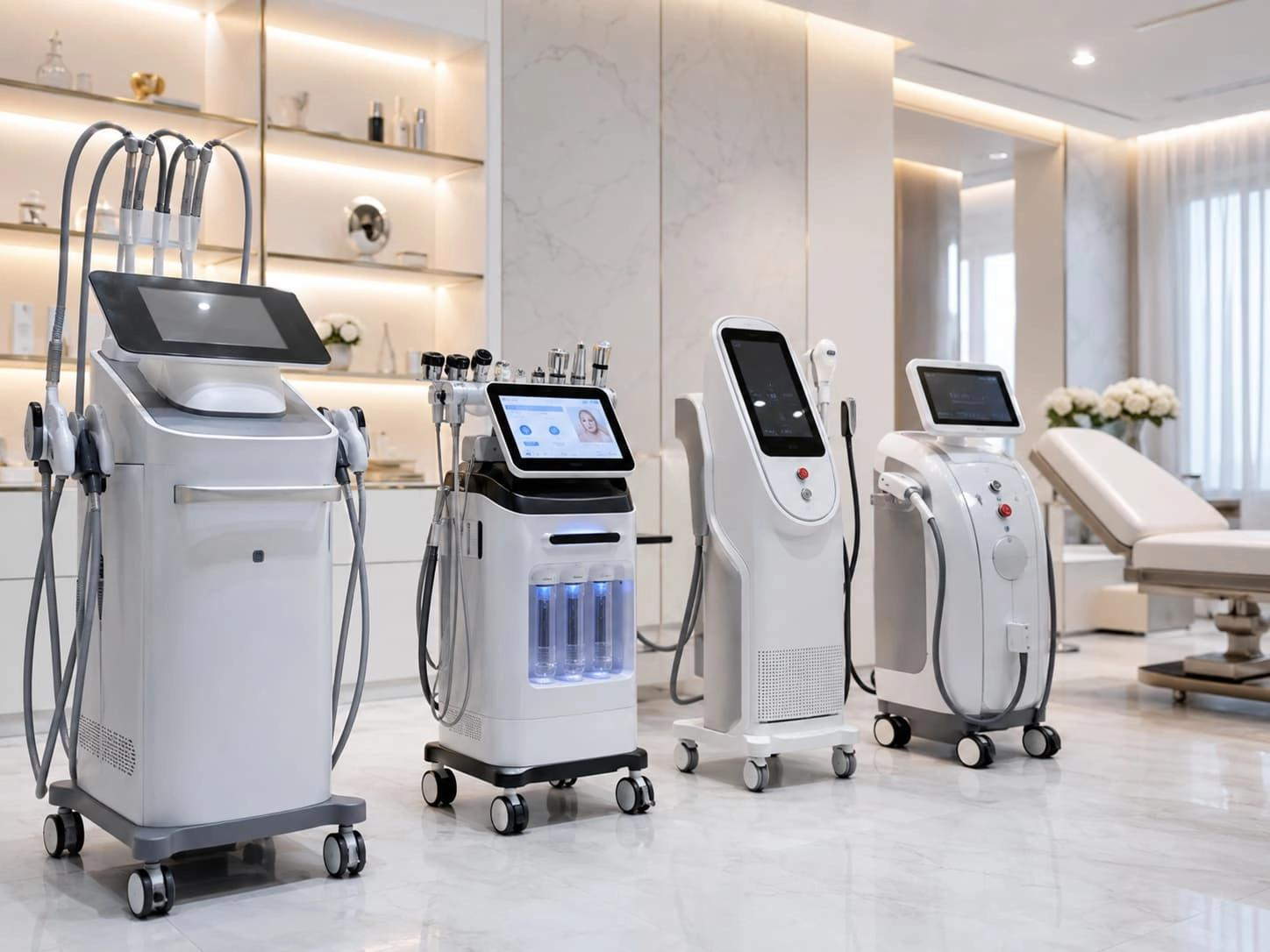
2. Hydrodermabrasion and hydration facial machine
Hydrodermabrasion systems typically combine liquid delivery, suction, and a specialized treatment tip to help cleanse the skin surface and remove loose debris. Depending on the system, they may also support superficial exfoliation and the application of compatible skincare solutions.
These machines can support facial cleansing and hydration-oriented service packages. Treatment protocols should be adjusted to skin condition, device instructions, and operator training.
3. Skin analysis system
A professional skin analyzer may use controlled illumination, magnification, imaging, or specialized light modes to help operators assess visible skin characteristics.
The main business value is consultation support. Visual analysis can help explain treatment priorities, document changes over time, and personalize skincare recommendations. Image-based findings should not be presented as definitive medical diagnoses unless the system is specifically authorized for that purpose.
4. LED light therapy equipment
LED devices deliver light at selected wavelengths. Different wavelengths interact with tissue in different ways, and the potential effects depend on the device, treatment parameters, indication, and evidence supporting its use.
In a professional setting, LED equipment may be incorporated into selected facial protocols. Operators should follow manufacturer instructions, eye protection requirements, and relevant contraindications. Marketing claims should reflect the evidence available for the specific device rather than general claims about LED technology.
Advanced Equipment for Expanding Treatment Services
5. Radiofrequency (RF) skin treatment systems
RF devices deliver electromagnetic energy that produces controlled heating in targeted tissue. Depending on the technology and application, this may support selected skin-tightening or tissue-remodeling treatments.
Professional operators must understand energy settings, treatment depth, contact requirements, contraindications, and the risk of excessive heating. Devices should be selected according to the intended indication and the operator's permitted scope of practice.
6. High-intensity focused ultrasound (HIFU) systems
HIFU systems focus ultrasound energy at designated depths. Certain professional systems are designed to create localized thermal effects that may support specific aesthetic treatments.
Not every ultrasound device has the same capabilities, and treatment outcomes vary by technology, patient selection, and protocol. Owners should verify device authorization, training requirements, safety documentation, and the evidence for the intended use before adding HIFU services.
7. Non-invasive body contouring equipment
Body contouring devices may use technologies such as vacuum-assisted mechanical massage, radiofrequency, ultrasound, or other energy-based methods. Their mechanisms and appropriate indications differ.
For example, vacuum-assisted rollers apply suction and mechanical movement to tissue, whereas ultrasound-based systems deliver acoustic energy. These technologies should not be treated as interchangeable, and no machine should be marketed as guaranteeing weight loss or permanent fat removal.
Choose a system based on the specific service you intend to offer, the available evidence, client suitability, and the applicable regulations.
Equipment Procurement Checklist
Before placing an order, verify the following:
-
Intended use and technical specifications.
-
Local regulatory status and any required authorization.
-
Operator training and treatment protocols.
-
Contraindications, safety features, and maintenance needs.
-
Warranty coverage, spare parts, and after-sales support.
-
Consumable costs and expected service life.
-
Installation, delivery, and staff training arrangements.
-
Availability of user manuals and safety documentation.
For international buyers, confirm that the machine's documentation, electrical specifications, labeling, and conformity requirements match the destination market. A supplier's general statement that a product is “certified” is not a substitute for verifying the specific documents and applicable rules.
4. Advantages and Comparison: Professional Equipment vs. Home Beauty Devices
Home beauty devices can serve customers who want convenient, personal-use treatments. Professional equipment is designed for a different operating environment and may offer more specialized functions, treatment controls, accessories, and workflow integration.
The key distinction is not simply that professional machines are larger or more powerful. It is whether the equipment is designed, authorized, and supported for its intended professional application.
| Factor | Professional Beauty Equipment | Home Beauty Devices |
|---|---|---|
| Primary purpose | Salon or clinic service delivery | Personal-use routines |
| Treatment workflow | Integrated into professional protocols | Designed for individual convenience |
| Operator requirements | May require professional training or a license | Depends on device and local rules |
| Service offering | Can support structured, paid treatment packages | Usually supports personal maintenance |
| Investment model | Equipment cost balanced against service revenue | Purchase cost borne by the individual user |
Professional equipment may help a salon differentiate its services, introduce treatment packages, and improve consistency when staff are properly trained. Nevertheless, more features do not automatically mean better outcomes or higher profits.
When comparing suppliers, consider the complete ownership cost: purchase price, shipping, installation, training, maintenance, consumables, downtime, and warranty support. A machine with a lower initial price may cost more over time if service is unreliable or replacement parts are difficult to obtain.
For manufacturers and distributors, clear specifications, appropriate documentation, training resources, and responsive after-sales support are important parts of the value proposition.
5. Applications and Client Needs: Turn Equipment into Sellable Services
Customers generally purchase a treatment experience and a service outcome, not a machine's technical specifications. A successful beauty business translates equipment capabilities into clear, responsible service offerings.
Build a Treatment Menu Around Customer Needs
A facial studio might create three levels of service:
-
Essential facial care: cleansing, basic skin assessment, and appropriate hydration.
-
Advanced facial care: selected exfoliation or device-assisted treatments for suitable clients.
-
Personalized treatment programs: a series of services based on consultation, client preferences, and realistic expectations.
A body treatment business could organize services around massage-based care or selected non-invasive body treatments, depending on the equipment, local regulations, and client suitability.
Avoid promising identical results for every client. Explain what a treatment is designed to do, how many sessions may be recommended according to the applicable protocol, what limitations exist, and when a medical professional should be consulted.
Use Consultation to Improve Customer Retention
A structured consultation can include the client's goals, relevant medical history where appropriate, contraindication screening, skin or treatment assessment, informed consent, and a record of the services performed.
For suitable treatments, photographs and follow-up appointments may help document progress, subject to privacy rules and client consent. Operators should explain realistic timelines and avoid presenting temporary changes as permanent results.
Follow-up communication can also support retention. Instead of pushing unnecessary repeat sessions, recommend a schedule that reflects the device instructions, evidence, client response, and applicable professional standards.
Train Staff Before Launching New Treatments
Buying a device is only the first step. Staff need to understand operating procedures, parameter selection, hygiene, contraindications, emergency response, and client communication.
Training should be specific to the model being used. When a treatment falls outside the salon's legal scope, it should not be offered merely because the machine is available.
6. Licensing, Compliance, and Business Operations
Licensing is one of the most important steps in opening a beauty business, but requirements vary by jurisdiction and service type.
In the United States, for example, the Small Business Administration advises entrepreneurs to check business registration, tax requirements, licenses, permits, insurance, and local zoning rules. Requirements differ by location and business activity. (Source: SBA, “Launch Your Business.”)
Depending on where you operate, you may need to investigate:
-
Business registration and tax registration.
-
Salon or establishment permits.
-
Individual esthetician, cosmetology, or other professional licenses.
-
Additional authorization for laser, medical, or advanced energy-based procedures.
-
Building, zoning, fire safety, and sanitation requirements.
-
Professional liability and general business insurance.
-
Privacy and consent requirements for client records and photographs.
Do not assume that a standard beauty salon license automatically authorizes every treatment. Some procedures may be restricted to particular licensed professionals or medical settings.
Before signing a lease or buying advanced equipment, contact the relevant local authorities and confirm which services your business can legally provide. Maintain records of equipment documentation, staff qualifications, training, maintenance, consent, and treatment procedures.
7. Return on Investment: Calculate Profitability Before Buying
Return on investment (ROI) helps entrepreneurs evaluate whether an equipment purchase or service expansion is financially worthwhile. The calculation should include operating expenses, realistic utilization, and the time needed to attract customers.
A basic formula is:
ROI = (Net Profit ÷ Total Investment) × 100%
For an equipment-specific evaluation, estimate the additional profit generated by the machine rather than treating all salon revenue as equipment-driven income.
Consider this simplified example:
A professional beauty machine costs $8,000, and installation and initial training cost another $1,000. The total initial investment is $9,000.
Suppose the machine supports 40 paid sessions per month, with an average price of $75 per session. Monthly revenue attributable to the service would be $3,000.
If consumables, operator labor, payment fees, and other variable costs total $30 per session, the contribution before fixed overhead is $45 per session, or $1,800 per month.
At that utilization level, the simple payback period would be approximately five months:
$9,000 ÷ $1,800 = 5 months
This is an illustrative calculation, not a profit guarantee. It excludes additional fixed overhead, taxes, financing costs, downtime, discounts, cancellations, and fluctuations in demand. If bookings are lower or costs are higher, payback will take longer.
Before purchasing equipment, model at least three scenarios:
-
Conservative: slower customer acquisition and fewer monthly sessions.
-
Expected: a realistic booking rate based on local demand and available staff.
-
Optimistic: stronger utilization after marketing and repeat bookings develop.
Also estimate break-even volume:
Break-even sessions = Monthly fixed costs ÷ Contribution per session
This helps determine how many appointments are required to cover operating expenses. A machine with a high treatment price may still be a poor investment if demand is limited, sessions take too long, or maintenance costs are excessive.
8. Conclusion: Build a Sustainable Beauty Business with the Right Equipment Strategy
Starting a beauty business in 2026 requires a balance between customer demand, professional capability, regulatory compliance, and financial discipline. The strongest starting point is a clear service concept, a realistic startup budget, a properly licensed operating model, and an equipment list based on actual client needs.
Professional beauty machines can help salons and aesthetic businesses expand treatment options, create differentiated service packages, and organize more consistent workflows. Their value, however, depends on appropriate selection, operator training, responsible marketing, reliable maintenance, and sufficient customer demand.
Before investing, compare suppliers carefully, verify regulatory documentation, and calculate equipment-specific profitability using realistic booking assumptions. Start with services that match your market, monitor customer feedback and financial performance, and expand your technology portfolio when the numbers support it.
A sustainable beauty business is not built by purchasing the most machines. It is built by selecting the right technology, delivering services responsibly, and turning customer trust into repeat business
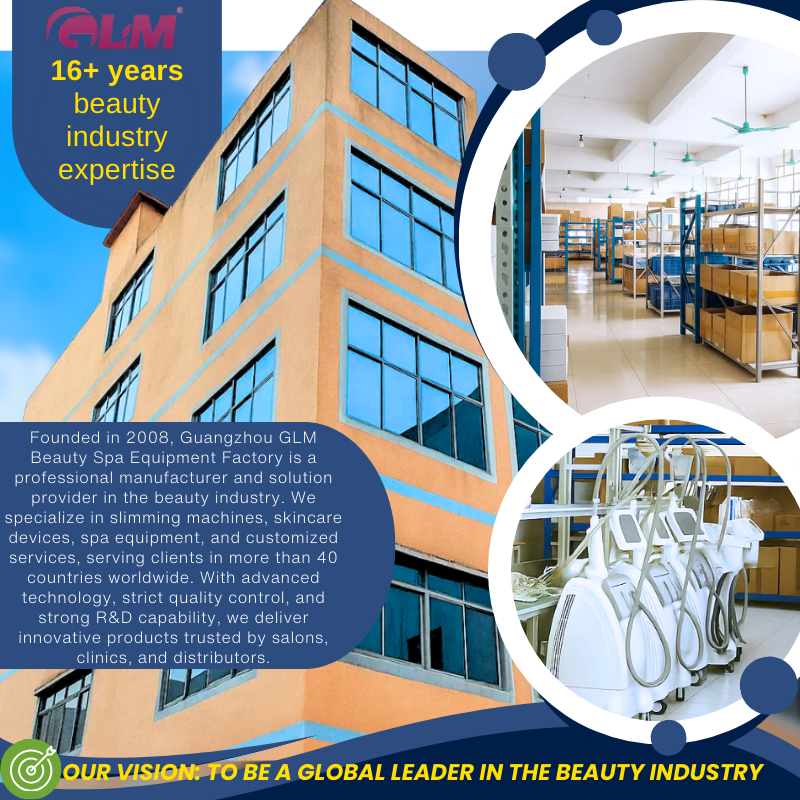
Founded in 2008, Guangzhou GLM Beauty Spa Equipment Factory specializes in research, development, manufacture and selling of beauty and slimming machines. Our production base is located in Guangzhou City, Guangdong Province, China. Since our foundation, we have introduced advanced technologies and equipment, to assure high quality and high performance of our products. With professional marketing guide and excellent after-sales service, our products have been exported to over 20 countries and regions, including Southeast Asia, the Middle East, Europe and the United States, won worldwide praises and gained a good reputation