
Introduction
A defined jawline is one of the most recognizable features of a balanced facial profile. However, as facial tissues gradually lose elasticity and structural support, the lower face can begin to look heavier. Early jowling, blurred jawline contours, and mild skin laxity may become increasingly noticeable even when overall skin quality remains good.
For aesthetic clinics, this creates an important treatment challenge. Many clients want a more structured lower-face appearance but are not ready to consider a traditional surgical facelift. This has increased interest in minimally invasive aesthetic procedures, including absorbable polydioxanone (PDO) thread lifting.
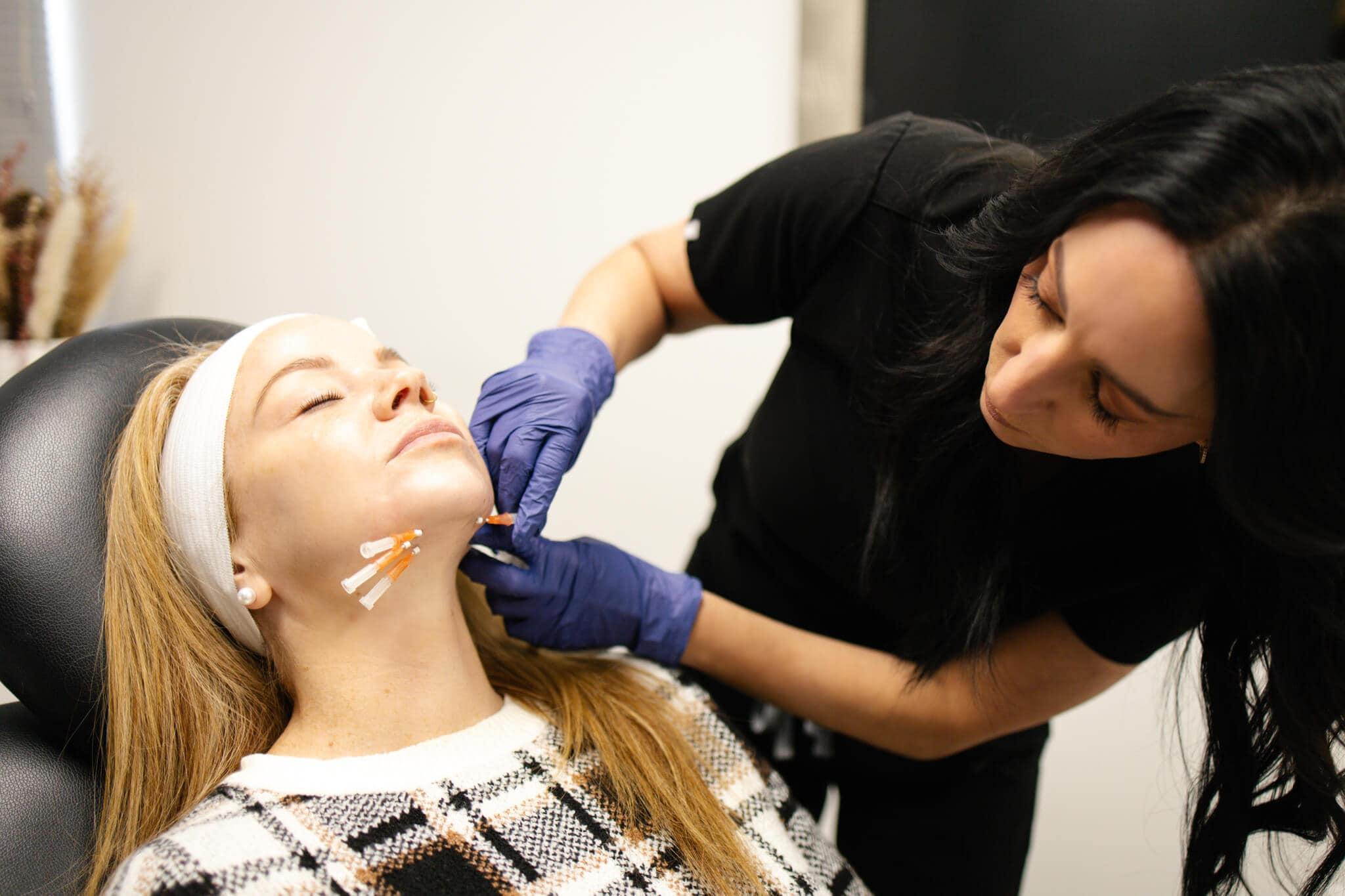
A PDO thread lift is designed to provide mechanical support and reposition selected soft tissues while the absorbable material gradually breaks down. Depending on the thread design and treatment strategy, the procedure can be used to create a more defined jawline, improve the appearance of mild jowls, and support a more balanced facial contour.
Importantly, thread lifting is not simply about inserting threads. Successful treatment depends on patient selection, anatomical assessment, vector planning, thread selection, sterile technique, and controlled placement. Professional clinics therefore increasingly combine clinical expertise with appropriate visualization, measurement, documentation, and treatment-support equipment.
This combination allows practitioners to approach facial contouring as a structured aesthetic treatment rather than a single procedure.
Background / Problem: Why Do Jowls Change the Facial Contour?
Jowls typically develop as part of the complex aging process affecting the skin, fat compartments, connective tissues, and supporting structures of the lower face.
With age, collagen and elastin production decrease, skin becomes less resilient, and soft tissues can gradually shift downward. Changes in facial fat compartments and supporting ligaments may further contribute to the transition from a sharp jawline to a softer, less defined contour.
Lifestyle factors, genetics, significant weight fluctuations, and individual facial anatomy can also influence how early jowling becomes visible.
From a clinic perspective, the challenge is not always simply “loose skin.” A client may present with a combination of mild skin laxity, tissue descent, reduced definition around the mandibular border, and changes in facial volume.
This is why a one-dimensional treatment approach may not always provide the most natural-looking result.
A professional consultation should first determine what is creating the appearance of a less defined jawline. Some clients may benefit from skin-tightening technologies, while others may be better suited to injectables, energy-based treatments, thread lifting, or a combination approach. In more advanced laxity, surgical consultation may be more appropriate.
PDO thread lifting generally occupies a different position from a surgical facelift. It is a minimally invasive option intended for selected patients seeking improvement without the incisions and recovery associated with traditional surgery. It should not be presented as an equivalent replacement for a facelift.
Technology / Mechanism: How PDO Threads Work
PDO, or polydioxanone, is an absorbable material that has been used in medical applications. In aesthetic thread procedures, different thread configurations are designed for different purposes.
Smooth PDO threads are generally associated with skin-quality and collagen-support applications, while barbed or cogged threads are designed to engage tissue mechanically and provide a lifting or repositioning effect.
For jowl and jawline applications, the practitioner typically considers the direction of tissue movement, the desired vector, the patient's anatomy, and the amount of laxity before selecting a treatment strategy.
The fundamental concept is relatively straightforward: the thread provides temporary mechanical support, while the surrounding tissue responds to the procedure during the period in which the material remains present. Over time, PDO is absorbed by the body.
However, the visible outcome is not determined by the material alone.
The placement vector is critical.
[In-Article Illustration: PDO Thread Lift for Jawline Contouring]
Recommended visual: A clean professional medical-aesthetic diagram showing a front and three-quarter facial view, with the jowl area highlighted and several PDO thread vectors extending upward toward the mid-face/temporal direction. Label: “PDO Thread Vectors for Lower-Face Contouring.” Use a clinical white background, neutral skin tones, no blood, no graphic surgical imagery.
The use of 3D facial imaging has also been explored as a way to objectively evaluate changes in soft-tissue position and facial contour following thread lifting. One clinical study used 3D imaging to measure changes around the jawline and other facial regions, illustrating how digital assessment can complement clinical observation.
This is where professional technology becomes valuable.
Before treatment, imaging and standardized photography can help practitioners evaluate facial symmetry, tissue distribution, and baseline contour. After treatment, the same tools can help document changes and communicate realistic outcomes to clients.
In a professional clinic, the objective is not to make the face look artificially “pulled.” The goal is usually to create controlled repositioning and a smoother transition between the cheek, jowl, and mandibular line.
Advantages / Comparison
PDO Thread Lift vs. Traditional Facelift
The most obvious distinction between PDO thread lifting and a traditional facelift is the degree of intervention.
A surgical facelift involves incisions, repositioning of facial tissues, removal or management of excess skin, and a significantly longer recovery process. It remains an important option for patients with more advanced facial laxity.
PDO thread lifting is considerably less invasive. It is generally performed through small access points rather than the larger surgical incisions associated with facelift surgery.
However, “less invasive” does not mean “risk-free.”
Thread lifting can be associated with bruising, swelling, pain, bleeding, dimpling, contour irregularities, infection, thread migration, nerve injury, and other complications. Recent literature emphasizes that anatomical knowledge, precise placement, patient-specific planning, and appropriate complication management are important to treatment safety.
Therefore, clinics should avoid positioning PDO threads as a simple beauty treatment that anyone can perform.
PDO Thread Lift vs. Home Beauty Devices
PDO thread lifting and non-invasive beauty devices also serve different purposes.
Professional energy-based devices may be used to support skin tightening, texture improvement, collagen-related treatments, or overall facial rejuvenation without inserting a thread into the tissue. Examples include selected radiofrequency, ultrasound, LED, oxygen, and other professional aesthetic technologies, depending on the device and indication.
These technologies can be particularly useful when a client has mild laxity or wants a non-invasive treatment approach.
PDO threads, in contrast, involve an invasive procedure and are intended to provide mechanical tissue support and repositioning.
For clinics, this difference creates an opportunity for treatment customization.
A client with mild skin laxity may be suitable for an energy-based treatment. A client with selected lower-face laxity may be evaluated for thread lifting. Another client may benefit from a staged combination of technologies and injectables.
The value of professional equipment is therefore not necessarily that it “replaces” PDO threads. Instead, it can support consultation, skin assessment, treatment planning, complementary rejuvenation, and post-treatment care.
Applications / Client Needs
1. Improving Early Jowl Appearance
PDO threads may be considered for carefully selected clients with mild to moderate tissue laxity and early jowl formation.
The objective is generally not dramatic transformation. Instead, the practitioner may aim to improve the visual continuity of the lower facial contour and create a cleaner transition along the jawline.
This makes patient selection particularly important.
2. Jawline Definition
For clients who feel that their jawline has become less visible, treatment planning may focus on the mandibular border and lower-face vectors.
A precise assessment can help determine whether the main concern is tissue descent, skin laxity, volume distribution, or a combination of factors.
Digital facial imaging can be useful here because clients often perceive facial contour differently from what can be observed during a clinical examination. Standardized images can provide a clearer baseline and make follow-up comparisons more objective.
3. Professional Facial Rejuvenation Programs
PDO thread lifting can also form part of a broader facial rejuvenation strategy.
For example, a clinic may develop treatment programs combining:
- Professional skin analysis
- Standardized before-and-after photography
- Energy-based skin treatments
- Injectable treatments when clinically appropriate
- PDO thread procedures for selected patients
- Post-treatment skincare guidance
- Scheduled follow-up assessment
The advantage of this approach is that the practitioner is not relying on one technology to solve every aesthetic concern.
Instead, each modality is assigned a specific role.
4. Supporting a Natural-Looking Result
Modern aesthetic clients are increasingly interested in results that look subtle rather than obviously “treated.”
For thread lifting, this means avoiding excessive traction and considering the patient's existing facial proportions.
An overly aggressive vector can create unnatural contour changes. Recent literature discussing thread-lift complications also highlights the importance of appropriate vector selection and controlling excessive pulling forces.
Professional consultation is therefore essential.
A practitioner should discuss expected improvement, limitations, recovery, potential complications, alternatives, and whether the treatment is appropriate for the individual's anatomy and goals. The American Academy of Dermatology similarly emphasizes informed consultation, practitioner experience, realistic expectations, risks, and alternatives when considering cosmetic procedures.
5. The Role of Professional Equipment in the Clinic
Although PDO threads themselves are the active treatment modality, professional aesthetic equipment can improve the overall clinical workflow.
High-quality skin analysis systems can provide standardized documentation of skin condition. Facial imaging can help evaluate symmetry and contour. Professional treatment platforms can support complementary skin-quality programs before or after a thread procedure when clinically appropriate.
For manufacturers and aesthetic-equipment suppliers, this creates a broader opportunity: the modern beauty clinic is not built around a single machine.
It is an integrated treatment environment.
A well-designed facial aesthetic workflow may include consultation, imaging, treatment planning, procedure, recovery support, documentation, and follow-up. Equipment that improves one or more of these steps can increase operational efficiency while helping practitioners communicate treatment plans more professionally.
The emphasis should remain on clinical appropriateness rather than simply adding more devices to the treatment room.
Conclusion
PDO thread lifting has become an important minimally invasive option for selected clients concerned about early jowls, lower-face laxity, and reduced jawline definition.
Its appeal comes from a combination of mechanical tissue support, strategic vector planning, and a less invasive treatment pathway compared with traditional facelift surgery. However, it is not a universal solution for facial aging, and it should not be marketed as a risk-free replacement for surgery.
For professional clinics, the strongest approach is a patient-centered one.
Detailed facial assessment, appropriate thread selection, anatomical knowledge, controlled placement, realistic communication, standardized photography, and follow-up all contribute to a more professional treatment process. Digital imaging and complementary aesthetic technologies can further support this workflow by helping practitioners assess skin condition, document changes, and design individualized rejuvenation programs.
For beauty-equipment manufacturers, this also highlights an important direction in the professional aesthetics market: equipment value increasingly comes from how effectively it supports the complete treatment journey.
PDO threads may provide the structural component of a jawline-focused treatment, while professional diagnostic, imaging, and skin-treatment technologies can help create a more comprehensive clinic experience.
Ultimately, successful facial contouring is not about making the face look tighter at any cost. It is about understanding facial anatomy, selecting the appropriate technology, controlling treatment variables, and creating a balanced result that respects the patient's natural proportions
Founded in 2008, Guangzhou GLM Beauty Spa Equipment Factory specializes in research, development, manufacture and selling of beauty and slimming machines. Our production base is located in Guangzhou City, Guangdong Province, China. Since our foundation, we have introduced advanced technologies and equipment, to assure high quality and high performance of our products. With professional marketing guide and excellent after-sales service, our products have been exported to over 20 countries and regions, including Southeast Asia, the Middle East, Europe and the United States, won worldwide praises and gained a good reputation