
1. Introduction
Non-invasive body contouring has become an important service category for professional beauty salons and aesthetic centers. As clients increasingly seek alternatives to invasive procedures, technologies such as ultrasonic cavitation, radiofrequency (RF), vacuum-assisted massage, and other body-shaping systems have attracted growing attention.
Among these options, ultrasonic cavitation is frequently discussed as a technology for addressing localized body contours. However, online marketing often blurs the distinction between localized contour improvement, measurable fat reduction, and overall weight loss. Some claims promise dramatic changes after a single session, while others suggest that ultrasonic cavitation is suitable for everyone.
The reality is more nuanced.
Ultrasonic cavitation systems are designed to deliver acoustic energy into targeted tissues, with effects depending on the device's operating parameters, treatment protocol, anatomical area, and the technology used. Their practical value should be assessed through realistic expectations, appropriate client selection, consistent treatment procedures, and careful safety management.
For professional beauty businesses, understanding the difference between myths and facts is essential. It helps practitioners communicate honestly, select suitable equipment, and develop services that prioritize client experience rather than exaggerated promises.
This guide examines common ultrasonic cavitation myths, explains the underlying technology, and explores how professional body-contouring equipment can be incorporated into responsible aesthetic practice.
2. Background and Common Problems: Why Ultrasonic Cavitation Is Misunderstood
Myth 1: Ultrasonic Cavitation Is the Same as Weight Loss
Fact: Localized body contouring and weight loss are different objectives.
Weight loss generally involves a reduction in total body mass, often associated with changes in energy balance and body composition. Body contouring, by contrast, focuses on the appearance or dimensions of specific areas, such as the abdomen, flanks, thighs, or upper arms.
Ultrasonic cavitation is marketed for localized contouring rather than as a primary treatment for obesity. A person may be close to their preferred body weight yet remain concerned about particular body areas. Another person may need broader weight-management support that a cosmetic device cannot provide.
Professional operators should therefore avoid presenting cavitation as a replacement for nutrition guidance, physical activity, medical weight management, or clinically indicated obesity treatment.
A more appropriate consultation begins with the client's goals. Is the objective to improve the appearance of a localized area, complement an existing body-contouring plan, or address a broader weight concern? The answer determines whether the treatment is suitable.
Myth 2: One Session Can Deliver Dramatic, Permanent Results
Fact: Outcomes vary, and a single session cannot guarantee a specific result.
Promotional images and dramatic before-and-after comparisons can create unrealistic expectations. Body measurements and appearance may also change temporarily because of posture, hydration, measurement technique, or other factors unrelated to lasting fat reduction.
The number of sessions required, the interval between treatments, and the degree of visible change depend on the device, treatment protocol, client characteristics, and the outcome being measured. Some clients may notice a change in appearance, while others may experience limited or no meaningful improvement.
A professional service should establish a baseline before treatment, use consistent measurement methods, and document progress under comparable conditions. Photographs should use consistent lighting, positioning, distance, and posture.
Rather than promising a particular number of centimeters lost, practitioners should explain what the technology is intended to do, what evidence supports the expected outcome, and what remains uncertain.
Myth 3: Every Device Labeled "Ultrasonic Cavitation" Works the Same Way
Fact: Equipment specifications and energy-delivery systems matter.
Devices marketed under the same category can differ in operating frequency, acoustic output, applicator design, control settings, contact requirements, and intended use. Some products combine ultrasound with RF or mechanical massage, while others use a single energy modality.
These differences affect how the device should be operated and what claims can reasonably be made about it. A multi-function system is not automatically more effective simply because it offers more treatment modes.
For beauty businesses purchasing equipment, technical documentation is more informative than a large list of advertised functions. Buyers should review the manufacturer's instructions, intended-use statements, applicable conformity documentation, contraindications, maintenance requirements, and available evidence for the specific device.
Understanding these details helps operators match equipment to their service model instead of relying on generic claims about the technology.
3. Technology and Mechanism: How Does Ultrasonic Cavitation Work?
Understanding Ultrasound and Acoustic Cavitation
Ultrasound consists of sound waves at frequencies above the range of human hearing. When ultrasound travels through tissue, it creates alternating pressure changes. Under certain conditions, these pressure changes can lead to cavitation, involving the formation, oscillation, or collapse of microscopic bubbles in a medium.
However, cavitation is not a single, uniform process. Its behavior depends on factors such as acoustic pressure, frequency, pulse characteristics, the properties of the medium, and the presence of pre-existing gas nuclei.
The term "ultrasonic cavitation" is also used broadly in the aesthetic-device market. The mechanism demonstrated in a laboratory or industrial setting cannot automatically be assumed to occur to the same degree in human tissue during a cosmetic treatment.
A device's actual effects depend on its engineering, operating parameters, energy delivery, and the tissues exposed. Therefore, it is important to distinguish the general physics of acoustic cavitation from clinical evidence supporting a particular aesthetic application.
What Happens During a Treatment?
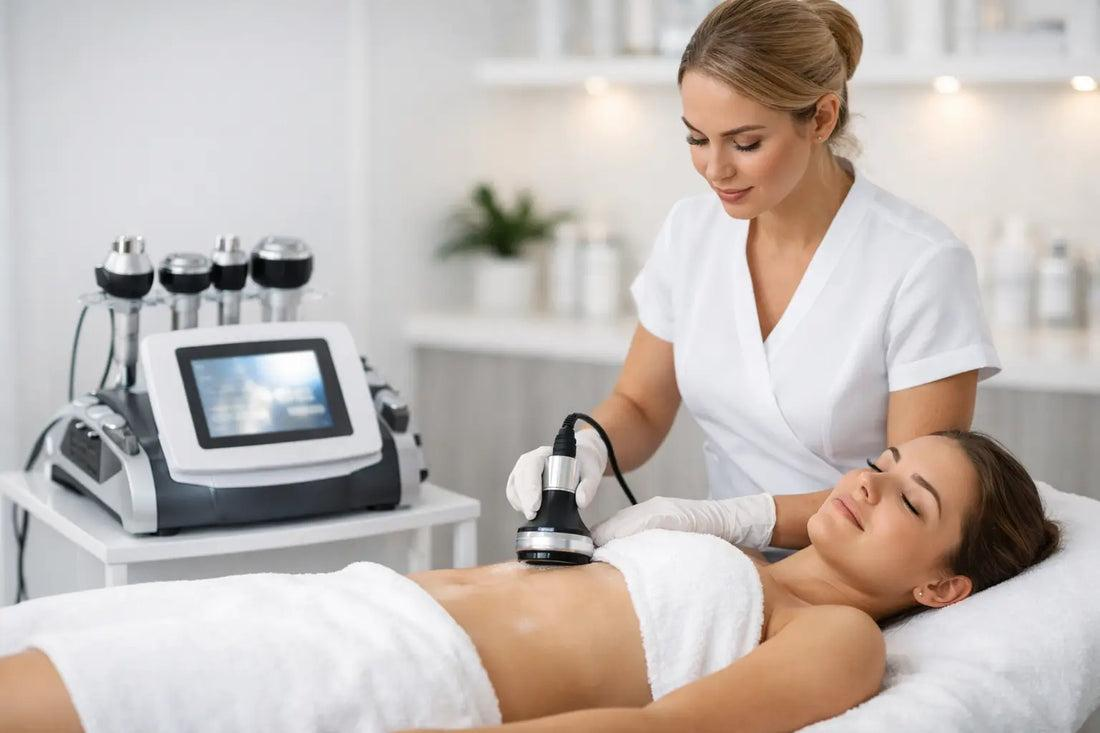
In a typical professional treatment workflow, the operator first assesses the client's goals, medical history, treatment area, and suitability for the procedure. The skin is inspected, and the manufacturer's specified coupling medium is applied when required to facilitate acoustic transmission and appropriate applicator contact.
The applicator is then used according to the device's instructions, including its specified movement pattern, treatment duration, output settings, and contact requirements.
The intended goal is to apply energy to a selected area under controlled conditions. Depending on the specific technology, tissue interaction may involve mechanical effects, localized heating, or other acoustic phenomena.
It is not accurate to assume that every cavitation device selectively destroys fat cells or that the body automatically eliminates a predictable quantity of fat after each session. Such claims require evidence for the specific device and protocol.
Professional operators should understand the manufacturer's explanation of the mechanism, follow validated procedures, and avoid substituting generalized online descriptions for device-specific training.
How Is Ultrasonic Cavitation Different From RF?
Ultrasonic cavitation and radiofrequency are different energy modalities.
Ultrasound delivers acoustic energy, while RF systems generate electromagnetic energy that can produce tissue heating. The effects depend on device design, output, applicator configuration, tissue characteristics, and the treatment protocol.
RF is commonly used in aesthetic practice for applications involving controlled heating and skin appearance, while ultrasonic devices may be marketed for localized body-contouring applications. These categories should not be treated as interchangeable, and combining them does not automatically improve outcomes.
Some professional systems integrate several technologies to support different service objectives. However, each modality should have a clear purpose, compatible operating instructions, and appropriate safety procedures. More functions are useful only when they serve an actual client need.
4. Advantages and Comparison: What Can Professional Equipment Really Offer?
A More Targeted Approach to Body Contouring
For appropriately selected clients, a professional body-contouring service can focus on specific areas rather than treating body weight as the only measure of progress.
The potential value of an ultrasonic cavitation system lies in its intended application, controllable operating parameters, and integration into a structured treatment service. It should not be evaluated solely by its advertised power, number of handles, or promotional claims.
A responsible service also considers client comfort, realistic treatment goals, consistent documentation, and follow-up. These elements contribute to a more professional experience even when visible results are modest.
Professional Equipment Versus Home-Use Devices
Professional systems and home-use devices differ in their intended users, design, operating instructions, and service environment. Professional equipment may provide trained operators with more configurable parameters, specialized applicators, structured treatment workflows, and access to technical support, depending on the product.
These features can support consistent service delivery when the operator has received appropriate training. They do not, by themselves, prove that a device produces better fat-reduction outcomes than every home-use alternative.
Home-use products may have different output limits, simpler controls, or narrower intended applications. Consumers should not assume that a device is suitable for unsupervised use simply because it is advertised online.
For salon owners and clinic managers, the relevant purchasing questions include:
-
Does the equipment have a clearly defined intended use?
-
Are its operating instructions, contraindications, and safety warnings available?
-
Are the output settings and applicator functions appropriate for the planned services?
-
Can the supplier provide technical training, maintenance guidance, and after-sales support?
-
Is the device's performance supported by evidence relevant to its intended application?
-
Are the applicable regulatory and conformity requirements satisfied in the target market?
The strongest equipment investment is one that fits the business's actual service requirements and can be operated responsibly, not necessarily the one with the most aggressive claims.
Why Multi-Function Systems Need Careful Evaluation
A combination system may include ultrasound, RF, vacuum-assisted functions, or mechanical massage. Such systems can broaden a salon's service menu and potentially reduce the need for several separate devices.
Nevertheless, each function should be evaluated independently. An RF handle should not be assumed to produce ultrasound effects, and a vacuum function should not be treated as evidence of enhanced fat-cell reduction.
Before purchasing a multi-function system, operators should confirm which technologies are genuinely included, how each is intended to be used, and whether the treatment sequence is supported by the manufacturer's instructions.
The business value of combination equipment depends on reliable performance, suitable applications, operator competency, and service demand—not merely the number of functions listed in a brochure.
5. Applications and Client Needs: Integrating Cavitation Into Professional Services
Client Assessment Comes First
A consultation should establish the client's goals, relevant medical history, expectations, and suitability for treatment. The operator should explain the intended cosmetic outcome and distinguish it from weight loss or medical treatment.
A cavitation procedure may be inappropriate for some individuals. Potential contraindications or precautions can include pregnancy, certain implanted electronic devices, active skin problems in the treatment area, impaired sensation, and relevant medical conditions. The exact restrictions depend on the device and its instructions.
Clients with unexplained swelling, a suspected medical condition, or concerns requiring diagnosis should be referred to an appropriately qualified healthcare professional rather than treated as a routine cosmetic case.
Operators should follow the manufacturer's screening requirements and local professional rules. If suitability is uncertain, postponing treatment is preferable to making assumptions.
Designing a Structured Treatment Plan
A professional plan should be based on the device's instructions and the client's individual needs. It commonly includes:
Step 1: Define the objective. Identify the area of concern and agree on a realistic, measurable goal.
Step 2: Establish a baseline. Record appropriate measurements and, with consent, standardized photographs. Document the conditions under which the measurements are taken.
Step 3: Confirm suitability. Review contraindications, skin condition, relevant health information, and the manufacturer's requirements.
Step 4: Apply the device correctly. Use only the specified applicator, coupling medium, output settings, treatment duration, and movement technique. Do not exceed the recommended protocol to pursue faster results.
Step 5: Monitor the response. Check client comfort and inspect the treated area as appropriate. Stop the procedure if an unexpected or concerning reaction occurs.
Step 6: Review progress. Assess outcomes at an appropriate interval using consistent methods. Modify or discontinue the plan when the response does not justify continued treatment.
This structured approach gives operators a repeatable process and helps clients understand why responsible treatment may require assessment and follow-up rather than a one-session promise.
Setting Realistic Expectations
Clients should be told that results vary and that visible changes are not guaranteed. Ultrasonic cavitation should not be presented as a substitute for healthy lifestyle habits, comprehensive weight management, or medically indicated care.
Practitioners should also explain that temporary changes in appearance do not necessarily demonstrate lasting fat reduction. When objective outcomes matter, consistent measurements and appropriate follow-up are more useful than relying exclusively on subjective impressions.
Clear communication supports trust and helps reduce dissatisfaction caused by unrealistic advertising.
6. Treatment Safety: What Professional Operators Should Know
Safety is not an optional feature of a body-contouring device. It depends on the equipment, operator training, client selection, treatment settings, and the quality of the service protocol.
Follow Device-Specific Instructions
There is no universal setting or treatment duration that is appropriate for every ultrasonic cavitation system. Operators should follow the manufacturer's specified parameters and training materials rather than copying settings from unrelated devices.
Using excessive output, treating the same area for longer than recommended, or applying the device incorrectly may increase the risk of discomfort, burns or other tissue injury, depending on the technology.
Applicators should be inspected and maintained according to the manufacturer's schedule. Faulty equipment should be removed from service until it has been assessed and repaired appropriately.
Screen for Contraindications
Contraindications vary across products and technologies. Before treatment, the operator should review the device's instructions and screen for relevant medical conditions, implanted devices, pregnancy, and issues affecting the treatment area.
Where a medical history raises concerns, the operator should follow the manufacturer's restrictions and seek appropriate clinical guidance when necessary. A cosmetic consultation is not a substitute for medical diagnosis.
Explain Possible Side Effects and Aftercare
Depending on the device and procedure, clients may experience temporary redness, tenderness, discomfort, or other local reactions. The actual risk profile depends on the technology and its use.
Clients should receive clear aftercare instructions and know which symptoms require prompt medical assessment. Severe, persistent, or worsening pain, significant swelling, blistering, or other unexpected symptoms should not be dismissed as evidence that the treatment is working.
Professional operators should document adverse events, follow the appropriate escalation procedure, and avoid repeating treatment until the concern has been assessed.
Verify Documentation and Regulatory Status
For equipment buyers, supplier evaluation should include technical specifications, instructions for use, risk information, maintenance requirements, warranty terms, and applicable conformity documentation.
Regulatory requirements differ by country and by the device's intended purpose. A CE mark, FDA-related claim, or other certification statement should be verified in context; it should not be interpreted as universal proof that every advertised outcome is clinically established.
Suppliers should be able to explain the device's intended use and provide documentation relevant to the market in which it will be sold. Accurate product descriptions and responsible marketing are part of professional quality management.
7. Conclusion: Facts Build Better Body-Contouring Services
Ultrasonic cavitation is often surrounded by exaggerated claims, but professional decision-making begins with a clear understanding of what the technology is—and what it is not.
It is not a guaranteed weight-loss solution, a promise of dramatic results after one session, or a technology that works identically across every device. Its appropriate role depends on the specific system, available evidence, client suitability, and the treatment protocol.
For beauty salons and aesthetic businesses, the most sustainable approach combines suitable equipment, trained operators, careful screening, realistic expectations, consistent documentation, and effective follow-up. Professional systems can support a structured body-contouring service when their functions match client needs and their use follows appropriate instructions.
For manufacturers and equipment suppliers, transparent specifications, practical training, reliable technical support, and evidence-based product communication are more valuable than exaggerated promises. For practitioners, these qualities help create a service that clients can understand and trust.
Ultimately, successful body contouring is not defined by the boldest marketing claim. It is built on appropriate technology, responsible treatment, and measurable, honestly communicated outcomes
Founded in 2008, Guangzhou GLM Beauty Spa Equipment Factory specializes in research, development, manufacture and selling of beauty and slimming machines. Our production base is located in Guangzhou City, Guangdong Province, China. Since our foundation, we have introduced advanced technologies and equipment, to assure high quality and high performance of our products. With professional marketing guide and excellent after-sales service, our products have been exported to over 20 countries and regions, including Southeast Asia, the Middle East, Europe and the United States, won worldwide praises and gained a good reputation