
1. Introduction
The demand for non-surgical aesthetic treatments has encouraged aesthetic clinics and professional beauty centers to expand their treatment portfolios beyond traditional facials and surface-level skincare. Today, many clients are looking for visible improvements in skin firmness, facial contour, and the appearance of sagging, while preferring treatments that do not involve incisions or lengthy recovery periods.
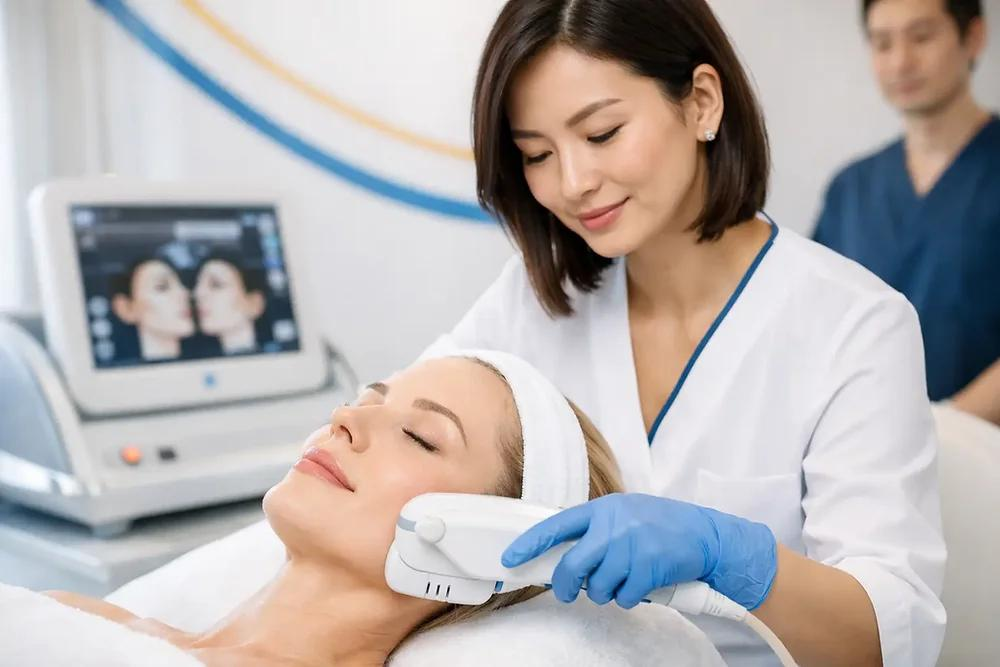
High-Intensity Focused Ultrasound (HIFU) has become an important technology in this market. By concentrating ultrasound energy at selected depths beneath the skin, HIFU systems are designed to support tissue tightening and collagen remodeling without intentionally damaging the entire skin surface. This makes the technology relevant to professional practices offering non-surgical facial rejuvenation and, with appropriately designed equipment and protocols, selected body-contouring applications.
For aesthetic clinics, HIFU is more than a treatment device. It represents an opportunity to introduce a technology-driven service, diversify revenue streams, and address client concerns that may not be fully met by conventional skincare treatments. However, successful implementation depends on understanding the technology, selecting equipment appropriate for the intended indication, managing client expectations, and maintaining rigorous safety standards.
Why is HIFU attracting continued attention in the professional aesthetics market? The answer lies in the combination of focused energy delivery, collagen-related tissue responses, customizable treatment approaches, and growing interest in non-surgical aesthetic options.
2. Background and the Problem: Why Clients Seek Non-Surgical Lifting
Skin aging is a multifactorial process. Over time, changes in collagen and elastin, alterations in fat distribution, reduced tissue support, and the effects of gravity can contribute to visible laxity and changes in facial contours. The jawline may appear less defined, the cheeks may lose some firmness, and the skin around the lower face and neck may become looser.
Traditional skincare treatments can improve hydration, surface texture, and the appearance of fine lines. Nevertheless, they generally cannot reproduce the tissue-level effects associated with focused energy treatments. On the other hand, surgical facelifts can address more substantial structural changes but involve surgery, recovery, and the risks associated with invasive procedures.
This creates a market for treatments positioned between surface-level skincare and surgery. HIFU is often considered within this category because it can deliver focused ultrasound energy to targeted tissue layers without surgical incisions.
Clients commonly ask three questions before choosing HIFU:
-
Can it improve the appearance of loose skin and facial contours?
-
How soon will results become visible, and how long might they last?
-
Is the treatment safe, and what discomfort or downtime should be expected?
Professional clinics must answer these questions accurately rather than relying on broad promises such as “instant lifting” or “permanent results.” HIFU outcomes vary according to the device, treatment parameters, anatomical area, practitioner skill, individual tissue characteristics, and the degree of skin laxity.
For clinics, this distinction is commercially important. Clear explanations and realistic expectations can improve client confidence, support informed consent, and reduce dissatisfaction caused by exaggerated marketing claims.
3. HIFU Technology and Mechanism: How Focused Ultrasound Works
3.1 Focused Ultrasound Energy Delivery
HIFU uses ultrasound energy that converges at a defined focal point within the target tissue. Instead of distributing all its energy across the skin surface, the system concentrates energy at a selected depth, where localized thermal effects can occur.
Depending on the device design and intended application, treatment cartridges or transducers may target different tissue depths. In aesthetic applications, these depths may include the dermis and deeper supportive tissue layers. Some systems are designed to reach specific deeper anatomical planes, but the appropriate depth depends on the indication, anatomy, device authorization, and treatment protocol.
The goal is to create controlled thermal effects in the intended tissue while limiting unnecessary exposure to surrounding structures. Accurate targeting is therefore central to treatment quality and safety.
3.2 Collagen Stimulation and Tissue Remodeling
Collagen is a structural protein that helps maintain skin firmness and support. With aging, collagen organization and production change, contributing to reduced elasticity and visible laxity.
Focused ultrasound can create localized thermal coagulation points in targeted tissue. These controlled effects may initiate a wound-healing response and stimulate subsequent collagen remodeling. Over time, this process may contribute to improved firmness and a more defined appearance in appropriately selected clients.
It is important to distinguish biological activity from guaranteed cosmetic results. Collagen remodeling is a gradual process, and the degree of visible improvement varies. HIFU does not restore all age-related tissue changes, remove every wrinkle, or reproduce the results of a surgical facelift.
3.3 Different Depths, Different Treatment Objectives
Professional HIFU systems may offer different transducers, cartridges, focal depths, or energy settings. These options allow trained practitioners to tailor treatment to the intended area and clinical objective.
For example, superficial treatment depths may be considered for selected dermal applications, while deeper focal depths may be used for appropriate supportive tissue targets. However, deeper is not automatically better. Incorrect depth selection, excessive energy, poor coupling, or unsuitable treatment patterns can increase the risk of injury.
Clinics should therefore evaluate the manufacturer's technical documentation, compatible cartridges, energy specifications, and approved indications rather than selecting a machine based only on the number of treatment depths advertised.
4. Advantages and Comparison: Why Clinics Consider HIFU
4.1 A Non-Surgical Approach to Selected Lifting Concerns
One of HIFU's main commercial advantages is its non-surgical treatment format. For appropriately selected clients, it may improve the appearance of mild to moderate skin laxity without incisions or the recovery associated with surgery.
This positioning is particularly relevant to clients who want a refreshed appearance but are not ready for an invasive procedure. However, HIFU should not be marketed as an equivalent replacement for surgery, especially when clients have substantial skin excess or advanced tissue laxity.
4.2 Gradual Results That Fit Collagen Remodeling
Some clients prefer a gradual change rather than a dramatic, immediate alteration in appearance. Because HIFU-related collagen remodeling develops over time, improvement may become more noticeable over several weeks to a few months.
The exact timeline depends on the treatment area, device, protocol, and individual response. Some clients may notice early changes, while others experience modest improvement. A professional clinic should explain that visible results are not guaranteed and that a follow-up assessment may be appropriate before considering additional treatment.
4.3 Complementary to Other Aesthetic Services
HIFU can occupy a distinct role within a broader aesthetic treatment portfolio. Depending on the client's needs, practitioners may combine it with skincare programs, selected energy-based procedures, or other aesthetic services as part of a carefully planned treatment pathway.
Combination treatments should not be performed simply because multiple technologies are available. Timing, tissue recovery, contraindications, treatment intensity, and cumulative risk must be evaluated. The clinic should establish clear protocols for sequencing procedures and refer clients to an appropriately qualified medical professional when the case exceeds its scope of practice.
4.4 Professional HIFU Versus Home-Use Devices
Professional and home-use devices should not be treated as interchangeable. Professional HIFU systems may offer more detailed parameter controls, application-specific transducers, treatment documentation, and technical support. They also require appropriate training and a clear understanding of anatomy and contraindications.
Home-use devices may operate at different energy levels or use different technologies altogether. A device marketed for home lifting is not necessarily equivalent to a professional focused-ultrasound system.
For clinic owners, the relevant comparison is not simply power output. It includes energy delivery accuracy, treatment consistency, safety controls, service support, operator training, and the suitability of the equipment for the clinic's intended services.
4.5 Business Value Beyond the Device Itself
The commercial value of a HIFU system depends on more than its purchase price. Clinics should consider the intended treatment market, consumable costs where applicable, staff training, maintenance, warranty coverage, local regulatory requirements, and the number of suitable clients in their target market.
A well-selected system can help a clinic differentiate its service portfolio. However, profitability depends on realistic pricing, qualified operation, appropriate client selection, and sustainable demand—not simply on purchasing a machine with a high number of features.
5. Clinical Results: What Can Clients Realistically Expect?
5.1 Areas Commonly Treated
Depending on the system's intended use and applicable authorization, HIFU treatments may target areas such as the brow, cheeks, jawline, submental region, or neck. Certain systems are also designed for specific body applications. Clinics must confirm that the device is suitable and authorized for each intended area rather than assuming that one platform can safely treat every body region.
5.2 When Do Results Appear?
Results are not always immediate. Some clients may observe an early change, but the more gradual effects associated with collagen remodeling generally develop over weeks to months. Published clinical findings vary according to the device, treatment protocol, study design, and outcome measures.
A clinic should avoid promising a fixed percentage of lifting or a guaranteed result by a specific date unless the claim is supported by reliable evidence applicable to the exact device and indication.
Before-and-after photographs can support consultations, but they should be captured with consistent lighting, camera distance, facial expression, and positioning. Image selection should be transparent, and client consent must be obtained before photographs are used for marketing.
5.3 Who May Be a Suitable Candidate?
Potential candidates are generally clients seeking improvement in selected signs of mild to moderate skin laxity and who understand the limits of non-surgical treatment. Suitability must be assessed individually.
Clients with significant skin excess, certain anatomical characteristics, active skin problems in the treatment area, or unrealistic expectations may require an alternative approach or referral. Practitioners should review relevant medical history, medications, prior procedures, skin condition, and other contraindications specified by the device manufacturer and applicable clinical guidance.
HIFU is not a weight-loss treatment, and facial lifting should not be presented as a substitute for surgery when surgery is clinically indicated.
6. Treatment Safety: What Professional Clinics Must Know
Safety is central to the long-term success of HIFU services. Focused ultrasound is an energy-based procedure, and incorrect use can cause adverse effects.
6.1 Possible Side Effects and Risks
Temporary redness, swelling, tenderness, tingling, or discomfort may occur after treatment. Depending on the device, treatment area, energy settings, and technique, more serious complications can include burns, unintended tissue injury, altered sensation, nerve-related effects, or unwanted changes in facial fat.
The possibility and severity of adverse effects depend on multiple factors. Clinics should not assume that a non-surgical procedure is risk-free simply because it does not involve incisions.
6.2 Assessment, Training, and Protocols
Before treatment, practitioners should conduct an appropriate consultation, review contraindications, explain expected benefits and limitations, obtain informed consent, and document the planned procedure.
Essential operational practices include:
-
Following the manufacturer's instructions for use and applicable local regulations.
-
Using only compatible transducers and approved treatment parameters.
-
Maintaining appropriate ultrasound coupling and correct handpiece positioning.
-
Avoiding inappropriate treatment over vulnerable anatomical structures.
-
Using suitable eye protection and other protective measures when required by the system's instructions.
-
Recording treatment settings, treatment areas, client responses, and follow-up observations.
-
Providing clear aftercare instructions and a pathway for managing adverse events.
Treatment should be performed only by practitioners whose qualifications and training meet local legal requirements. Where regulations restrict HIFU to licensed healthcare professionals, clinics must comply with those restrictions.
6.3 Equipment Quality and Regulatory Considerations
When evaluating a HIFU device, clinics should review the manufacturer's identity, technical specifications, quality-management documentation, applicable conformity assessments, device registration or authorization where required, warranty terms, and after-sales support.
A CE mark, FDA clearance, FDA approval, or other regulatory status should never be assumed from a supplier's general marketing statement. The exact device, model, intended use, and jurisdiction matter. Regulatory claims should be verified through appropriate official documentation.
For manufacturers and distributors, transparent technical information and reliable training resources can help professional buyers evaluate equipment more confidently. For clinics, due diligence is an important part of both risk management and long-term business planning.
7. Applications and Client Needs: Building a Professional HIFU Service
A successful HIFU service begins with client assessment rather than selecting a treatment package first. A clinic should identify the client's main concern—such as reduced jawline definition, mild lower-face laxity, or visible neck looseness—and determine whether HIFU is appropriate.
A practical service pathway includes the following stages:
-
Consultation: Discuss concerns, medical history, expectations, and treatment alternatives.
-
Assessment: Evaluate skin laxity, relevant anatomy, contraindications, and suitability for the specific device.
-
Treatment planning: Select appropriate parameters and treatment areas according to the manufacturer's instructions and practitioner training.
-
Procedure: Deliver treatment using consistent technique, suitable coupling, and documented settings.
-
Aftercare: Explain expected temporary reactions, care instructions, and warning signs that require professional assessment.
-
Follow-up: Review the response at an appropriate interval, document outcomes, and decide whether further treatment or an alternative approach is warranted.
This structured approach helps clinics deliver a more consistent client experience while avoiding the assumption that every client needs the same energy level or number of treatment lines.
For distributors and equipment manufacturers, the needs of professional clinics extend beyond the hardware. Buyers may also value operator training, clear manuals, troubleshooting support, maintenance availability, warranty coverage, and assistance with understanding local compliance requirements. OEM customization, private labeling, and packaging options may be relevant to distributors, provided they do not obscure the true manufacturer, intended use, or regulatory status of the device.
8. Conclusion
HIFU devices have attracted attention in aesthetic clinics because they offer a technology-based option for selected non-surgical lifting and skin-tightening treatments. Focused ultrasound can create localized thermal effects that may stimulate collagen remodeling, making it relevant to clients seeking gradual improvements in skin firmness and facial contour.
Nevertheless, clinical outcomes depend on appropriate device selection, treatment planning, practitioner competence, and individual tissue response. HIFU is not a universal solution for skin aging, and it cannot guarantee the same results as a surgical facelift. Safety also requires more than purchasing a technically advanced machine: clinics need suitable training, verified equipment documentation, careful client assessment, and consistent treatment protocols.
For professional aesthetic businesses, the strongest long-term strategy is to combine reliable technology with evidence-informed communication and responsible service delivery. By understanding what HIFU can—and cannot—achieve, clinics can build more credible treatment programs and help clients make better-informed decisions about non-surgical aesthetic care
Founded in 2008, Guangzhou GLM Beauty Spa Equipment Factory specializes in research, development, manufacture and selling of beauty and slimming machines. Our production base is located in Guangzhou City, Guangdong Province, China. Since our foundation, we have introduced advanced technologies and equipment, to assure high quality and high performance of our products. With professional marketing guide and excellent after-sales service, our products have been exported to over 20 countries and regions, including Southeast Asia, the Middle East, Europe and the United States, won worldwide praises and gained a good reputation