Introduction
A client completes several aesthetic treatments but sees little improvement. The immediate reaction is often to blame the device: Is the machine powerful enough? Is the technology outdated? Should we increase the energy?
In professional aesthetic practice, the real answer is often more complicated.
For light-based treatments, clinical performance depends on how energy interacts with the target tissue. Three concepts are particularly important: wavelength, fluence, and energy density. They determine where the energy is absorbed, how much energy reaches a specific area, and whether the treatment produces the intended biological response.
This is why two devices can look similar on a specification sheet yet produce different treatment experiences and outcomes. A device may advertise high power, but if the wavelength is poorly matched to the target, the fluence is inappropriate, or the treatment parameters are not properly adjusted, more energy does not necessarily mean better results.
For professional beauty salons and aesthetic clinics, understanding these parameters is therefore not just technical knowledge. It is part of delivering consistent treatments, managing client expectations, and making better use of professional equipment.
Background: Why Clients May Not See the Expected Results
Aesthetic treatments rarely work according to a simple formula of “more energy = better results.”
Consider laser hair reduction. The objective is not simply to send as much light as possible into the skin. The wavelength needs to interact effectively with the melanin in the hair follicle while limiting unnecessary heating of surrounding tissue. Pulse duration, fluence, spot size, cooling, hair characteristics, skin type, and treatment interval can all influence the final result.
Professional literature identifies several commonly used wavelengths for hair removal, including approximately 755 nm alexandrite, 800–810 nm diode, and 1064 nm Nd. These wavelengths interact differently with melanin and penetrate tissue differently. Professional treatment therefore requires appropriate patient selection and parameter management rather than relying on a single universal setting.
This explains a common situation in clinics: one client responds quickly while another sees slower or weaker improvement even when the same device is used.
The machine may not be the problem.
The treatment strategy may be.
Technology and Mechanism: Understanding Wavelength
Wavelength determines how light interacts with tissue.
Measured in nanometers (nm), wavelength describes the distance between successive peaks of a light wave. In aesthetic technology, different wavelengths are selected because biological tissues and chromophores absorb different wavelengths to different degrees.
The main principle is known as selective photothermolysis. In simple terms, the goal is to deliver light energy that is preferentially absorbed by a target chromophore, generating a controlled thermal effect while minimizing unwanted injury to surrounding tissue. Modern dermatologic laser systems use this principle for applications including hair removal, vascular treatment, pigmentation management, and skin rejuvenation.
For example, in hair removal, melanin is an important target. Shorter wavelengths such as 755 nm generally have stronger melanin absorption, while longer wavelengths such as 1064 nm penetrate more deeply and are less strongly absorbed by epidermal melanin.
This is one reason wavelength selection matters so much.
A 755 nm system, an 810 nm diode laser, and a 1064 nm Nd system are not simply three versions of the same machine. Their interaction with tissue is different, which means their clinical applications and parameter strategies can also differ.
Why One Wavelength Cannot Solve Every Problem
Imagine a clinic treating clients with different skin tones, hair thicknesses, hair depths, and treatment goals.
Using exactly the same wavelength and settings for everyone may simplify operation, but it does not necessarily optimize treatment.
Longer wavelengths can offer deeper penetration and may be particularly useful when treating more pigmented skin, while shorter wavelengths may provide stronger absorption by melanin. For this reason, professional multi-wavelength diode platforms have become useful in practices that need greater flexibility.
The important point is not that one wavelength is universally “better.”
It is that the right wavelength should match the target and treatment objective.
Fluence: The Energy Delivered to the Treatment Area
If wavelength answers “where should the energy go?”, fluence helps answer “how much energy is being delivered to a given area?”
Fluence is commonly expressed in joules per square centimeter (J/cm²).
A simplified formula is:
Fluence = Energy ÷ Treatment Area
For example, if a laser delivers 20 joules over an area of 2 cm², the fluence is 10 J/cm².
This distinction is important because a device's total energy output does not tell you how much energy is actually being delivered to each unit of treatment area.
A large spot size can distribute energy across a larger area, while a smaller spot can concentrate the same total energy into a smaller area. Consequently, simply comparing the “joules” or “watts” listed on two machines may not provide a meaningful comparison of their treatment parameters.
In professional settings, fluence is considered alongside pulse duration, spot size, wavelength, cooling, skin type, and the characteristics of the target tissue. Recent clinical reviews specifically emphasize that parameter selection should be dynamic rather than based on a single specification.
Higher Fluence Does Not Automatically Mean Better Results
One of the most important concepts for operators is that increasing fluence is not a universal solution for poor treatment results.
If fluence is too low, the target may not receive sufficient thermal energy to produce the desired response.
If fluence is too high, the risk of excessive heating and unwanted tissue effects increases.
The practical objective is therefore to identify an appropriate treatment window rather than simply choosing the highest available setting.
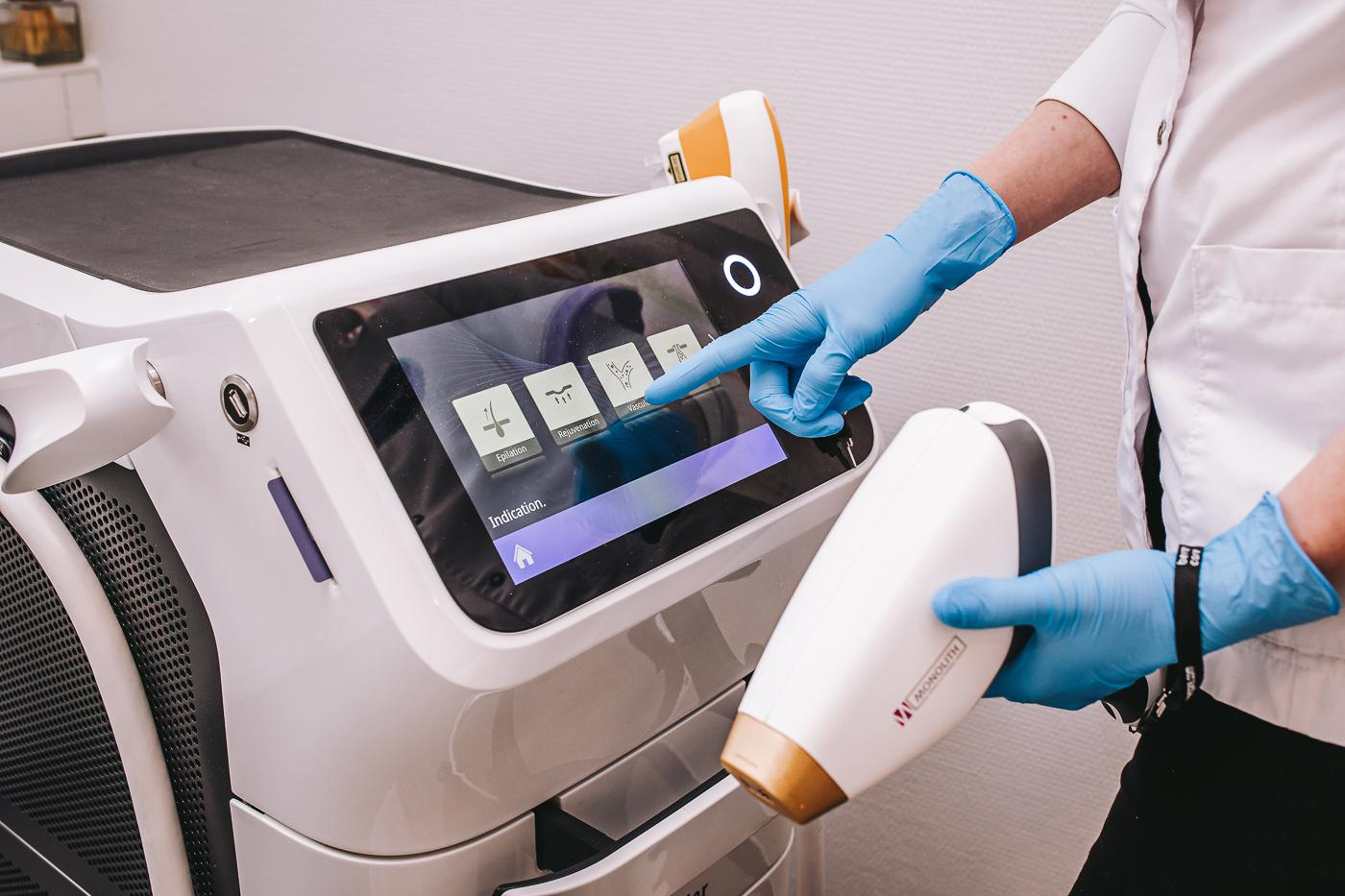
This is where professional equipment becomes particularly valuable. Well-designed systems can provide controlled parameter adjustment, consistent energy delivery, cooling functions, multiple handpieces or wavelengths, and interfaces that help operators select appropriate settings according to treatment requirements.
Energy Density: Why Delivery Matters
The term energy density is often used in discussions of light-based aesthetic equipment and can overlap conceptually with fluence depending on the technology and context.
The key idea is simple: energy needs to be delivered to the right area, at the right level, in the right amount of time.
A treatment is not determined by energy alone.
Consider two devices that both claim similar maximum energy output. If one delivers energy inconsistently across the treatment spot while the other provides more uniform energy distribution, their practical performance may differ.
For professional clinics, consistency is critical.
A client does not experience the specification sheet. The client experiences the treatment.
Consistent energy delivery can help operators reproduce treatment protocols, monitor responses, and build more predictable treatment workflows.
Advantages and Comparison: Professional Equipment vs. Basic Home Devices
Home-use beauty devices and professional aesthetic platforms serve different purposes.
Consumer devices are generally designed around convenience, simplified operation, and lower treatment intensity. Professional equipment, by contrast, is designed for trained operators who can evaluate the client's skin characteristics, treatment objectives, contraindications, and treatment response.
This difference is particularly important for energy-based technologies.
1. More Flexible Parameter Control
Professional systems may provide adjustable fluence, pulse duration, spot size, cooling, and wavelength options depending on the platform.
This allows practitioners to create treatment strategies rather than applying one fixed output to every client.
2. Multiple Wavelength Options
For clinics offering hair reduction, multi-wavelength diode systems can provide greater flexibility.
Common diode configurations include wavelengths around 755 nm, 808 nm, and 1064 nm, each offering different optical characteristics.
A multi-wavelength platform can therefore help a clinic address a broader range of client profiles and treatment requirements.
3. Better Treatment Workflow
Professional devices are also designed for repeated daily operation.
Ergonomic handpieces, larger treatment spots, cooling systems, user interfaces, preset protocols, and stable energy delivery can improve workflow efficiency during busy clinic schedules.
For a professional operator, this matters because treatment quality is not only about the technology itself. It is also about how reliably the technology can be used from one client to the next.
4. Greater Importance of Operator Skill
Advanced equipment does not eliminate the need for trained operators.
In fact, the more parameter flexibility a device provides, the more important proper assessment becomes.
Skin type, hair color, hair thickness, treatment area, previous treatment history, and immediate skin response should all be considered when determining an appropriate protocol.
Professional studies on laser hair removal similarly emphasize patient selection and appropriate fluence management to balance efficacy and adverse-event risk.
Applications: Matching Parameters to Client Needs
Understanding wavelength and fluence becomes most valuable when it is applied to real treatment scenarios.
Hair Reduction
Hair removal is one of the clearest examples.
The objective is to heat the hair follicle sufficiently to interfere with its growth while protecting surrounding tissue as much as possible.
Different wavelengths can be selected according to skin characteristics and hair properties. Alexandrite around 755 nm, diode around 800–810 nm, and Nd at 1064 nm are established platforms used for long-term hair reduction.
For professional clinics, the advantage of a flexible diode platform is not simply having more numbers on the screen. It is the ability to adapt the treatment approach to different client profiles.
Pigmentation and Vascular Applications
Other light-based treatments demonstrate the importance of chromophore selection.
Melanin, hemoglobin, and water have different absorption characteristics. Consequently, wavelength selection changes depending on the target.
Recent reviews categorize dermatologic laser applications by wavelength and target, including vascular treatments with pulsed-dye and Nd systems, pigmentation applications, and fractional laser approaches for rejuvenation and scar management.
This is why clinics should evaluate a laser platform according to its intended applications rather than judging it solely by maximum power.
Skin Rejuvenation
For rejuvenation-oriented treatments, the target may be different from hair follicles or pigment.
Depending on the technology, the objective may involve controlled thermal stimulation of dermal tissue or interaction with water-containing structures.
Again, the relationship between wavelength, energy, pulse duration, spot size, and tissue response determines how the treatment should be designed.
A Practical Checklist for Professional Operators
When a client is not seeing the expected results, consider the following questions before simply increasing energy:
1. Is the wavelength appropriate for the target?
The first question should be whether the selected wavelength is suitable for the client's skin characteristics and treatment objective.
2. Is the fluence appropriate?
Too little energy may produce insufficient treatment effects, while excessive energy can increase unwanted thermal effects.
3. Is pulse duration appropriate?
Energy delivery over time influences how heat accumulates and dissipates within tissue.
4. Is the spot size suitable?
Spot size affects energy distribution and penetration characteristics.
5. Is cooling adequate?
Cooling can help manage epidermal temperature and improve treatment tolerability where appropriate.
6. Is the treatment interval correct?
Some aesthetic treatments require multiple sessions because biological targets change over time. A technically correct treatment can still produce disappointing results if sessions are poorly scheduled.
7. Is the client expectation realistic?
Professional treatment should always include realistic communication about expected outcomes, treatment cycles, individual variability, and maintenance.
Conclusion
When clients are not seeing the results they expected, the solution is not always a more powerful machine or a higher energy setting.
The real question is whether the treatment parameters are appropriately matched to the target.
Wavelength determines how light interacts with tissue. Fluence describes energy delivered per unit area. Energy density and delivery characteristics help determine how effectively that energy reaches the treatment zone. Pulse duration, spot size, cooling, skin characteristics, treatment intervals, and operator technique then complete the picture.
For professional beauty salons and aesthetic clinics, this is where advanced equipment can provide real value.
A well-designed professional platform is not simply a machine that produces high energy. It is a system that gives trained operators greater control over how energy is delivered.
When technology, parameters, operator expertise, and client assessment work together, treatment becomes more than a matter of turning up the power.
It becomes a controlled, adaptable, and professional treatment strategy.
And that is often the difference between simply performing a procedure and building a treatment protocol designed around the client
Founded in 2008, Guangzhou GLM Beauty Spa Equipment Factory specializes in research, development, manufacture and selling of beauty and slimming machines. Our production base is located in Guangzhou City, Guangdong Province, China. Since our foundation, we have introduced advanced technologies and equipment, to assure high quality and high performance of our products. With professional marketing guide and excellent after-sales service, our products have been exported to over 20 countries and regions, including Southeast Asia, the Middle East, Europe and the United States, won worldwide praises and gained a good reputation