Introduction
The aesthetic industry continues to evolve as consumers seek non-invasive skin rejuvenation, laser hair removal, pigmentation correction, skin tightening, and other professional aesthetic treatments. For medical spas, dermatology clinics, and aesthetic centers, investing in advanced laser equipment is an important step toward expanding treatment offerings and strengthening market competitiveness.
However, purchasing professional aesthetic laser equipment often requires a substantial upfront investment. High-performance laser systems, multi-functional aesthetic platforms, and advanced energy-based devices can represent a significant financial commitment, particularly for newly established clinics and growing Med Spa businesses.
This is where aesthetic laser equipment financing becomes an important business strategy in 2026. Rather than paying the full equipment price upfront, clinic owners can explore equipment leasing, installment financing, equipment loans, and other flexible payment arrangements. These options can help businesses manage cash flow while gaining access to technologies that support new revenue opportunities.
Financing, however, should not be viewed simply as a way to make expensive equipment affordable. It should be part of a broader investment strategy that considers treatment demand, equipment utilization, operating costs, maintenance requirements, and long-term return on investment (ROI).
Understanding how financing works and how to evaluate the commercial value of professional aesthetic equipment can help Med Spas make more informed purchasing decisions.
Background and Problem: Why Equipment Costs Matter to Med Spas
Professional aesthetic laser equipment is a long-term business investment. Unlike ordinary salon supplies, these systems involve advanced optical components, energy delivery technologies, cooling systems, software controls, and specialized treatment handpieces.
For example, clinics may consider investing in:
-
Diode laser hair removal systems for long-term hair reduction services.
-
Q-switched or picosecond laser systems for selected pigmentation and tattoo-related applications.
-
Fractional laser platforms for professional skin resurfacing treatments.
-
Nd:YAG laser systems for specific vascular and pigmentation applications, depending on the device's indications.
-
Multi-functional aesthetic platforms that combine different technologies for broader treatment offerings.
Although these devices can expand a clinic's service portfolio, their purchase price is only one part of the total investment.
Business owners also need to consider installation, staff training, consumables, maintenance, insurance, marketing, room preparation, and potential downtime. A clinic that spends most of its available capital on equipment may have limited resources left for customer acquisition, staff development, and daily operations.
This creates a common challenge: how can a Med Spa introduce advanced technology without putting unnecessary pressure on its working capital?
Equipment financing provides one possible solution. By spreading payments over an agreed period, businesses may preserve cash for other operating priorities. Instead of delaying equipment upgrades until sufficient cash has accumulated, eligible clinics can potentially introduce new treatments earlier.
Nevertheless, financing does not automatically make an investment profitable. The equipment must match the clinic's customer base, treatment capabilities, and business objectives.
Technology and Mechanism: Understanding Aesthetic Laser Equipment Financing
Aesthetic laser equipment financing refers to financial arrangements that allow clinics to acquire professional laser systems without paying the entire purchase price immediately. Different financing structures have different ownership arrangements, repayment schedules, and contractual obligations.
1. Equipment Leasing
Equipment leasing allows a clinic to use a laser system in exchange for regular payments over a specified term.
Depending on the contract, the leasing company may retain ownership of the equipment during the lease period. At the end of the agreement, the clinic may have options such as returning the equipment, renewing the lease, or purchasing it through a buyout arrangement.
Leasing can be attractive to businesses that want to introduce newer technologies while preserving initial capital. It may also be useful when a clinic is testing demand for a particular treatment category before committing to long-term ownership.
However, buyers should carefully review the total lease cost, end-of-term conditions, early termination provisions, maintenance responsibilities, and any purchase option.
2. Equipment Loans
An equipment loan provides financing specifically for purchasing machinery or other business equipment.
The clinic receives funds to purchase the laser system and repays the lender through scheduled installments, usually with interest. Depending on the financing structure, the equipment may serve as collateral.
Unlike a typical operating lease, an equipment loan is generally designed to support ownership of the purchased asset. This can be suitable for established clinics that plan to use the same equipment for several years.
Before signing an agreement, business owners should compare the annual percentage rate (APR), loan term, down payment, fees, collateral requirements, and total repayment amount.
3. Installment Payment Plans
Some equipment manufacturers, distributors, or financing partners offer installment arrangements that divide the purchase price into multiple payments.
These plans may provide a simpler purchasing process for qualified buyers, depending on the supplier's policies and local financial regulations.
For international buyers, payment terms may also involve currency exchange, international bank transfers, import duties, shipping costs, and local financing restrictions. It is important to distinguish manufacturer payment arrangements from independent third-party financing.
4. Comparing Common Financing Options
Each financing structure serves a different business purpose.
| Financing Method | Main Feature | Potential Advantage | Key Consideration |
|---|---|---|---|
| Equipment leasing | Regular payments for equipment use | Preserves initial capital | Ownership and end-of-term conditions |
| Equipment loan | Borrowed funds for equipment purchase | Supports long-term ownership | Interest and repayment obligations |
| Installment plan | Purchase price divided into payments | Predictable payment schedule | Supplier terms and eligibility |
| Cash purchase | Full payment upfront | No financing interest | Greater immediate cash commitment |
The best option depends on the clinic's financial position, equipment requirements, expected usage, and long-term growth plans.
Advantages and Comparison: Why Flexible Financing Can Support Clinic Growth
1. Preserving Working Capital
Cash flow is essential for maintaining a stable aesthetic business. Clinics need sufficient funds for employee salaries, rent, utilities, consumables, advertising, and unexpected operating expenses.
Financing can reduce the amount of capital tied up in a single equipment purchase. This allows business owners to allocate funds across multiple areas rather than concentrating their entire budget on one machine.
For example, a clinic may choose to finance a new laser system while keeping available cash for staff training, promotional campaigns, and customer retention programs.
The objective is not simply to borrow more money, but to maintain a healthier balance between fixed investment and daily operating liquidity.
2. Expanding Treatment Services Earlier
Consumer interest in professional aesthetic treatments creates opportunities for clinics that can respond to changing market demand.
A Med Spa that currently offers basic facial treatments may want to introduce laser hair removal, pigmentation treatments, or skin rejuvenation services. However, purchasing every new system outright may delay expansion.
A suitable financing arrangement may help qualified businesses introduce additional technologies earlier, allowing them to test treatment demand and develop new service categories.
Before investing, clinics should assess local competition, customer demographics, treatment pricing, and the number of potential appointments each month.
3. Improving Equipment Upgrade Flexibility
Aesthetic technology continues to develop, with manufacturers introducing improvements in laser wavelengths, pulse control, energy delivery, cooling systems, and treatment interfaces.
For clinics that frequently update their technology, leasing may offer a way to align equipment use with a defined upgrade cycle.
However, a newer model is not automatically a better investment. Equipment upgrades should be based on meaningful improvements in treatment capabilities, safety features, operational efficiency, and customer demand.
4. Supporting Business Scalability
For expanding Med Spa groups, financing may help distribute equipment investments across multiple locations.
Instead of purchasing all systems simultaneously, a business may introduce equipment in stages according to each location's customer volume and service requirements.
This approach can make expansion more manageable, provided that the financing commitments remain consistent with projected cash flow.
ROI Planning: How to Evaluate the Financial Value of Aesthetic Laser Equipment
Financing decisions should always be connected to a realistic return-on-investment plan.
A professional laser system may generate revenue through treatment appointments, packages, repeat visits, and complementary services. However, the actual financial performance depends on utilization, pricing, operating expenses, and market demand.
Step 1: Estimate Monthly Treatment Revenue
Start by identifying the services that the equipment will support.
For example, a laser hair removal system may offer several treatment areas, including the face, underarms, arms, legs, and other suitable body areas.
A simplified revenue calculation is:
Monthly Treatment Revenue = Average Treatment Price × Number of Monthly Treatments
If a clinic performs 80 treatments per month at an average price of $100, its estimated monthly gross treatment revenue would be $8,000.
This is an illustrative calculation, not a guaranteed result. Actual revenue depends on local pricing, treatment suitability, appointment capacity, customer demand, and repeat booking rates.
Step 2: Calculate Monthly Operating Costs
Revenue alone does not determine profitability. Clinics should calculate all relevant operating expenses, including:
-
Equipment financing or lease payments.
-
Staff wages and treatment commissions.
-
Consumables and disposable accessories.
-
Equipment maintenance and servicing.
-
Electricity and facility expenses.
-
Marketing and customer acquisition.
-
Insurance and other business expenses.
The remaining amount after operating costs represents a more useful basis for evaluating the equipment's financial contribution.
Step 3: Compare Equipment Payments with Expected Cash Flow
A financing agreement should fit the clinic's expected monthly cash flow, including periods when customer demand may be lower.
Business owners should model conservative, moderate, and optimistic scenarios rather than relying on a single revenue forecast.
For example, a clinic may calculate whether it can comfortably meet its monthly payments if appointment volume falls below expectations for two or three months.
This approach helps reduce the risk of taking on financing obligations that depend on unrealistic sales targets.
Step 4: Calculate the Break-Even Point
The break-even point indicates how much business activity is required to cover the relevant costs.
For a simple equipment investment model:
Break-Even Treatments = Monthly Equipment-Related Fixed Costs ÷ Contribution per Treatment
Contribution per treatment is the treatment price minus variable costs directly associated with delivering that treatment.
For example, if monthly equipment-related fixed costs are $2,000 and the contribution per treatment is $80, the clinic needs 25 treatments per month to cover those costs.
This simplified model does not replace a complete business forecast, but it provides a useful starting point for investment evaluation.
Step 5: Consider the Total Cost of Ownership
The purchase price or monthly payment does not represent the full cost of owning and operating professional equipment.
A complete evaluation should include the equipment's expected service life, warranty coverage, maintenance availability, spare parts, consumable requirements, training support, and potential downtime.
A machine with a lower initial price may become more expensive if maintenance is difficult or technical support is unreliable.
For this reason, selecting a dependable manufacturer and understanding after-sales support are important parts of ROI planning.
Applications and Client Needs: Choosing Equipment That Matches Business Goals
Financing is most effective when it supports a clear treatment strategy rather than encouraging unnecessary equipment purchases.
For Newly Established Med Spas
New clinics often need to balance equipment investment with branding, interior preparation, staff recruitment, and initial marketing.
A carefully selected laser system may help establish a focused treatment portfolio without requiring the clinic to purchase multiple machines immediately.
New business owners should prioritize equipment that matches their target customers and can be operated safely by appropriately trained professionals.
For Established Aesthetic Clinics
Established clinics may already have a stable customer base and treatment history. Their equipment investments can be guided by actual booking data, customer requests, and service profitability.
For example, if existing clients frequently request professional hair reduction or skin rejuvenation treatments, introducing a suitable laser platform may help address an identifiable service gap.
Financing can provide flexibility, but the decision should be supported by realistic utilization forecasts.
For Multi-Location Med Spa Businesses
Businesses operating several clinics may need standardized equipment, consistent treatment protocols, and coordinated maintenance support.
A phased financing strategy can help distribute equipment purchases according to each location's performance.
Before expanding, management should consider staff training consistency, technical support coverage, device compatibility, and the cost of maintaining multiple systems.
Why Professional Equipment Matters
Professional aesthetic laser equipment is designed for trained operators working in controlled clinical or professional treatment environments.
Compared with many consumer home-use devices, professional systems may offer different energy specifications, treatment handpieces, operating parameters, cooling configurations, and workflow capabilities.
These differences do not mean every professional device is appropriate for every clinic or client. Device selection must consider its intended indications, applicable regulations, operator qualifications, contraindications, and treatment protocols.
For equipment buyers, working with an experienced manufacturer can help clarify technical specifications, available configurations, training requirements, and maintenance arrangements before purchase.
Conclusion
Aesthetic laser equipment financing in 2026 is more than a purchasing convenience. When structured carefully, it can become part of a broader growth strategy for Med Spas, aesthetic clinics, and professional beauty businesses.
Flexible leasing, equipment loans, and installment arrangements may help eligible businesses preserve working capital, introduce new treatment technologies, and plan equipment upgrades without concentrating all available funds in a single purchase.
However, successful financing begins with a clear understanding of the clinic's business model. Treatment demand, equipment utilization, monthly operating costs, repayment capacity, maintenance support, and long-term ROI should all be evaluated before signing an agreement.
Choosing the right equipment is equally important. A reliable aesthetic laser system should match the clinic's treatment objectives, target customers, professional capabilities, and expected service volume.
For aesthetic equipment manufacturers and suppliers, providing transparent specifications, dependable technical support, operator training, and flexible purchasing information can help professional buyers make more confident investment decisions.
Ultimately, sustainable Med Spa growth does not depend on purchasing the most expensive equipment. It depends on investing in the right technology, managing financial commitments responsibly, and turning professional treatment capabilities into consistent customer value
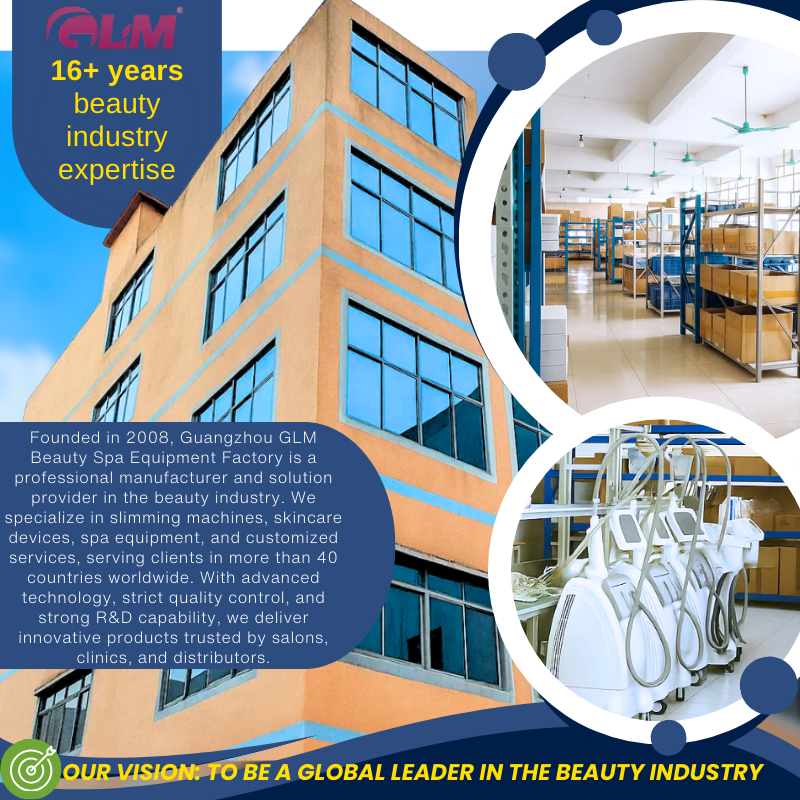
Founded in 2008, Guangzhou GLM Beauty Spa Equipment Factory specializes in research, development, manufacture and selling of beauty and slimming machines. Our production base is located in Guangzhou City, Guangdong Province, China. Since our foundation, we have introduced advanced technologies and equipment, to assure high quality and high performance of our products. With professional marketing guide and excellent after-sales service, our products have been exported to over 20 countries and regions, including Southeast Asia, the Middle East, Europe and the United States, won worldwide praises and gained a good reputation