
Introduction
Healthy-looking hair does not begin with the hair shaft alone. It begins with the scalp.
For professional salons, head spas, scalp-care centers, and aesthetic clinics, this is becoming increasingly important. Clients are asking more detailed questions about oily scalps, dryness, dandruff, thinning hair, sensitivity, and changes in hair density. At the same time, they increasingly expect personalized treatments rather than one-size-fits-all hair-care routines.
This is where scalp analysis technology and professional hair-care devices can work together.
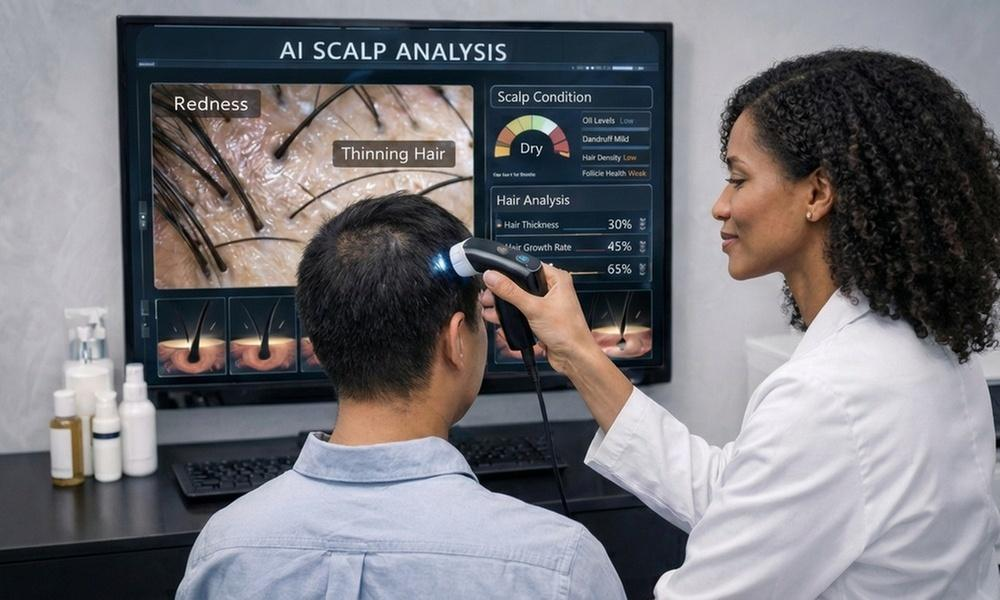
A scalp analyzer can provide a closer visual assessment of the scalp and hair, helping professionals identify conditions that may not be obvious during a normal consultation. Hair-care devices can then be selected according to the client's individual needs, creating a more structured treatment process.
The concept is simple: analyze first, treat second, and monitor continuously.
Modern professional scalp analysis systems may use high-resolution imaging, magnification, specialized lighting, digital image processing, and AI-assisted analysis. Leading professional hair-care platforms are already combining diagnostic imaging with personalized treatment recommendations, demonstrating the industry's shift toward more data-driven scalp care.
For beauty businesses, this approach is not simply about adding another machine to the treatment room. It is about building a more professional service workflow in which technology supports consultation, treatment selection, client education, and progress tracking.
Background: Why Scalp Analysis Should Come Before Treatment
Traditional scalp consultations often rely on three things: visual observation, client descriptions, and the operator's experience.
These methods remain valuable, but they have limitations.
A client may say that their scalp is oily, itchy, dry, or uncomfortable. Another client may be concerned about thinning hair. However, looking at the scalp under normal room lighting may not provide enough information to understand the distribution of scalp oil, visible buildup, flakes, follicular openings, or differences in hair density.
Magnified scalp imaging can provide a much closer view.
Professional scalp analysis systems can capture enlarged images of the scalp and hair, allowing operators to observe details that are difficult to evaluate with the naked eye. Depending on the system, imaging can help visualize features such as follicular openings, hair shafts, surface scaling, and other scalp characteristics.
This changes the consultation conversation.
Instead of simply telling a client, "Your scalp looks oily," a professional can show the client an enlarged image and explain what is visible. The same principle applies when discussing buildup, dryness, flakes, or apparent differences in hair density.
For professional salons, this visual communication can be particularly valuable because clients can better understand why a specific treatment or service is being recommended.
More importantly, analysis creates a starting point for treatment planning.
A scalp-care program should not automatically use the same device, intensity, duration, or treatment sequence for every client. The scalp condition, treatment objective, sensitivity, and professional assessment should all be considered.
This is why diagnosis and treatment technology are most effective when they are integrated rather than used separately.
Technology and Mechanism: How Scalp Analysis and Hair-Care Devices Work Together
The workflow can generally be divided into four stages:
Analyze → Plan → Treat → Monitor
1. Analyze: Make the Scalp More Visible
The first stage is obtaining detailed information.
A professional scalp analyzer typically combines a camera or optical probe with magnification and controlled illumination. More advanced systems may use multiple light modes to reveal different visual characteristics.
For example, white light can provide a clear view of the scalp surface and hair. Specialized illumination can make certain surface characteristics easier to observe. Some modern systems also use AI-assisted software to analyze captured images and organize information into measurable parameters.
Kérastase's K-SCAN, for example, uses 4K imaging and three light technologies, including UV, cross-polarized, and white light, to analyze aspects such as dandruff, porphyrin, fiber diameter, and root density.
The purpose of professional scalp analysis is not to replace professional judgment or medical diagnosis. Instead, it provides a more detailed visual reference that can support the operator's assessment and treatment decisions.
2. Plan: Match Treatment Technology to the Client
Once the scalp has been assessed, the operator can build a more appropriate treatment plan.
Different clients may require different approaches.
For a scalp with visible buildup, the priority may be professional cleansing and preparation.
For a dry or uncomfortable scalp, the treatment may focus more on hydration, soothing care, and gentle stimulation.
For clients concerned about hair density or the appearance of thinning, a professional may consider technologies designed to support scalp-care routines and hair-growth-oriented programs.
This is where the value of multifunctional professional beauty equipment becomes more apparent.
Instead of treating every client with the same protocol, operators can combine different technologies according to the purpose of the session.
3. Treat: Apply Professional Hair-Care Technologies
Professional hair-care devices can incorporate several technologies depending on the machine configuration.
One increasingly discussed option is low-level light therapy (LLLT) or photobiomodulation.
Research has investigated red and near-infrared light technologies for hair and scalp applications. A 2025 systematic review and meta-analysis covering 38 studies and more than 3,000 participants evaluated LLLT and LED therapy across several types of alopecia.
Another clinical study evaluated a helmet-style low-level light device over 24 weeks and reported improvements in hair density and thickness, together with reduced sebum secretion in the vertex area.
These findings do not mean that light therapy is appropriate for every client or that it should be presented as a universal solution. Professional operators still need to consider the individual's condition, contraindications, device specifications, treatment parameters, and applicable regulations.
Beyond light-based technology, professional scalp-care systems may also incorporate technologies such as thermal treatment, hydro spray, micro-massage, galvanic current, or other specialized treatment functions.
The objective is not to use as many technologies as possible. The objective is to use the right technology for the right treatment purpose.
4. Monitor: Compare Before and After
One of the most valuable advantages of digital scalp analysis is documentation.
After a treatment, the same scalp area can be photographed or analyzed again. Comparing images over multiple sessions can help operators evaluate visible changes and communicate progress with clients.
This creates a more complete service cycle:
Initial Analysis → Personalized Treatment → Follow-Up Analysis → Protocol Adjustment
Instead of treating scalp care as a single appointment, salons can turn it into a structured professional program.
Advantages: Why Combining Diagnosis and Devices Makes Sense
More Personalized Treatment
The most obvious advantage is personalization.
Without analysis, operators may rely heavily on general symptoms and client descriptions. With digital imaging, they have additional visual information to support their decisions.
This can make treatment protocols more targeted rather than based entirely on standardized routines.
Better Client Communication
Scalp conditions are often difficult for clients to understand because they cannot easily see them.
A magnified scalp image changes that.
When clients can see visible oil buildup, flakes, follicular areas, or differences between scalp regions, the consultation becomes more concrete.
This can also make professional recommendations easier to explain.
More Professional Service Experience
Technology can help transform scalp care from a simple cleansing service into a more structured professional experience.
A typical session might begin with analysis, continue with customized treatment, and finish with documentation or aftercare recommendations.
This workflow can support premium positioning for salons, head spas, and professional scalp-care centers.
Easier Progress Tracking
Digital images can create a visual reference for future appointments.
Rather than relying only on memory, the operator can compare images captured at different stages of a treatment program.
For long-term scalp-care services, this can help improve consistency and client engagement.
Greater Value from Professional Equipment
Professional equipment is particularly valuable when it is integrated into a complete service workflow.
A scalp analyzer provides information.
A treatment device provides a method of professional care.
The operator provides assessment, technique, parameter selection, and service expertise.
Together, these components create a stronger value proposition than any individual machine used independently.
Professional Equipment vs. Basic Home Hair-Care Tools
Home hair-care products and devices can be useful for routine maintenance, but professional environments have different requirements.
A salon or clinic needs equipment that can support repeated treatments, standardized workflows, client consultations, and professional documentation.
Professional systems may also offer larger displays, higher-quality imaging, multiple treatment modes, adjustable parameters, specialized handpieces, or integration with other treatment procedures, depending on the device.
The key difference is therefore not simply "professional machines are stronger."
It is that professional equipment is designed to become part of a professional treatment workflow.
For example, a home user may simply apply a light-based device according to a general routine. A professional operator can first analyze the scalp, document the starting condition, select a suitable treatment protocol, perform the session, and reassess the scalp over time.
That additional layer of assessment and management is what makes professional scalp-care technology particularly valuable.
Applications: Where Can This Combination Be Used?
1. Professional Hair Salons
Hair salons can integrate scalp analysis into consultations before washing, scalp treatments, or specialized hair-care programs.
The analyzer can become a consultation tool that helps stylists move beyond basic hair appearance and discuss scalp condition more professionally.
2. Head Spas and Scalp-Care Centers
Head spas are particularly well suited to this model.
A typical service can follow a structured sequence:
Scalp Analysis → Cleansing → Professional Device Treatment → Relaxation/Massage → Re-Analysis → Home-Care Guidance
This approach makes the experience more systematic while allowing different services to be customized according to the client's condition.
3. Aesthetic and Hair Clinics
Clinics may use scalp imaging as part of a broader hair and scalp assessment workflow.
For clients concerned about hair thinning or changes in density, imaging can provide useful visual documentation. However, when symptoms suggest an underlying medical condition, clients should be referred to an appropriately qualified medical professional rather than relying solely on beauty-device analysis.
4. Beauty Equipment Training and Demonstration
For beauty equipment manufacturers and distributors, scalp analysis can also be used as a demonstration tool.
Instead of explaining device functions only through technical specifications, a supplier can demonstrate a complete workflow:
Analyze the scalp → identify the treatment objective → demonstrate the device → document the session → compare results.
This allows buyers to understand not only what a machine does, but how it can be integrated into a commercial service.
Client Needs: Turning Data into a Better Treatment Experience
Modern clients increasingly want personalization.
They want to know:
- What is happening on my scalp?
- Why does my scalp become oily or flaky?
- Why does my hair appear thinner?
- Which professional treatment is suitable for me?
- How can I monitor changes over time?
A scalp analyzer can help answer the first questions visually. Professional hair-care devices can then become part of the treatment solution.
This creates an important shift in the customer experience.
Instead of:
"Here is a treatment we offer."
The conversation becomes:
"Here is what we observed, here is the treatment objective, and here is how we plan to address it."
That difference can have a significant impact on perceived professionalism.
It also supports service customization. A salon can develop different treatment programs around different client needs rather than offering one standardized scalp-care package.
Conclusion
The future of professional scalp care is not simply about adding more advanced machines. It is about connecting better analysis with better treatment decisions.
Scalp analysis technology provides a clearer view of the scalp and hair. Professional hair-care devices provide treatment technologies that can be incorporated into customized protocols. Operators connect the two through professional assessment, parameter selection, technique, and follow-up.
The result is a more complete service model:
Analyze first. Personalize the treatment. Document the process. Monitor the results.
For salons, head spas, scalp-care centers, and aesthetic clinics, this approach can improve consultation quality while creating a more technology-driven and professional client experience.
As AI, digital imaging, light-based technologies, and multifunctional beauty equipment continue to develop, the combination of scalp diagnostics and professional treatment devices is likely to become an increasingly important part of modern hair and scalp-care services.
The most effective technology is not necessarily the machine with the longest feature list. It is the technology that helps professionals understand the client better, deliver a more appropriate treatment, and build a consistent care journey from the first consultation to follow-up
Founded in 2008, Guangzhou GLM Beauty Spa Equipment Factory specializes in research, development, manufacture and selling of beauty and slimming machines. Our production base is located in Guangzhou City, Guangdong Province, China. Since our foundation, we have introduced advanced technologies and equipment, to assure high quality and high performance of our products. With professional marketing guide and excellent after-sales service, our products have been exported to over 20 countries and regions, including Southeast Asia, the Middle East, Europe and the United States, won worldwide praises and gained a good reputation