
Introduction
In professional aesthetic practice, skin tightening is rarely a one-dimensional problem. A client may present with mild skin laxity, reduced firmness, a less defined jawline, fine lines, or changes in overall skin quality at the same time. Treating only one layer may therefore leave part of the concern unaddressed.
This is where the combination of High-Intensity Focused Ultrasound (HIFU) and Radiofrequency (RF) becomes particularly interesting.
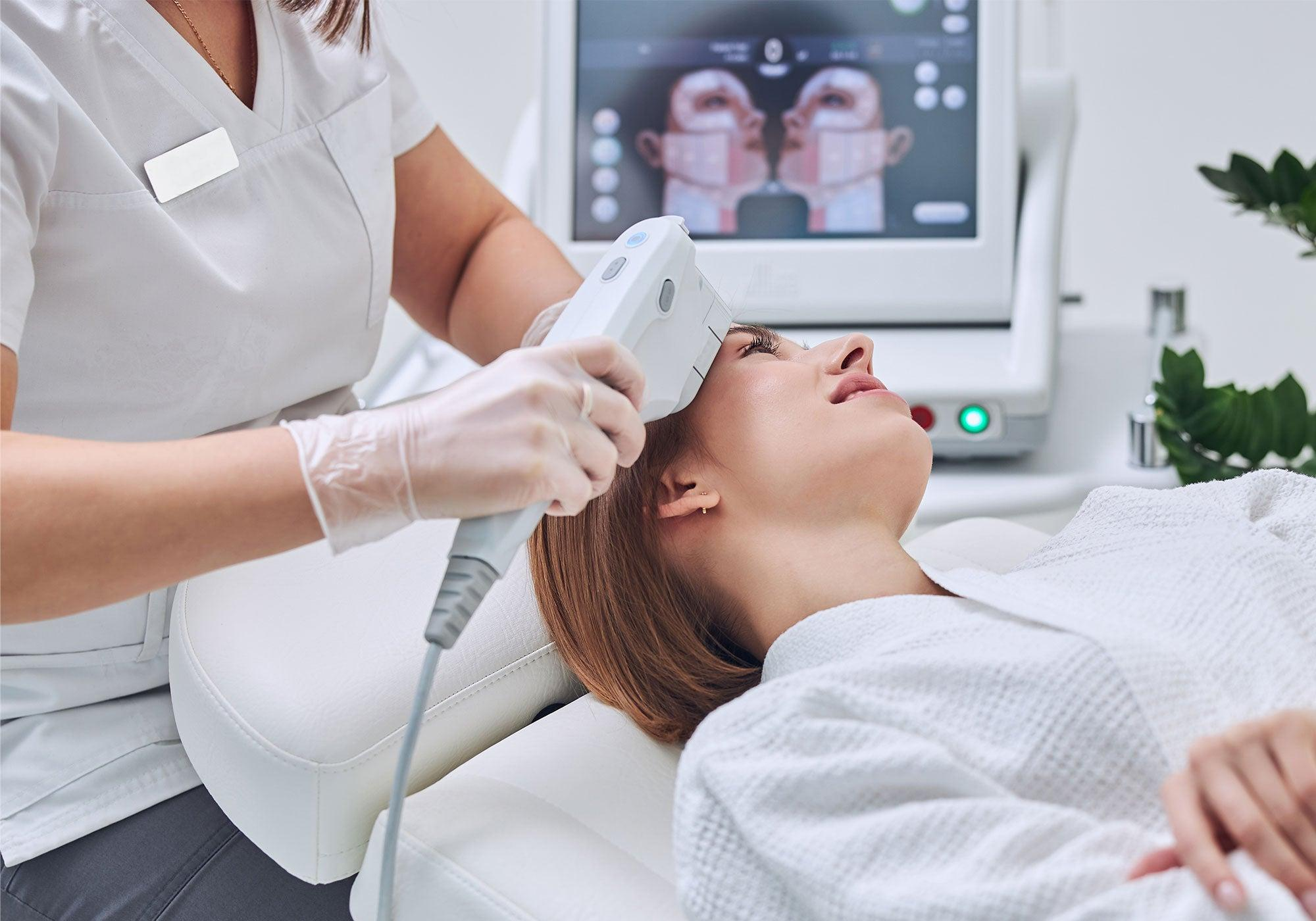
Rather than viewing HIFU and RF as competing technologies, professional practitioners can consider them as two different energy-based approaches that interact with tissue in different ways. HIFU uses focused ultrasound energy to create controlled thermal effects at selected depths, while RF generates heat within tissue through radiofrequency energy. Their delivery patterns, treatment depths, and clinical applications are not identical.
The concept behind a HIFU + RF protocol is therefore not simply “more energy.” It is a multilayer strategy: selecting the appropriate technology for the appropriate tissue target and designing a treatment plan around the client's anatomy, skin condition, treatment goals, and professional assessment.
For beauty clinics and aesthetic practices, this approach also creates greater flexibility. Instead of relying on one device for every tightening concern, practitioners can build treatment protocols around different layers of the skin and different stages of the client's aesthetic journey.
Background / Problem: Why One Treatment May Not Address Every Layer
Skin laxity develops through multiple structural changes. Collagen and elastin gradually decline, tissue becomes less resilient, and the relationship between the skin, dermis, subcutaneous tissue, and deeper supporting structures changes over time.
From a practitioner's perspective, however, not every client has the same problem.
One client may primarily need improvement in skin firmness and texture. Another may be more concerned about a softer jawline or visible sagging. A third may have both deeper laxity and reduced dermal quality.
This is why the common question, “Is HIFU better than RF?” can be misleading.
The more useful question is:
Which technology is better suited to the tissue layer and treatment objective?
HIFU and RF approach tissue differently. HIFU concentrates ultrasound energy at defined focal points, allowing practitioners to work at selected depths. RF, depending on the device configuration, produces broader volumetric heating within targeted tissue. Current aesthetic guidance increasingly emphasizes that these technologies have different roles rather than one universally superior option.
This distinction is important for professional clinics because treatment quality depends not only on the energy source but also on how appropriately that energy is delivered.
Technology / Mechanism
HIFU: Focused Energy for Deeper Structural Targeting
High-Intensity Focused Ultrasound uses ultrasound waves that converge at a selected focal point. Instead of broadly heating the entire tissue volume, the energy is concentrated at specific depths, producing controlled thermal zones.
Depending on the platform and treatment protocol, different cartridges or transducers may be designed for different depths. In aesthetic applications, HIFU is commonly associated with deeper tissue targeting and structural tightening, including treatment approaches directed toward deeper supportive layers.
The controlled thermal effect can stimulate a biological remodeling response. Existing collagen fibers may contract, while the subsequent healing and remodeling process can contribute to gradual changes in tissue firmness and structure.
Importantly, HIFU should not be interpreted as a surgical facelift. Professional results depend on device design, treatment parameters, patient anatomy, and practitioner technique. Results also develop progressively rather than appearing entirely immediately.
For practitioners, the main advantage of HIFU is therefore its ability to deliver focused energy to selected depths rather than simply heating the surface.
RF: Broad Thermal Stimulation for Dermal Quality
Radiofrequency takes a different approach.
RF energy produces heat within tissue through an electrical field. Depending on the type of RF technology—such as monopolar, bipolar, or multipolar RF—the energy distribution and depth can vary significantly.
Rather than creating discrete focal points in the same way as focused ultrasound, many RF systems are designed to create a broader zone of thermal stimulation within the dermis and surrounding tissue.
This makes RF particularly relevant when the treatment objective involves overall skin firmness, dermal quality, and surface-level rejuvenation. Professional RF platforms may also incorporate temperature monitoring, controlled energy delivery, cooling systems, and adjustable treatment parameters to improve consistency and treatment comfort.
The underlying principle is controlled thermal stimulation followed by collagen remodeling. However, a higher energy setting is not automatically a better setting. Recent professional commentary emphasizes that the appropriate thermal dose depends on tissue characteristics, treatment depth, duration, device configuration, and individual anatomy.
This is one reason professional equipment and trained operators remain important. The goal is not simply to maximize energy, but to deliver an appropriate and controlled treatment.
Why HIFU + RF Makes Sense as a Multilayer Strategy
The real value of combining HIFU and RF comes from their differences.
HIFU can provide focused treatment at selected deeper layers, while RF can provide broader thermal stimulation within the dermal region. In a carefully designed treatment plan, these different approaches may complement each other rather than duplicate the same function.
Think of the skin as a multilayer structure rather than a single surface.
HIFU = focused, deeper structural targeting
RF = broader dermal thermal stimulation
HIFU + RF = a multilayer treatment strategy
This does not mean that every client needs both technologies during the same session. In professional practice, the technologies may be used sequentially, in separate sessions, or as part of a longer-term maintenance program depending on the device, indication, treatment area, and practitioner assessment.
[Suggested Inline Illustration: HIFU + RF multilayer skin-treatment diagram]
A useful protocol may therefore begin with assessment rather than technology selection. The practitioner evaluates skin thickness, laxity, facial structure, treatment area, sensitivity, previous aesthetic procedures, and the client's desired outcome before deciding whether one modality or a combination is appropriate.
Advantages / Comparison
1. Different Energy Delivery Patterns
The most fundamental difference is how energy is delivered.
HIFU concentrates ultrasound energy into focal points at selected depths. RF generally creates a broader heating pattern within tissue.
For a clinic, this means the two technologies can offer different treatment options within the same skin-tightening category.
2. Different Treatment Objectives
HIFU is often selected when deeper structural tightening and lifting are the primary concerns.
RF is often selected when practitioners want to focus on dermal firmness, skin quality, and broader thermal stimulation.
Neither technology should automatically be considered superior. The appropriate choice depends on the client's anatomy and treatment objective.
3. Greater Protocol Flexibility
A clinic equipped with both technologies can create more flexible treatment pathways.
For example, a practitioner may use a deeper-focused modality for a client whose primary concern is facial laxity, while RF may become part of a skin-quality or maintenance strategy. Another client may benefit from a combination approach because both deeper laxity and dermal firmness are relevant concerns.
This flexibility can also help clinics develop treatment programs rather than selling isolated procedures.
4. Professional Equipment Enables More Controlled Treatment
The difference between professional and home-use equipment is not simply the size of the machine.
Professional platforms are designed around controlled energy delivery, applicator selection, treatment parameters, operator technique, and treatment-area management. Depending on the system, professional equipment may offer multiple treatment modes, adjustable parameters, temperature control, cooling, interchangeable handpieces, or different cartridges.
Home devices may be convenient for maintenance-oriented use, but they generally operate within a different performance and treatment framework.
For professional clinics, the greater value lies in the ability to assess the client and adapt the protocol rather than applying the same setting to everyone.
5. A More Complete Consultation Conversation
HIFU + RF also gives practitioners a better framework for explaining treatment.
Instead of telling clients that one technology is “stronger,” the practitioner can explain that different technologies address different tissue characteristics.
This makes the consultation more educational and realistic:
- What is the primary concern?
- Which tissue layer is most relevant?
- Is the goal lifting, firming, skin-quality improvement, or maintenance?
- Which technology is appropriate for the treatment area?
- Should treatments be performed together or separately?
- What results can reasonably be expected over time?
This approach supports responsible aesthetic practice while helping clients understand why a professional treatment plan may contain more than one technology.
Applications / Client Needs
Facial Firming and Contouring
For clients concerned about a less defined jawline, mild-to-moderate laxity, or changes in facial firmness, HIFU and RF may have complementary roles.
A practitioner can assess whether the dominant concern is deeper structural laxity, dermal looseness, or a combination of both. HIFU may be considered for deeper targeted treatment, while RF may be incorporated when broader dermal tightening and skin-quality support are relevant.
The exact treatment sequence should always follow the specifications of the equipment and professional assessment.
Neck and Lower-Face Treatments
The neck and lower face require particularly careful treatment planning because tissue thickness and anatomical structures vary considerably.
A professional operator can adjust the treatment strategy according to the area instead of treating the entire face uniformly.
This is where a multilayer concept becomes valuable. Different areas may require different depths, energy distribution, treatment passes, or treatment intervals.
Mature-Skin Programs
For mature clients, the objective may not be a dramatic lifting effect alone. They may also want improved firmness, smoother-looking skin, and a more refined overall appearance.
In these cases, clinics can consider HIFU and RF as components of a broader aesthetic maintenance program.
The emphasis should remain on gradual improvement and realistic expectations. Energy-based treatments stimulate remodeling processes that develop over time rather than producing the same result as surgical repositioning.
Customized Professional Treatment Plans
One of the strongest applications of a HIFU + RF platform strategy is customization.
Professional clients increasingly expect treatments to be adapted to their individual concerns rather than receiving a standardized procedure.
A clinic may therefore design different pathways:
Deep-laxity focused: HIFU-centered treatment plan.
Dermal-firmness focused: RF-centered treatment plan.
Multilayer concern: HIFU + RF used as complementary modalities.
Maintenance: RF or another suitable modality incorporated according to the client's response and treatment schedule.
This approach can also make equipment investment more practical for clinics because different technologies can serve different client needs rather than competing for exactly the same indication.
Conclusion
HIFU + RF should not be understood simply as “two technologies are better than one.”
The stronger concept is complementary multilayer treatment.
HIFU and RF use different forms of energy and distribute that energy differently. HIFU can focus energy at selected depths for deeper structural treatment, while RF can provide broader thermal stimulation within the dermal region. Their differences create an opportunity for professional practitioners to design more individualized treatment strategies.
For beauty salons, aesthetic clinics, and professional treatment centers, this means moving away from a technology-versus-technology mindset.
The question is not simply whether HIFU or RF is the better machine.
The more professional question is:
Which technology, at which depth, for which client, and for which treatment objective?
When equipment capabilities, treatment parameters, anatomical assessment, and operator expertise are brought together, HIFU and RF can become complementary tools within a broader skin-tightening and aesthetic treatment portfolio.
For equipment manufacturers and professional beauty-equipment suppliers, this multilayer approach also highlights an important product value: modern aesthetic equipment is not only about delivering energy. It is about giving professional operators the flexibility, control, and treatment options needed to build customized protocols for different clients and different clinical goals.
Ultimately, the value of HIFU + RF lies not in using more energy, but in using the right technology for the right layer and the right treatment objective
Founded in 2008, Guangzhou GLM Beauty Spa Equipment Factory specializes in research, development, manufacture and selling of beauty and slimming machines. Our production base is located in Guangzhou City, Guangdong Province, China. Since our foundation, we have introduced advanced technologies and equipment, to assure high quality and high performance of our products. With professional marketing guide and excellent after-sales service, our products have been exported to over 20 countries and regions, including Southeast Asia, the Middle East, Europe and the United States, won worldwide praises and gained a good reputation
