
Introduction
Fuller, better-defined lips have become an important part of modern facial aesthetics. However, lip enhancement is no longer simply about adding as much volume as possible. Many clients now prefer subtle definition, balanced proportions, a natural-looking smile, and results that complement the rest of the face.
This shift has made two professional aesthetic options particularly relevant: the lip flip and lip filler. Although both can make the lips appear fuller, they work in fundamentally different ways. A lip flip uses a neuromodulator to temporarily relax selected muscles around the upper lip, while lip filler physically adds volume to the lips, most commonly using hyaluronic acid-based dermal filler.
For aesthetic clinics and professional beauty practices, understanding this difference is essential. The right treatment is not simply determined by the desire for "bigger lips." Instead, practitioners need to evaluate lip anatomy, muscle activity, existing volume, facial proportions, smile dynamics, and the client's desired outcome.
Professional treatment equipment also has an important supporting role. Although aesthetic devices do not replace injectable treatments, technologies used for skin preparation, cooling, cleansing, visualization, comfort management, and post-treatment care can help clinics create a more controlled and professional treatment experience.
Background: Why Lip Enhancement Is Not One-Size-Fits-All
Clients seeking lip enhancement may have very different concerns.
Some may naturally have thin lips and want additional volume. Others may already have adequate lip volume but feel that their upper lip rolls inward when smiling. Some clients may want a more defined Cupid's bow, while others are primarily concerned with vertical lip lines or a gummy smile.
These differences matter because adding filler is not always the only way to create the appearance of fuller lips.
A lip flip can make the upper lip appear more visible by relaxing the muscle around the upper lip and allowing the vermilion to turn slightly outward. Importantly, it does not actually add physical volume to the lip.
Lip filler works differently. Dermal filler, commonly based on hyaluronic acid, is injected directly into strategic areas of the lips to increase volume and improve shape or definition. The result can therefore be more structurally customizable than a lip flip.
This distinction gives professional practitioners more than one pathway for addressing lip concerns.
Technology and Mechanism: How Does a Lip Flip Work?
A lip flip is generally performed using a neuromodulator such as botulinum toxin. The practitioner places a small amount of product into carefully selected muscles around the upper lip.
The goal is not to enlarge the lip by adding material. Instead, the treatment temporarily reduces muscle activity. The upper lip can then rotate or "flip" slightly outward, exposing more of the vermilion and creating a fuller visual appearance.
One important muscle involved in this process is the orbicularis oris, which contributes to lip pursing and movement. When selected muscle activity is reduced, the upper lip may appear less tucked inward, particularly during smiling.
This mechanism can be useful for clients who already have reasonable lip volume but lose visible upper-lip fullness when they smile.
The result is generally subtle. A lip flip is therefore better understood as a shape and exposure treatment rather than a true volume-enhancement treatment.
Results are temporary. Cleveland Clinic notes that a lip flip commonly lasts around two to five months, while the American Society of Plastic Surgeons has described results lasting approximately 10 to 12 weeks in some patients. Individual outcomes vary depending on treatment technique, anatomy, and the patient's response.
Technology and Mechanism: How Does Lip Filler Work?
Lip filler takes a fundamentally different approach.
Instead of modifying muscle activity, dermal filler is injected into specific areas of the lips. Hyaluronic acid is one of the most commonly used materials because it can provide volume while interacting with water within the tissue.
Professional injectors can place filler strategically to address different aesthetic objectives, such as:
- Increasing overall lip volume
- Defining the vermilion border
- Enhancing the Cupid's bow
- Improving upper-to-lower lip proportions
- Restoring volume lost with age
- Creating more visible lip projection
Because filler physically adds material, the practitioner has greater control over where additional volume is introduced.
According to the American Academy of Dermatology, hyaluronic acid fillers generally provide immediate results, although swelling and other temporary treatment effects can affect the appearance during the early recovery period.
For clinics, this makes lip filler particularly relevant when a client's primary concern is genuine loss of lip volume rather than muscle-driven lip inversion.
Lip Flip vs. Lip Filler: Key Differences
The easiest way to understand the difference is to consider what each treatment changes.
| Treatment | Primary Mechanism | Main Purpose | Adds Actual Volume? | Typical Result |
|---|---|---|---|---|
| Lip Flip | Temporarily relaxes selected muscles | Turns the upper lip slightly outward | No | Subtle increase in visible lip area |
| Lip Filler | Adds dermal filler to the lip | Adds volume and definition | Yes | More customizable volume and contour |
A lip flip may be considered when a client says, "I like my lips, but my upper lip disappears when I smile."
A filler treatment may be more relevant when the client says, "My lips are too thin and I want more volume."
There can also be situations where a qualified medical practitioner considers combining approaches. The appropriate treatment plan depends on the individual's anatomy, goals, medical history, and professional assessment.
Advantages and Comparison
The Advantages of a Lip Flip
One of the main attractions of a lip flip is its ability to create a subtle enhancement without physically increasing lip volume.
This can appeal to clients who prefer a conservative aesthetic result or who are concerned about an overly augmented appearance.
A lip flip may also be considered for certain clients whose upper lip becomes less visible during smiling. By modifying muscle activity, the treatment can change how the upper lip sits rather than simply increasing its size.
However, the limitations should also be explained clearly. Because a lip flip does not add volume, it cannot provide the same volumizing effect as dermal filler. Excessive muscle relaxation may also temporarily affect activities such as drinking through a straw, speaking, or maintaining a normal lip seal.
The Advantages of Lip Filler
Lip filler provides a more direct approach to volume enhancement.
For clients with naturally thin lips or age-related volume loss, filler can restore fullness while allowing practitioners to work on specific areas of the lip.
Modern treatment planning increasingly emphasizes proportion rather than simply increasing size. A conservative injection strategy can help create results that fit the client's facial structure.
The American Academy of Dermatology emphasizes that natural-looking filler results depend significantly on the injector's knowledge, training, and technique.
At the same time, filler is a medical procedure and should be performed by appropriately qualified professionals in an appropriate clinical setting. The AAD specifically advises against receiving filler injections in non-medical settings such as salons, parties, or homes.
Why Professional Equipment Still Matters
When discussing injectable aesthetics, equipment should not be presented as a replacement for trained injectors.
Instead, professional aesthetic equipment can support the overall treatment workflow.
For example, skin analysis systems can help practitioners document skin condition and treatment areas before a procedure. Professional cleansing equipment can support hygienic skin preparation according to the clinic's protocols. Cooling devices can also be incorporated into appropriate treatment workflows when indicated to improve patient comfort.
In addition, professional clinics may use specialized lighting, magnification, photography systems, and digital skin-analysis technologies to document treatment areas and compare progress over time.
These technologies contribute to a more standardized service process.
For manufacturers of professional beauty equipment, this creates an important opportunity: the value of a device is not necessarily limited to one treatment. A well-designed system can become part of a clinic's broader consultation, preparation, treatment, documentation, and aftercare workflow.
Applications and Client Needs
For Clients Wanting a Subtle Enhancement
A lip flip may be discussed when the client wants the upper lip to appear slightly more visible without significantly increasing its physical volume.
This can be particularly relevant for clients who prefer a conservative aesthetic style.
For Clients Seeking Noticeable Volume
Lip filler may be more appropriate when the primary objective is to increase actual lip volume.
Professional injectors can evaluate the upper and lower lips together and determine where additional volume may improve facial balance.
For Clients Concerned About Their Smile
Some clients may notice that their upper lip appears to roll inward when they smile. A lip flip can sometimes be considered in these cases because its mechanism focuses on muscle activity around the upper lip.
However, not every smile pattern is suitable for this approach. A detailed assessment should come before treatment.
For Mature Clients Experiencing Volume Loss
Age-related changes can affect lip volume, definition, and surrounding skin.
In these cases, filler may address volume loss more directly, while other professional aesthetic technologies can support the surrounding skin-care strategy.
Depending on the clinic's service portfolio, treatments such as professional cleansing, hydration, skin analysis, LED-based procedures, or other non-invasive technologies may be incorporated into broader facial treatment programs.
The key is to match each technology to its actual function rather than presenting one device as a universal solution.
Building a Professional Lip Enhancement Workflow
A modern aesthetic clinic can approach lip enhancement as a complete client journey rather than a single injection.
The workflow may include:
1. Consultation and Facial Assessment
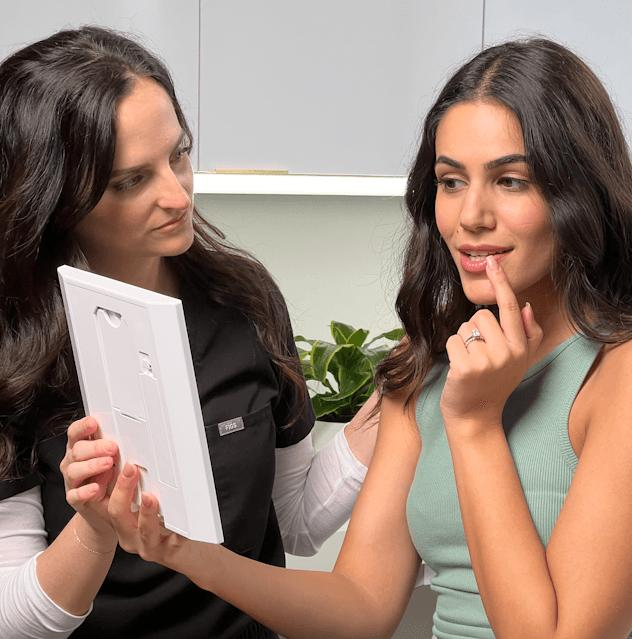
Evaluate lip proportions, symmetry, muscle movement, smile dynamics, skin condition, and the client's expectations.
2. Treatment Planning
Determine whether the client's concern is primarily related to volume, shape, muscle activity, or a combination of factors.
3. Skin Preparation
Professional cleansing and appropriate preparation help establish a controlled treatment environment according to clinic protocols.
4. Injectable Treatment
A qualified medical professional performs the selected injectable treatment using appropriate products, techniques, and safety procedures.
5. Comfort Management
Depending on the treatment and clinic protocol, appropriate cooling, topical anesthetic, or other comfort measures may be considered.
6. Documentation and Follow-Up
Professional photography and digital analysis can help clinics document baseline appearance and monitor changes during follow-up visits.
This workflow demonstrates why professional equipment has value beyond a single machine function. A clinic's technology portfolio can support consistency, client communication, treatment documentation, and service quality across multiple aesthetic procedures.
Safety and Professional Practice
Lip enhancement should never be treated as a simple beauty-service procedure.
Both neuromodulator injections and dermal filler injections require appropriate professional knowledge and patient assessment. Filler injections carry potential complications, including swelling, bruising, infection, lumps, and, in rare cases, vascular complications.
Clients should also be cautious about so-called "needle-free filler" devices. The American Academy of Dermatology and FDA have warned about serious injuries associated with needle-free filler devices, including tissue damage and vascular complications.
For professional clinics, this reinforces an important principle: technology should support qualified treatment—not replace professional medical judgment.
Equipment used around injectable treatments should therefore be selected according to its intended function, technical specifications, regulatory requirements, and the clinic's professional protocols.
Conclusion
Lip flip and lip filler are not competing treatments in the simplest sense. They address different aspects of lip appearance.
A lip flip primarily changes the position and visibility of the upper lip by temporarily reducing selected muscle activity. Lip filler directly adds volume and can provide more extensive control over lip shape, projection, and definition.
For professional aesthetic clinics, the key is individualized treatment planning. Instead of asking which procedure is universally better, practitioners can first identify what the client actually wants to change: volume, definition, projection, upper-lip visibility, or smile dynamics.
At the same time, professional aesthetic equipment can strengthen the surrounding treatment workflow through skin analysis, preparation, comfort management, documentation, and aftercare.
As aesthetic preferences continue moving toward personalized and natural-looking results, the combination of qualified practitioners, carefully selected injectable techniques, and professional technology can help clinics build more structured and comprehensive lip-enhancement services.
The goal is not simply to create bigger lips. It is to create a treatment plan that fits the client's anatomy, expectations, and overall facial aesthetics
Founded in 2008, Guangzhou GLM Beauty Spa Equipment Factory specializes in research, development, manufacture and selling of beauty and slimming machines. Our production base is located in Guangzhou City, Guangdong Province, China. Since our foundation, we have introduced advanced technologies and equipment, to assure high quality and high performance of our products. With professional marketing guide and excellent after-sales service, our products have been exported to over 20 countries and regions, including Southeast Asia, the Middle East, Europe and the United States, won worldwide praises and gained a good reputation