
Introduction
The under-eye area is one of the first facial regions to reveal changes in volume, skin quality, and facial structure. Even relatively mild hollowing can create shadows beneath the eyes, making a person appear tired, stressed, or older than they actually are. For clients seeking a refreshed appearance without surgery, tear trough fillers have become an important option in modern aesthetic clinics.
However, treating the tear trough is not simply a matter of adding volume beneath the eyes. The periorbital region contains thin skin, delicate soft tissues, ligaments, muscles, fat compartments, and important vascular structures. As a result, natural-looking correction depends on accurate assessment, appropriate patient selection, suitable filler characteristics, and highly controlled treatment by a qualified medical professional. Recent literature continues to emphasize anatomy-based planning and individualized treatment rather than a one-size-fits-all injection approach.
For professional beauty clinics and aesthetic practices, technology can support this process before and after treatment. Digital skin analysis, facial imaging, magnification, professional lighting, cooling systems, and other clinical equipment can help practitioners document skin condition, evaluate visible concerns, improve consultation quality, and support a more comprehensive facial rejuvenation workflow.
The goal is not to make the under-eye area look “filled.” The goal is to make the transition between the lower eyelid and cheek appear smoother while maintaining the patient's natural facial expression.
Background / Problem: Why Do Tear Troughs Create a Tired Appearance?
A tear trough is a depression located in the transition between the lower eyelid and cheek. Although it is often associated with aging, under-eye hollowing can appear at different ages and may be influenced by genetics, facial anatomy, changes in soft-tissue volume, skin thinning, and the structure of the midface.
As facial tissues change over time, the relationship between the lower eyelid, orbital rim, cheek fat compartments, and surrounding structures can become more pronounced. Reduced soft-tissue support may deepen an existing depression, while changes in skin thickness can make shadows and underlying structures more visible.
This is why “dark circles” should not automatically be interpreted as a filler problem.
Under-eye darkness may result from several different factors, including:
- Structural hollowing and shadowing
- Skin pigmentation
- Visible vascular structures
- Thin or translucent skin
- Fine lines and wrinkles
- Lower-eyelid fat prominence
- Malar bags or festoons
- Midface volume loss
A filler may improve the shadow created by a structural hollow, but it cannot correct every cause of under-eye discoloration or puffiness. Patients with prominent fat protrusion, significant skin laxity, persistent edema, or certain types of pigmentation may require a different or multimodal treatment strategy.
This distinction is extremely important for professional clinics. A sophisticated treatment plan begins with diagnosis rather than immediately selecting a product.
The Importance of Professional Assessment
Before treatment, practitioners should evaluate facial symmetry, skin quality, the degree of hollowing, adjacent midface volume, previous filler treatments, medical history, and the patient's expectations.
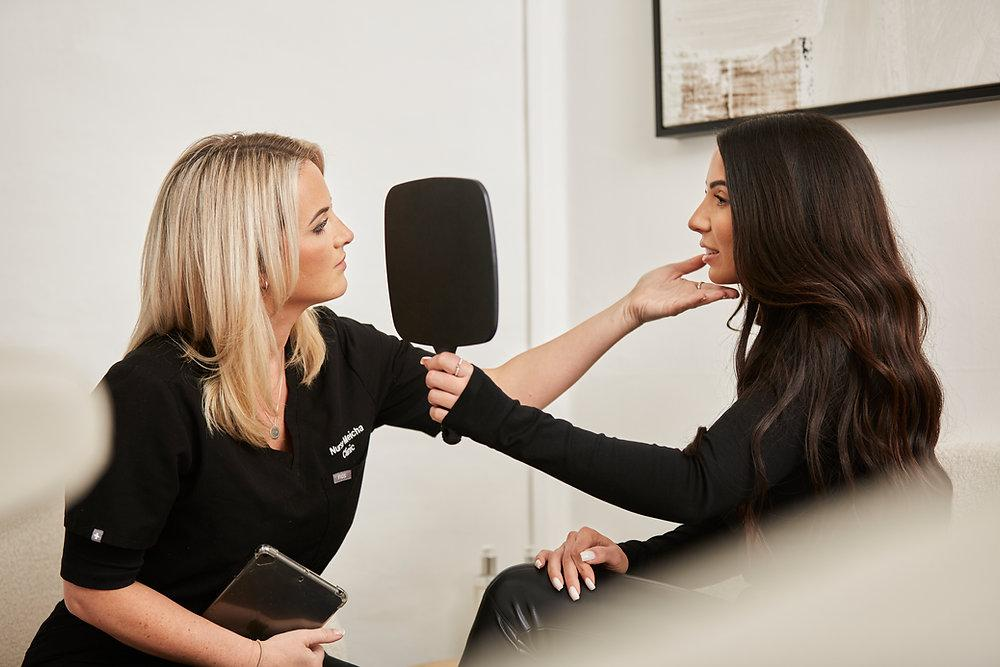
Photography under consistent lighting can help establish a baseline and make subtle changes easier to evaluate over time. Modern aesthetic clinics can further enhance consultation workflows with professional imaging and skin-analysis equipment.
[Inline Image Recommendation — Place Here]
Suggested visual: A professional aesthetic clinic consultation showing a practitioner using a facial imaging or skin-analysis device to evaluate the under-eye and midface area. Include a clean digital facial map or side-by-side assessment screen, with the patient seated in a clinical setting.
This type of technology does not replace anatomical knowledge or clinical judgment. Instead, it helps create a more systematic consultation process and provides visual documentation that can support communication between practitioner and client.
Technology / Mechanism: How Do Tear Trough Fillers Work?
Hyaluronic acid (HA) fillers are widely used for appropriate cases of infraorbital hollowing because they can restore lost or reduced soft-tissue volume and soften the transition between the lower eyelid and cheek. Research has shown that HA fillers can provide effective improvement in selected patients when treatment is appropriately planned.
The principle is relatively straightforward: instead of attempting to change the color of the under-eye area directly, the practitioner addresses the structural depression responsible for part of the visible shadow.
When the contour becomes smoother, light can reflect more evenly across the lower eyelid-cheek transition. This can create the visual impression of a brighter and more rested appearance.
However, the mechanism behind a natural result is much more sophisticated than simply adding volume.
Precision Starts Before the Injection
The latest clinical literature emphasizes that patient assessment should consider at least three major factors:
- The quantity and distribution of soft tissue in the midface and infraorbital area
- The quality of the infraorbital skin
- The severity and anatomical characteristics of the hollow
In some patients, correcting adjacent midface volume loss may improve the appearance of the lower eyelid-cheek junction and reduce the need for direct infraorbital correction. This reinforces an important principle in modern facial aesthetics: the treatment area should not always be considered in isolation.
Why Filler Selection Matters
The under-eye area moves naturally with facial expression, blinking, smiling, and changes in facial position. Therefore, filler characteristics matter.
A 2025 review highlighted the importance of choosing an HA filler that is smooth, malleable, adaptable during facial movement, and relatively limited in water absorption for this delicate anatomical area.
This is one reason professional injectors do not necessarily use the same filler product or treatment philosophy for every facial region.
The objective is controlled correction rather than maximum volume.
Precision Is More Than Needle or Cannula Choice
There is ongoing discussion about whether needles or cannulas are preferable for different tear trough techniques. A systematic review found no statistically significant difference in reported aesthetic outcomes, satisfaction, or adverse events between the needle- and cannula-based literature reviewed, indicating that technique should be selected according to anatomy, practitioner experience, and clinical circumstances rather than treating one instrument as universally superior.
The most important factor is therefore not the device alone. It is the combination of anatomical knowledge, product selection, controlled placement, patient selection, and the ability to recognize when filler is not the appropriate solution.
Advantages / Comparison: Why Professional Precision Matters
1. Natural-Looking Volume Restoration
A successful tear trough treatment should not create an obvious “filled” appearance. Instead, it should soften the transition between the lower eyelid and cheek.
The best result is often subtle: the client still looks like themselves, but the face appears more balanced and less fatigued.
This is particularly important in the eye area because even small contour changes can influence facial expression.
2. Individualized Treatment Instead of Standardized Volume
Different patients have different causes of under-eye hollowing. One client may primarily have structural volume loss, while another may have pigmentation, thin skin, or lower-eyelid fat prominence.
Professional assessment allows the practitioner to determine whether filler alone is appropriate or whether another treatment—or a combination approach—should be considered.
3. Technology-Assisted Consultation
Professional aesthetic equipment can add value before the injection begins.
Advanced skin-analysis systems can help practitioners document factors such as visible pigmentation, texture, skin condition, and asymmetry. High-quality photography and imaging can also establish consistent before-and-after records.
For clinics, this creates a more professional consultation experience while helping clients understand why their treatment plan may differ from someone else's.
4. Better Integration With Other Aesthetic Services
Under-eye rejuvenation is increasingly viewed as part of an overall facial treatment strategy rather than an isolated procedure.
Depending on the patient's condition and the clinic's scope of practice, professional treatments may include skin-quality management, energy-based treatments for appropriate concerns, phototherapy, cooling or soothing protocols, and other non-invasive services.
These technologies do not replace filler when structural volume correction is required. Instead, they can address different aspects of the aesthetic concern.
For example, a client may have both structural shadowing and superficial skin-quality concerns. Filler may address the structural component, while appropriate professional skin treatments may target texture or pigmentation.
This multimodal approach can be more logical than expecting one treatment to solve every under-eye concern.
5. Professional Equipment Versus Home Devices
Home beauty devices are increasingly popular for basic skincare and maintenance. However, the role of professional equipment in an aesthetic clinic is different.
Professional systems are designed for controlled clinical workflows, standardized assessment, adjustable treatment parameters, documentation, and use by trained operators. In a tear trough treatment pathway, their greatest value may occur around the injectable procedure rather than replacing the injection itself.
A professional clinic can combine consultation technology, imaging, skin analysis, treatment equipment, hygiene protocols, and medical expertise into one coordinated service.
That integrated workflow is difficult to reproduce with a consumer device at home.
Applications / Client Needs: Building a Professional Tear Trough Treatment Workflow
For aesthetic clinics, a high-quality tear trough service can be organized around several stages.
Stage 1: Consultation and Assessment
The first objective is to determine what the client actually wants to improve.
The practitioner can evaluate:
- Under-eye hollow depth
- Facial symmetry
- Midface volume
- Skin thickness and quality
- Pigmentation
- Fine lines
- Puffiness or fat prominence
- Previous filler history
- Patient expectations
Standardized photography and professional imaging can support this stage.
The consultation should also explain the limitations of filler. If the primary concern is pigmentation, prominent fat pads, severe laxity, or another condition that is not primarily caused by hollowing, filler may not be the most appropriate first-line solution.
Stage 2: Personalized Treatment Planning
Once the underlying concern has been identified, the practitioner can determine whether the patient is a suitable candidate for tear trough filler.
The concept of “less is more” is particularly relevant in this region. The objective is not to completely eliminate every natural contour but to create a smoother transition while maintaining facial movement and proportion.
Recent clinical guidance emphasizes careful patient selection and conservative correction because excessive or poorly positioned filler can create visible irregularities or unwanted swelling.
Stage 3: Professional Injection
The actual injection should be performed only by an appropriately trained and qualified medical professional operating within applicable regulations.
The periorbital region contains important vascular and anatomical structures. Potential complications include bruising, swelling, malar or lower-eyelid edema, contour irregularities, vascular occlusion, and, rarely, serious complications such as skin necrosis or vision loss.
This is why professional experience and emergency preparedness are essential components of the treatment environment.
The purpose of technology is to support this clinical process—not to substitute for it.
Stage 4: Post-Treatment Observation and Skin Management
After an injectable treatment, clinics can use appropriate professional comfort and skin-management protocols according to the practitioner's assessment.
Cooling equipment, gentle soothing procedures, professional skincare systems, and documentation tools may help clinics create a more complete post-treatment experience when clinically appropriate.
Follow-up photography can also help practitioners evaluate the evolution of the result rather than judging the final outcome immediately after treatment.
Stage 5: Long-Term Facial Rejuvenation
A tear trough consultation can also become the starting point for a broader facial rejuvenation plan.
For example, a clinic may identify that the client's primary concern involves a combination of:
- Midface volume changes
- Skin laxity
- Fine lines
- Pigmentation
- Texture changes
- Under-eye hollowing
Instead of over-treating the tear trough itself, the practitioner can develop a staged plan that addresses each concern with the most appropriate modality.
This approach aligns with the direction of modern aesthetic medicine: personalized treatment based on anatomy, skin condition, and the interaction between different facial areas.
Conclusion
Tear trough fillers can be an effective option for carefully selected clients with under-eye hollowing, but natural-looking results depend on much more than the filler itself.
The key is precision at every stage—from diagnosis and patient selection to product choice, treatment planning, injection technique, documentation, and follow-up.
Current evidence emphasizes the complex anatomy of the infraorbital region and the importance of individualized assessment. HA fillers may restore volume and soften structural shadows, while professional imaging and skin-analysis technologies can support a more comprehensive consultation and treatment workflow.
For professional beauty clinics and aesthetic practices, the future of under-eye rejuvenation is not simply about adding more product. It is about understanding the face as an interconnected structure and choosing the right technology, treatment modality, and level of correction for each individual.
The most convincing result is often the one that does not look “treated.” The client simply looks fresher, more balanced, and more naturally rested.
Important note: Tear trough filler is a medical aesthetic procedure and should only be performed by appropriately qualified professionals according to local regulations. This article is intended for professional education and marketing communication and does not replace clinical training or medical advice
Founded in 2008, Guangzhou GLM Beauty Spa Equipment Factory specializes in research, development, manufacture and selling of beauty and slimming machines. Our production base is located in Guangzhou City, Guangdong Province, China. Since our foundation, we have introduced advanced technologies and equipment, to assure high quality and high performance of our products. With professional marketing guide and excellent after-sales service, our products have been exported to over 20 countries and regions, including Southeast Asia, the Middle East, Europe and the United States, won worldwide praises and gained a good reputation