
Introduction
Professional beauty treatments are becoming increasingly focused on one key goal: delivering visible skin improvements with greater comfort, minimal downtime, and more personalized care. As clinics and aesthetic salons expand their treatment menus, advanced treatment-room tools are playing a more important role in helping professionals meet these expectations.
Among the technologies gaining attention is nano infusion, a professional treatment designed to enhance the delivery of carefully selected skincare formulations while supporting a smoother, more hydrated, and refreshed appearance.
Nano infusion is sometimes grouped together with microneedling or referred to as “nano needling,” but the technologies are not interchangeable. Professional nano infusion devices are generally designed to work at the skin's superficial barrier rather than targeting the deeper dermis like traditional microneedling. The treatment therefore occupies a different position within a professional aesthetic menu.
For beauty clinics and professional salons, the appeal goes beyond the treatment itself. A well-designed nano infusion device can become part of a broader facial protocol, helping practitioners combine device technology, professional-grade formulations, hydration, and finishing treatments into a more complete client experience.
Background: Why Nano Infusion Is Becoming a Treatment-Room Trend
The modern aesthetic client often wants results without a lengthy recovery period. Stronger procedures can provide significant skin improvements, but not every client is comfortable with needles, visible redness, or extended downtime.
This has created a growing space for low-downtime technologies that can be incorporated into professional facial services.
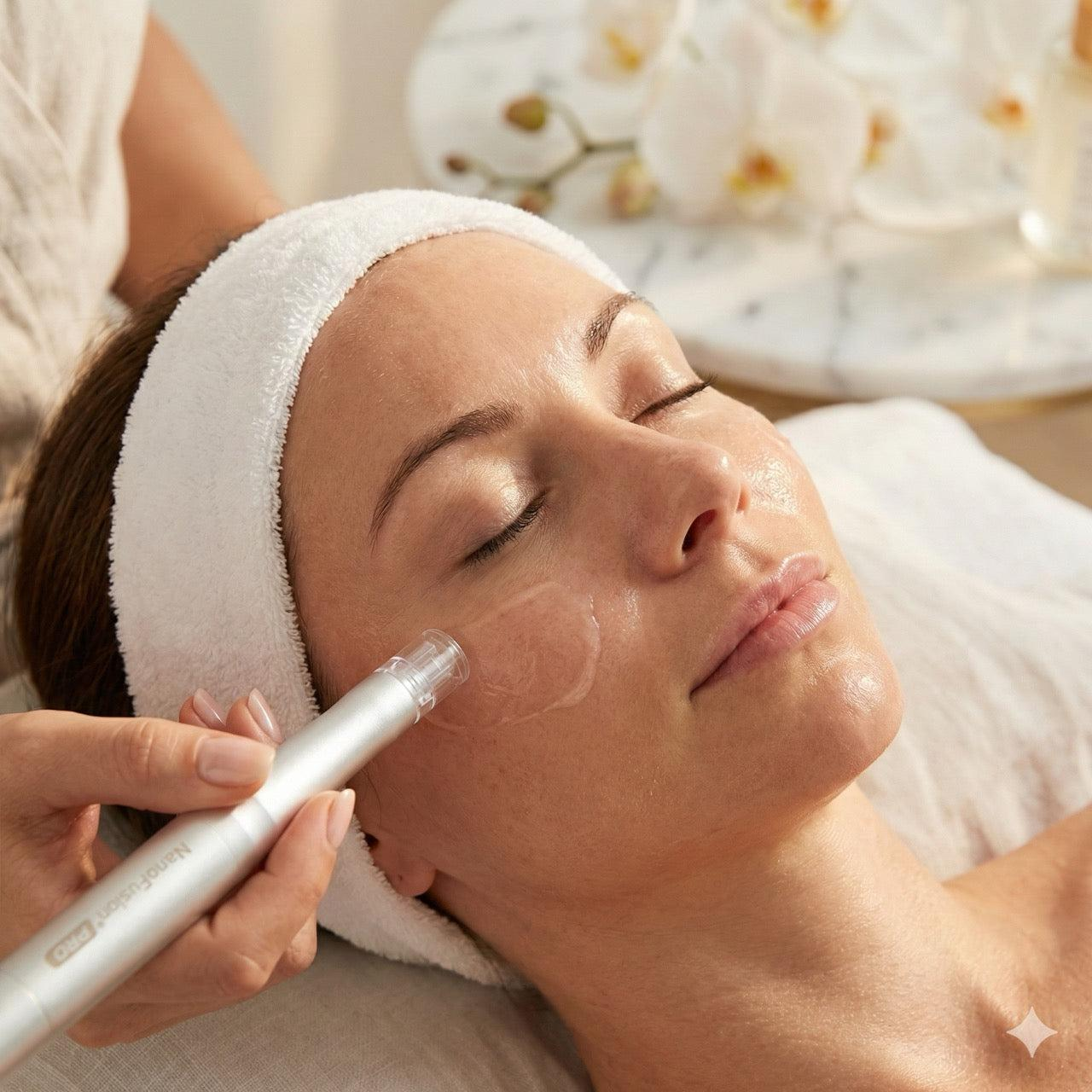
Nano infusion addresses this demand by using a specialized nano tip to create temporary superficial microchannels in the outermost layer of the skin. These microscopic pathways can temporarily reduce the skin's natural barrier resistance, helping selected topical ingredients move beyond simple surface application.
This distinction is important.
Traditional skincare depends largely on passive topical absorption. The skin barrier is designed to limit the movement of substances from the outside environment into the body. Nano infusion takes a device-assisted approach: rather than simply placing serum on the skin, the professional uses controlled mechanical action to create temporary pathways that can improve product delivery.
For treatment rooms, this creates a practical opportunity. Nano infusion can be positioned as a standalone advanced facial or incorporated into multi-step services involving cleansing, exfoliation, serum infusion, hydration masks, LED therapy, and other compatible professional treatments.
The result is not simply another skincare step. It is a device-assisted treatment platform that can help professionals build more structured and customizable facial protocols.
Technology and Mechanism: How Does Nano Infusion Work?
Understanding the technology is essential for understanding why the equipment matters.
A professional nano infusion device typically uses a specialized cartridge containing extremely fine nano-scale tips, such as silicone or other suitable materials depending on the device design. During treatment, the tip is moved across prepared areas of the skin according to the manufacturer's recommended technique.
The mechanical action creates temporary microchannels in the superficial skin barrier. These channels provide additional pathways for appropriately selected topical formulations.
The key concept is enhanced transdermal delivery.
The device itself is not necessarily the primary source of the visible cosmetic result. Instead, the device helps create a temporary environment in which selected ingredients can be delivered more effectively than through conventional topical application alone.
This makes serum selection particularly important. Professional protocols commonly favor lightweight, water-based formulations designed for treatment compatibility. Ingredients such as hyaluronic acid, peptides, niacinamide, and other professionally formulated actives may be incorporated depending on the client's needs and the manufacturer's protocol. However, not every skincare product is suitable for use with a nano infusion device.
This is also where professional equipment can provide an important advantage.
A treatment-room device should not be evaluated only by whether the tip moves or vibrates. Professionals should consider factors such as:
- Tip design and consistency
- Operating speed or intensity control
- Ergonomic handling
- Treatment-area precision
- Cartridge replacement
- Ease of cleaning and maintenance
- Compatibility with the intended treatment protocol
- Operator control and consistency
A device that is comfortable to hold and easy to control can make a meaningful difference during repeated treatments throughout a working day.
Nano Infusion vs. Microneedling: Understanding the Difference
One of the most common questions surrounding nano infusion is how it compares with microneedling.
The two treatments may appear similar because both use handheld devices and specialized tips. However, their mechanisms and treatment objectives are different.
Microneedling is designed to create controlled micro-injuries that extend deeper into the skin and stimulate a wound-healing response. Nano infusion, by contrast, is generally focused on superficial microchanneling and product delivery rather than intentionally creating dermal wounds.
This difference affects the client experience and the way each treatment is positioned.
| Nano Infusion | Microneedling |
|---|---|
| Focuses on superficial microchannels | Uses controlled skin penetration |
| Primarily supports product delivery | Primarily stimulates a wound-healing response |
| Generally associated with minimal downtime | May involve more visible post-treatment response |
| Suitable for advanced facial protocols | Often positioned as a more intensive skin treatment |
| Can be integrated with hydration-focused services | Often requires more specific treatment planning |
For professional salons, nano infusion can therefore serve as a complementary technology rather than a replacement for more intensive procedures.
It gives practitioners another option when a client wants an advanced treatment experience but prefers a gentler approach.
Advantages: Why Professional Clinics Are Adding Nano Infusion
1. Enhanced Product Delivery
The most obvious advantage is its ability to support the delivery of suitable topical formulations.
Instead of relying entirely on passive absorption, the practitioner uses controlled device action to temporarily increase skin permeability. This can make the serum-infusion stage more meaningful within a professional facial protocol.
2. Minimal-Downtime Treatment Positioning
Many clients want an upgraded facial experience without committing to a treatment that significantly interrupts their schedule.
Nano infusion is often positioned as a low-downtime treatment, making it attractive for clients seeking a refreshed appearance without the recovery expectations associated with more aggressive procedures.
3. Flexible Treatment Protocols
Another advantage is flexibility.
A clinic can design different nano infusion protocols according to skin goals. For example, one service may emphasize hydration and radiance, while another may focus on texture refinement or a more comprehensive rejuvenation facial.
The device can become one component within a larger treatment sequence rather than a single-purpose machine.
4. Premium Treatment Experience
Professional clients increasingly evaluate treatments based on both results and experience.
A dedicated nano infusion device adds a visible technology component to the treatment. When combined with professional consultation, skin analysis, carefully selected formulations, and post-treatment care, it can help transform a conventional facial into a more structured technology-assisted service.
5. Efficient Treatment-Room Workflow
For busy salons and clinics, workflow efficiency matters.
A compact handheld device can be easier to integrate into an existing facial room than a large multifunction system. It can also allow professionals to move between treatment zones with greater flexibility.
Ergonomic design becomes particularly important when the same practitioner performs multiple services throughout the day. Professional device selection should therefore consider not only technical specifications but also weight, grip, controls, cartridge handling, and overall usability.
Applications and Client Needs
Nano infusion can be incorporated into a wide range of professional facial services.
Hydration and Dehydrated Skin
Clients experiencing dry or dehydrated-looking skin may benefit from a treatment protocol centered around hydration-supporting formulations.
In this type of service, nano infusion can be paired with hydrating serums and a finishing mask to create a more intensive moisture-focused facial.
Dull or Tired-Looking Skin
For clients seeking a brighter and fresher appearance, nano infusion can be incorporated into a radiance-focused facial.
The professional can combine skin preparation, appropriate active ingredients, nano infusion, and finishing care to create a treatment that feels more comprehensive than a conventional facial.
Fine Lines and Texture Concerns
Nano infusion may also be incorporated into facial protocols targeting the appearance of fine lines and uneven texture.
The technology should not be presented as a replacement for medical procedures. Instead, it can be positioned as a professional aesthetic tool that supports ingredient delivery and overall skin-conditioning protocols.
Pre-Event Treatments
Because of its low-downtime positioning, nano infusion can also be attractive for clients preparing for events, photography, travel, or other occasions when they want their skin to look refreshed.
Treatment timing should always follow the device manufacturer's protocol and the professional's assessment of the client's skin condition.
Combination Facial Protocols
One of the strongest applications is combination treatment.
Nano infusion can be integrated with other compatible treatment-room technologies, including LED light therapy and professional hydration masks. Industry protocols commonly use nano infusion as part of a sequence rather than treating it as an isolated procedure.
For example, a clinic could develop a premium facial workflow:
Skin Assessment → Cleansing → Skin Preparation → Nano Infusion → LED Therapy → Hydration Mask → Barrier-Supportive Finishing Care
This type of structured service can help clinics differentiate their treatment menu while giving practitioners more opportunities to personalize the client experience.
What Professionals Should Look for in a Nano Infusion Device
Not all nano infusion devices are equally suited to professional treatment rooms.
When selecting equipment, professionals should look beyond appearance and basic specifications.
Consistent Performance
The device should provide stable operation throughout the treatment. Consistency is important because uneven technique can affect the overall treatment experience.
Ergonomic Design
A lightweight, balanced handpiece can reduce operator fatigue and improve control during longer treatment sessions.
Adjustable Settings
Different facial zones and client sensitivities may require different treatment approaches. Adjustable operating parameters can give professionals greater control when permitted by the device protocol.
Reliable Tip System
The cartridge or nano tip is one of the most important components of the system. Professionals should pay attention to material quality, consistency, replacement procedures, and hygiene requirements.
Professional Workflow Compatibility
A good device should fit naturally into the clinic's existing workflow.
If the device requires complicated setup or interrupts the treatment sequence, its practical value may be lower than its technical specifications suggest.
The best equipment is therefore not necessarily the device with the longest feature list. It is the one that allows trained professionals to deliver a repeatable, efficient, and well-structured treatment.
Professional Protocol and Safety Considerations
Nano infusion may have a gentler profile than more invasive procedures, but professional treatment still requires proper training, consultation, hygiene, and protocol control.
Before treatment, professionals should assess the client's skin condition and review relevant contraindications according to local regulations, professional standards, and the manufacturer's instructions.
Skin preparation is particularly important. The treatment surface should be thoroughly cleansed, because materials present on the skin during device application may be introduced into the temporary microchannels.
Serum compatibility is equally important. Increased skin permeability means that unsuitable or irritating ingredients may also be delivered more readily. Professional protocols therefore emphasize appropriate formulations rather than simply using any serum available in the treatment room.
After the treatment, barrier-supportive and soothing care can help complete the protocol. Practitioners should also provide clients with clear aftercare instructions and follow the specific recommendations associated with their equipment and professional scope.
Regulatory requirements can differ by location, so clinics should verify applicable local rules before introducing nano infusion services.
Conclusion
Nano infusion represents an important development in the evolution of professional treatment-room tools.
Its value does not come simply from the word “nano” or from the novelty of a handheld device. The real opportunity lies in how the technology can be integrated into a complete professional treatment protocol.
By creating temporary superficial microchannels, nano infusion can support enhanced delivery of appropriately selected topical formulations. This makes it particularly useful for hydration-focused, radiance, texture, and advanced facial services where clients want a more technology-driven experience without the downtime associated with more aggressive procedures.
For beauty salons, aesthetic clinics, and professional treatment centers, the technology also provides flexibility. A well-designed nano infusion device can become part of standalone services, premium facial upgrades, combination protocols, and customized treatment programs.
As professional skincare continues moving toward personalized, technology-assisted experiences, treatment-room tools will increasingly be judged not only by what the device can do, but by how effectively it supports the entire workflow—from consultation and preparation to treatment, finishing care, and client experience.
Nano infusion is therefore more than a passing beauty trend. When supported by appropriate equipment, professional formulations, trained operators, and structured protocols, it can become a practical addition to the modern aesthetic treatment room
Founded in 2008, Guangzhou GLM Beauty Spa Equipment Factory specializes in research, development, manufacture and selling of beauty and slimming machines. Our production base is located in Guangzhou City, Guangdong Province, China. Since our foundation, we have introduced advanced technologies and equipment, to assure high quality and high performance of our products. With professional marketing guide and excellent after-sales service, our products have been exported to over 20 countries and regions, including Southeast Asia, the Middle East, Europe and the United States, won worldwide praises and gained a good reputation