1. Introduction
The demand for non-surgical body contouring continues to evolve in 2026. Today's clients are no longer focused exclusively on reducing unwanted fat. Many are also interested in improving muscle definition, enhancing body firmness, and achieving a more athletic appearance without undergoing invasive procedures or committing to intensive exercise routines.
This shift has encouraged aesthetic clinics and professional body contouring centers to expand their treatment offerings beyond traditional fat-reduction technologies. Muscle stimulation devices have become an important part of this development, providing an additional approach to body shaping by activating targeted muscle groups through controlled electrical impulses.
One technology attracting attention in the professional aesthetics market is TruSculpt Flex. Developed for non-invasive muscle conditioning, this system uses Multi-Directional Stimulation (MDS) technology to stimulate muscle contractions through different treatment modes. It is designed to address areas such as the abdomen, buttocks, and thighs, helping improve muscle tone, strength, and firmness.
For aesthetic professionals, the technology represents an opportunity to offer more comprehensive body contouring programs. Rather than focusing solely on the appearance of subcutaneous fat, practitioners can incorporate muscle conditioning into personalized treatment plans.
Understanding how advanced muscle stimulation works, what results it is designed to support, and where it fits into professional aesthetic services is essential for clinics looking to develop effective non-surgical body sculpting solutions in 2026.
2. Background and Problem: Why Fat Reduction Alone Is Not Always Enough
Traditional body contouring treatments have largely focused on reducing localized fat deposits, improving body proportions, and refining the overall silhouette. Technologies such as radiofrequency, cryolipolysis, and ultrasound-based treatments have provided different approaches to addressing unwanted fat and body shape concerns.
However, reducing fat does not necessarily produce the muscle definition that many clients expect.
For example, a client may achieve a smaller waistline but still feel that the abdominal area lacks firmness. Another may have relatively low levels of localized fat but want more visible muscle tone in the thighs or buttocks. In these situations, fat-focused treatments alone may not fully address the client's aesthetic goals.
Muscle conditioning introduces another dimension to non-surgical body contouring. By activating specific muscle groups, electrical muscle stimulation can support improvements in muscle strength, endurance, and tone.
This is particularly relevant for clients who:
-
Want a firmer-looking abdomen and more defined abdominal muscles.
-
Wish to improve the appearance and tone of their buttocks.
-
Want better muscle definition in the thighs.
-
Prefer non-invasive aesthetic treatments over surgical body shaping.
-
Need an additional muscle-conditioning option alongside their existing fitness routine.
For professional clinics, this creates an opportunity to move from single-purpose treatments toward integrated body contouring programs. Instead of presenting fat reduction as the only solution, practitioners can assess whether a client's goals also require muscle conditioning.
The key is to understand that fat reduction and muscle stimulation address different aspects of body appearance. They should be selected according to individual needs rather than treated as interchangeable technologies.
3. Technology and Mechanism: How TruSculpt Flex Stimulates Muscles
3.1 Electrical Muscle Stimulation and Controlled Contractions
TruSculpt Flex uses electrical muscle stimulation (EMS) to trigger controlled muscle contractions.
Under normal circumstances, muscles contract when they receive electrical signals from the nervous system. EMS technology introduces controlled electrical impulses through electrodes positioned over selected treatment areas. These impulses stimulate motor nerves and cause the targeted muscles to contract.
Unlike ordinary voluntary exercise, where individuals consciously control each movement, electrical stimulation produces involuntary muscle contractions according to the programmed treatment parameters.
The intensity, duration, and pattern of stimulation can be adjusted by the operator to create different contraction experiences. This allows practitioners to customize treatments according to the client's tolerance, treatment objectives, and selected muscle groups.
The purpose is not simply to produce a strong sensation. It is to provide structured muscle activation that supports muscle conditioning within a professionally supervised treatment environment.
3.2 Multi-Directional Stimulation (MDS) Technology
A key feature of TruSculpt Flex is its proprietary Multi-Directional Stimulation technology.
Traditional muscle stimulation systems may rely on relatively uniform contraction patterns. MDS is designed to deliver different stimulation patterns to targeted muscles, providing a more varied approach to muscle activation.
This allows the treatment system to simulate different types of physical exercise through programmed electrical stimulation.
For professional operators, the benefit is greater flexibility when designing treatment protocols. Different clients have different fitness backgrounds, muscle conditions, and aesthetic expectations. A personalized stimulation approach makes it easier to adapt the treatment experience rather than applying one identical program to everyone.
3.3 Three Treatment Modes: PREP, TONE, and SCULPT
TruSculpt Flex incorporates three distinct treatment modes, each designed to create a different muscle contraction pattern.
PREP Mode
PREP mode focuses on preparing the muscles for stimulation. Its contraction pattern is designed to create twisting and stretching movements similar to those experienced during a warm-up.
This mode helps gradually introduce the muscles to electrical stimulation and build tolerance before more intensive contractions.
TONE Mode
TONE mode is designed to generate repeated muscle contractions with holding and relaxation phases.
Its pattern is intended to resemble strength and endurance exercises, supporting muscle conditioning through repeated activation.
For clients interested in improving muscle firmness and functional muscle conditioning, this mode provides a structured stimulation approach.
SCULPT Mode
SCULPT mode focuses on rapid, deep, and sequential muscle contractions.
Its pattern is designed to simulate more intensive muscle-building movements, offering a different stimulation experience from the gradual preparation and repeated contraction patterns of the other modes.
Together, these three modes provide practitioners with different ways to approach muscle stimulation according to individual treatment goals.
It is important to remember that these modes simulate aspects of physical exercise; they do not replace a complete fitness program or guarantee the same physiological adaptations as conventional resistance training.
4. Advantages and Comparison: Professional Muscle Stimulation in Body Contouring
4.1 Non-Invasive Muscle Conditioning
One of the main advantages of advanced muscle stimulation is that it does not require surgical incisions or invasive procedures.
Electrical impulses activate targeted muscles through external electrodes, allowing clients to receive muscle-conditioning treatments without surgery.
This makes the technology relevant to individuals who want to improve muscle tone while avoiding the recovery requirements associated with invasive body sculpting procedures.
4.2 Targeted Treatment Areas
TruSculpt Flex is designed for muscle conditioning in the abdomen, buttocks, and thighs.
These areas are frequently included in professional body contouring consultations because they contribute significantly to overall body proportions and silhouette.
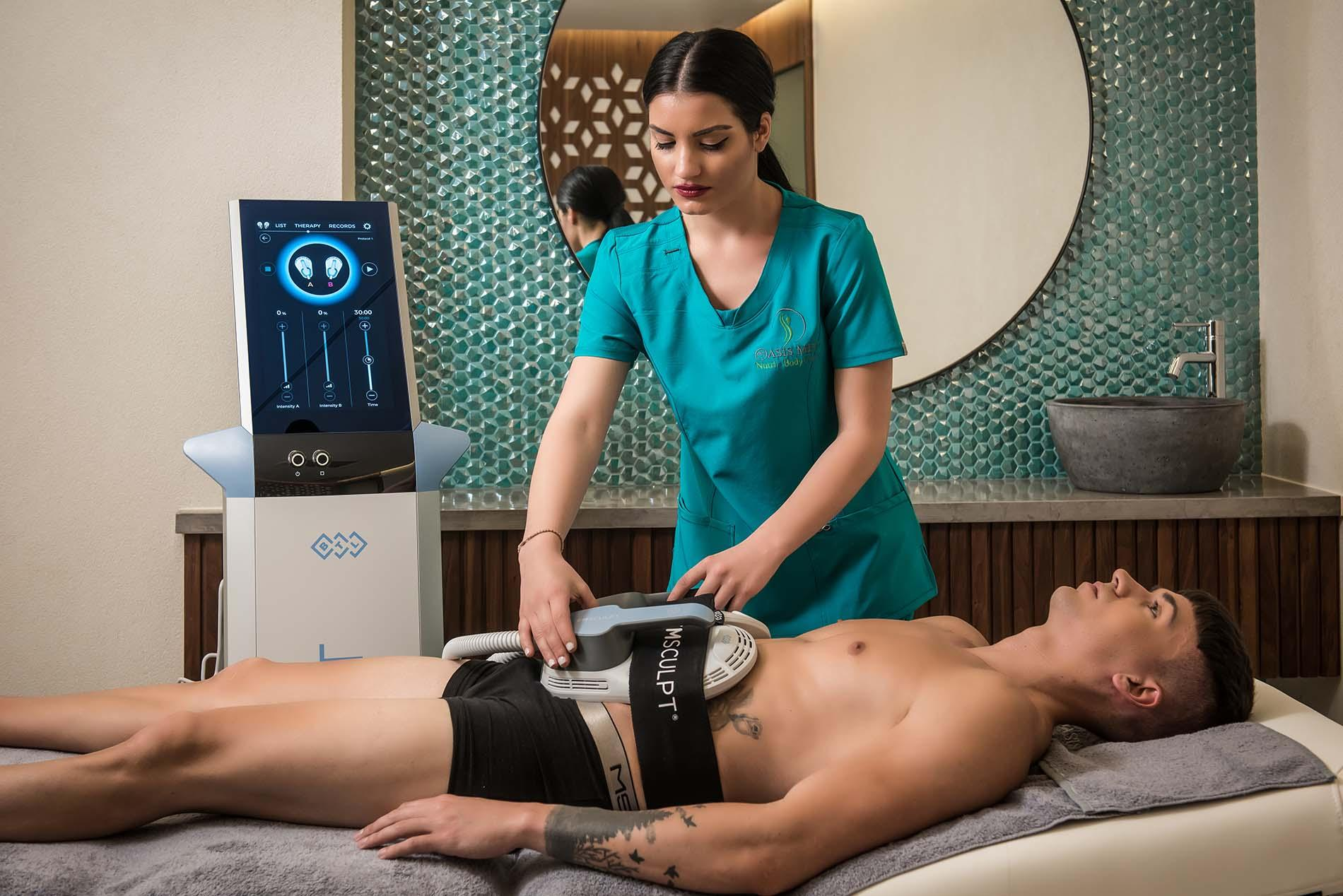
The ability to position applicators over selected muscle groups allows practitioners to focus on the areas most relevant to each client's treatment objectives.
4.3 Multiple Stimulation Patterns
The availability of PREP, TONE, and SCULPT modes offers greater protocol flexibility than a system limited to one contraction pattern.
Operators can select the appropriate stimulation approach according to the treatment plan, while adjusting intensity to maintain a tolerable and controlled experience.
4.4 Professional Devices Versus Home-Use EMS Products
Home-use EMS products are widely available, but professional muscle stimulation systems serve a different purpose.
Professional equipment is designed for supervised treatment environments, with structured operating parameters, dedicated applicators, and protocols that trained operators can adjust according to individual needs.
Professional clinics can also provide:
-
Initial consultations and treatment suitability assessments.
-
Individualized muscle stimulation protocols.
-
Consistent applicator positioning and treatment monitoring.
-
Progress photography and follow-up evaluations.
-
Combined treatment planning when clinically appropriate.
These services add value beyond the stimulation device itself.
However, professional equipment should not be assumed to produce superior results simply because it is used in a clinic. Device specifications, regulatory status, operator training, treatment protocols, and individual patient factors all influence treatment quality and outcomes.
4.5 Muscle Stimulation Is Not the Same as Fat Reduction
An important distinction in modern body contouring is the difference between muscle conditioning and fat reduction.
EMS targets muscle activation. It should not be marketed as a direct fat-destruction technology or as a guaranteed weight-loss solution.
Radiofrequency-based fat reduction, cryolipolysis, and muscle stimulation each address different tissue targets and treatment objectives.
For example, a clinic may consider a combined approach for a suitable client: one technology to address localized fat concerns and another to support muscle conditioning.
Cutera's broader truBody approach illustrates this concept by combining truSculpt technology for fat reduction with truSculpt Flex for muscle conditioning.
The choice of treatment should always be based on individual assessment, device indications, and the client's expectations.
5. Applications and Client Needs: How Clinics Can Incorporate TruSculpt Flex
5.1 Abdominal Muscle Conditioning
The abdomen is one of the most common areas of interest in body contouring consultations.
Some clients want a firmer abdominal appearance, while others are interested in improving the definition of their abdominal muscles.
TruSculpt Flex can be incorporated into professional abdominal muscle-conditioning programs by positioning applicators over the appropriate muscle groups and selecting a suitable stimulation mode.
Treatment planning should consider the client's abdominal condition, comfort level, medical history, and aesthetic objectives.
5.2 Buttock Firmness and Muscle Tone
The gluteal muscles play an important role in lower-body shape and overall body proportions.
Clients may seek improved buttock firmness or a more defined appearance without surgery.
Electrical muscle stimulation offers a non-invasive approach to activating targeted gluteal muscles. Professional operators can adjust the treatment parameters according to the client's tolerance and the intended muscle-conditioning program.
It should be presented as a muscle-conditioning treatment rather than a guaranteed buttock-lifting or volume-enhancement procedure.
5.3 Thigh Muscle Definition
The thighs are another important area for body contouring treatments.
Clients may be concerned about the appearance of their upper legs, muscle firmness, or overall lower-body definition.
By targeting selected thigh muscle groups, muscle stimulation can become part of a broader treatment strategy designed to support muscle tone and conditioning.
Practitioners should distinguish between concerns related to muscle tone, localized fat, loose skin, and cellulite, as these conditions may require different treatment approaches.
5.4 Personalized Treatment Programs
Not every client requires the same stimulation intensity or treatment schedule.
A professional consultation should evaluate the client's aesthetic goals, current activity level, muscle condition, medical background, and suitability for electrical stimulation.
Based on this assessment, practitioners can develop a treatment plan that specifies the target areas, stimulation modes, intensity progression, and follow-up schedule.
Clients should also understand that treatment outcomes vary. Muscle stimulation is most appropriately positioned as a complement to healthy lifestyle habits, including regular exercise and balanced nutrition.
5.5 Building a More Comprehensive Body Contouring Service
For aesthetic clinics, muscle stimulation can expand the range of services available to existing and potential clients.
Rather than offering only one type of body sculpting treatment, clinics can develop customized programs that address multiple concerns.
For example:
-
Fat-focused treatments for suitable localized fat concerns.
-
Muscle stimulation for abdominal, gluteal, or thigh conditioning.
-
Skin-tightening technologies when skin laxity is an appropriate treatment concern.
-
Lifestyle guidance to support long-term body composition goals.
This integrated approach allows practitioners to create more individualized treatment experiences while helping clients understand why different technologies serve different purposes.
6. Safety, Professional Assessment, and Treatment Expectations
Although non-invasive muscle stimulation does not involve surgery, it should not be considered risk-free.
Clients may experience tingling, discomfort, skin irritation, or temporary muscle soreness. Electrical stimulation may also affect heart rate, and individual suitability must be evaluated before treatment.
A professional clinic should review the manufacturer's instructions for use, screen relevant medical conditions, and assess the presence of implanted electronic devices or other contraindications specified in the device documentation.
Treatment should be performed by appropriately trained personnel using approved operating parameters. Practitioners should never increase stimulation intensity beyond the client's tolerance simply to create a stronger sensation.
It is also important to communicate realistic expectations. Muscle tone and strength improvements depend on individual characteristics, treatment consistency, and broader lifestyle factors. Results are not identical for every client, and treatment photographs should accurately represent actual outcomes.
In the United States, truSculpt Flex has an FDA 510(k) clearance record for its specified muscle-conditioning indications. This is a regulatory clearance based on substantial equivalence, not a blanket FDA approval for weight loss or fat reduction. Clinics should verify the indications and regulatory requirements applicable in their own markets.
7. Conclusion: The Future of Muscle Stimulation in Non-Surgical Body Contouring
In 2026, professional body contouring is increasingly focused on personalized treatment strategies rather than relying on a single technology to address every aesthetic concern.
TruSculpt Flex demonstrates how advanced electrical muscle stimulation can contribute to this development. Through Multi-Directional Stimulation and its PREP, TONE, and SCULPT modes, the system provides a structured approach to muscle activation in areas such as the abdomen, buttocks, and thighs.
For professional aesthetic clinics, muscle stimulation offers an additional way to address client demands for improved muscle tone, firmness, and body definition. When incorporated into an appropriate treatment plan, it can complement other body contouring technologies and support a more comprehensive service offering.
The future of non-surgical body sculpting will depend not only on technological innovation but also on professional assessment, individualized protocols, operator expertise, and responsible communication of treatment outcomes.
Ultimately, the most effective body contouring strategy is not necessarily the one that uses the most technologies, but the one that selects the right technology for the right client and the right treatment objective
Founded in 2008, Guangzhou GLM Beauty Spa Equipment Factory specializes in research, development, manufacture and selling of beauty and slimming machines. Our production base is located in Guangzhou City, Guangdong Province, China. Since our foundation, we have introduced advanced technologies and equipment, to assure high quality and high performance of our products. With professional marketing guide and excellent after-sales service, our products have been exported to over 20 countries and regions, including Southeast Asia, the Middle East, Europe and the United States, won worldwide praises and gained a good reputation