
1. Introduction
Cellulite is one of the most common aesthetic concerns addressed by professional body contouring clinics and beauty salons. It typically appears as uneven, dimpled skin around the thighs, buttocks, hips, and sometimes the abdomen. Although it is not generally considered a medical problem, its appearance can influence body confidence and create demand for professional aesthetic treatments.
However, cellulite is not a single-condition problem with one universal solution. Some clients present with shallow dimpling and relatively firm skin, while others have deeper depressions, reduced elasticity, localized fat accumulation, or several concerns at the same time. These differences explain why a standardized treatment protocol may not deliver equally satisfactory results for every client.
For beauty professionals, the key is to understand what contributes to the visible texture of the skin and select appropriate technologies accordingly. A 6-in-1 cavitation machine can be a useful component of a personalized body contouring program when its actual functions match the client's needs.
Rather than treating every client with the same settings and sequence, professionals can use structured assessments, carefully selected treatment modalities, and consistent progress monitoring to develop more realistic and individualized service plans.
2. Background: Why Different Types of Cellulite Need Different Approaches
Cellulite develops through interactions between subcutaneous fat, connective tissue, skin structure, and other individual factors. Fibrous connective bands, commonly called septae, connect the skin to deeper tissues. When these bands pull downward while surrounding fat lobules push upward, the skin surface can develop characteristic depressions and irregularities.
Skin aging, reduced elasticity, changes in fat distribution, hormonal influences, and fluid-related factors may further affect the appearance of cellulite. The relative importance of these factors differs from person to person. Consequently, visible dimpling does not always indicate that excess fat is the primary issue.
For practical treatment planning, professionals can distinguish among several common presentation patterns.
Classic or diffuse cellulite often appears as widespread, shallow unevenness across the thighs or buttocks. Its appearance may become more noticeable when the client stands, changes position, or gently compresses the skin. The treatment objective may focus on improving the overall appearance of the skin surface and addressing accompanying contour concerns.
Linear or pronounced cellulite may present as more distinct grooves, deeper depressions, or localized dimples. Some depressions remain visible even when the client is standing at rest. In these cases, connective-tissue tethering and skin structure may be more important than fat volume alone. A non-invasive cavitation treatment should not be presented as a direct method for releasing fibrous bands.
Cellulite accompanied by localized fat accumulation involves both surface irregularities and visible fullness in areas such as the abdomen, hips, or thighs. A body contouring program may address the contour concern separately from the skin texture concern, provided the selected technology is appropriate for the treatment area and the client is a suitable candidate.
Cellulite with reduced skin firmness requires additional consideration of skin quality and elasticity. Even when the underlying contour changes, loose skin may continue to influence the overall appearance.
These patterns can overlap. A client may have localized fat accumulation, shallow dimpling, and reduced skin firmness simultaneously. A professional assessment should therefore consider the dominant concern instead of relying exclusively on a cellulite label.
3. Technology and Mechanism: Understanding the Role of a 6-in-1 Cavitation Machine
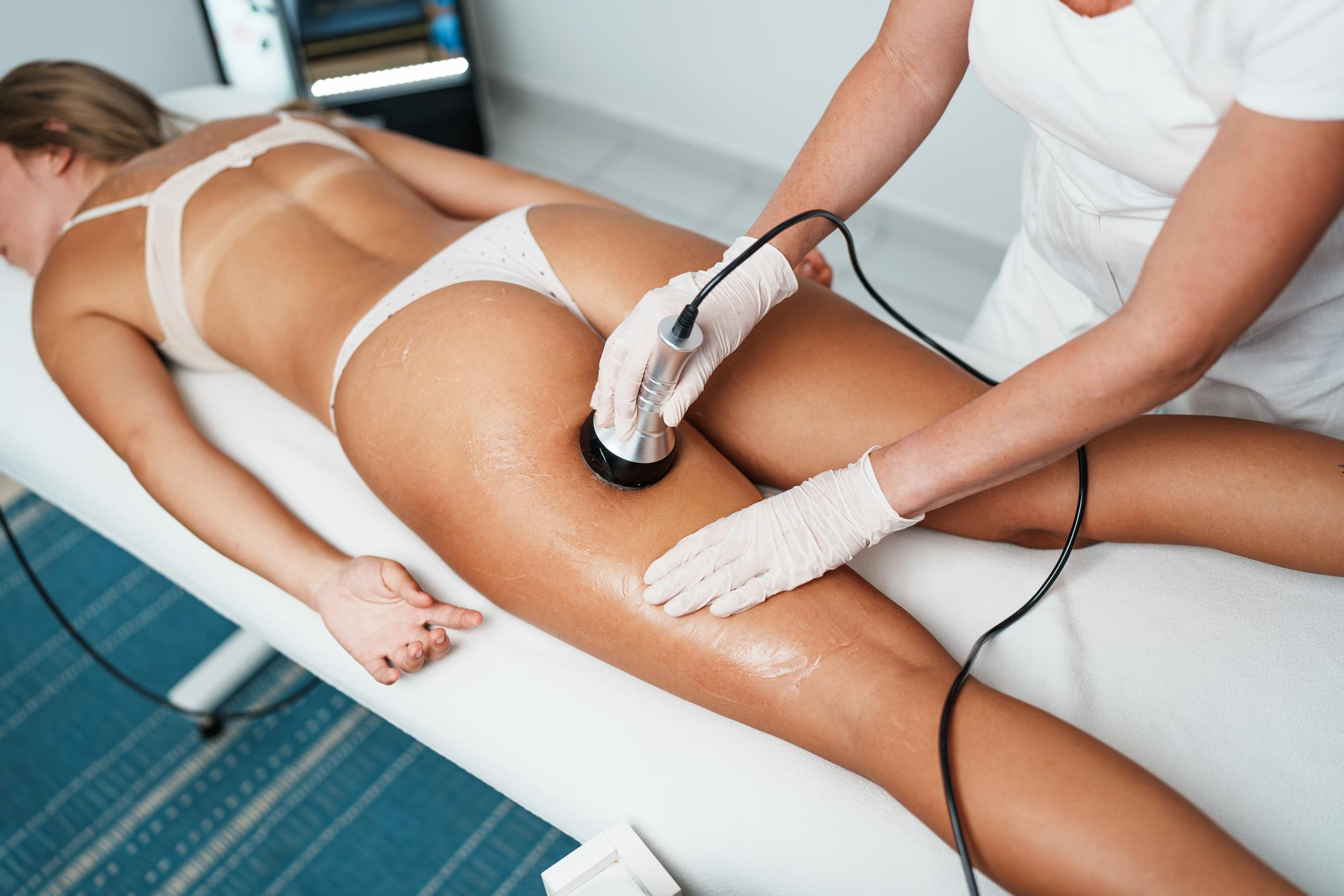
A 6-in-1 cavitation machine typically combines several body or facial aesthetic functions within one platform. However, the term “6-in-1” is not a standardized technical specification. The actual technologies, handpieces, operating modes, and intended treatment areas vary by manufacturer and model.
Before developing a treatment protocol, operators should verify the equipment's specifications, instructions for use, contraindications, and applicable local regulatory requirements.
Ultrasound Cavitation
Ultrasound cavitation systems deliver acoustic energy into targeted tissue. Depending on the technology and operating parameters, ultrasound may produce mechanical effects in tissue and, in certain systems, thermal effects. These mechanisms should not be assumed to be identical across all devices marketed as cavitation machines.
In aesthetic body contouring, cavitation systems are generally marketed for localized body shaping rather than as a comprehensive treatment for every structural cause of cellulite. They may be considered when localized fullness is an appropriate treatment target, but outcomes depend on the specific device, treatment protocol, client characteristics, and available clinical evidence.
It is important to distinguish cosmetic body contouring from weight-loss treatment. Non-invasive contouring procedures are not substitutes for obesity treatment, and results are not guaranteed.
Additional Functions and Complementary Technologies
Depending on the model, a six-function platform may combine ultrasound cavitation with technologies such as radiofrequency, vacuum-assisted massage, mechanical rolling, or other aesthetic modalities. This is only an example of a possible configuration, not a definition of every 6-in-1 machine.
Each function serves a different potential role. Radiofrequency uses electrical energy to generate tissue heating and may be intended to improve the appearance of skin firmness in appropriately designed systems. Vacuum and mechanical massage functions apply suction or mechanical movement to superficial tissues and may temporarily influence tissue appearance or fluid distribution.
These technologies should not be treated as interchangeable. Nor should every available function automatically be used during one session.
For example, a client with localized fullness may have different priorities from a client whose main concern is deep, fixed dimpling. Adding more technologies does not necessarily produce a better outcome. The objective is to select the functions that correspond to the intended treatment goal and the machine's verified capabilities.
Why Protocol Design Matters
A device is only one part of a professional treatment system. Client screening, area selection, parameter control, treatment technique, session scheduling, hygiene, and aftercare all influence service quality.
Operators should follow the manufacturer's instructions rather than copying settings from unrelated devices. Ultrasound and other energy-based technologies can produce biological effects, and inappropriate use may cause injury. A professional protocol must therefore prioritize suitability and safety over treatment intensity.
4. Advantages and Comparison: Personalized Protocols Versus One-Size-Fits-All Treatment
A personalized approach offers several practical advantages for professional clinics and salons.
First, it aligns the treatment with the dominant concern. When localized fullness is the main objective, an appropriate body contouring function may be considered. When deep dimpling or substantial skin laxity dominates, the operator should explain that a cavitation platform may not directly address the underlying structural issue. Other professionally assessed options may be more suitable.
Second, it supports more rational technology selection. A multi-function machine can provide operational flexibility when its handpieces have clearly defined roles. Instead of purchasing or using a separate device for every minor concern, a clinic may be able to incorporate several compatible services into an organized treatment menu. The commercial value depends on actual functionality, reliability, staff training, and client demand.
Third, it improves consultation quality. Clients often expect cellulite treatments to remove every dimple or permanently reshape an area. A structured consultation helps clarify the difference between reducing the appearance of localized fullness, improving visible skin texture, and treating deeper structural depressions. This makes expectations more realistic and helps avoid exaggerated claims.
Fourth, it makes progress easier to evaluate. Standardized photographs, consistent lighting, similar body positioning, and documented treatment parameters can help professionals compare changes over time. Measurements and photographs should be interpreted carefully because posture, hydration, lighting, and natural variation can affect appearance.
Compared with home-use devices, professional equipment may offer more treatment options, adjustable operating parameters, and a workflow designed for trained operators. These advantages depend on the specific product and do not automatically establish superior clinical effectiveness. Home-use devices also vary considerably, so comparisons should be based on verified specifications rather than marketing labels alone.
Professional equipment should never be described as universally safer or more effective simply because it is used in a salon. Training, appropriate screening, maintenance, and compliance with local requirements remain essential.
5. Applications and Client Needs: Building a Practical Treatment Protocol
A professional cellulite service should begin with consultation rather than immediate device operation.
Step 1: Assess the Client and Define the Goal
Identify the treatment area, visible skin changes, degree of localized fullness, skin firmness, relevant medical history, and the client's expectations. Ask whether the primary goal is to improve the appearance of shallow dimpling, address localized contour concerns, or manage several concerns together.
Record relevant contraindications and follow the manufacturer's screening guidance. Do not proceed when the client has a condition or circumstance that makes the selected treatment unsuitable. Depending on the technology and local rules, additional medical assessment may be necessary.
Step 2: Match the Technology to the Treatment Objective
For clients with localized fullness and relatively mild surface irregularities, an appropriate cavitation function may be considered as part of a broader contouring plan. If the machine includes additional verified technologies, the operator may consider whether those functions are suitable for the client's skin condition and treatment goals.
For deep, fixed dimples, pronounced tethering, or substantial skin laxity, explain the limitations of non-invasive cavitation. A referral or consultation with an appropriately qualified healthcare professional may be appropriate when the concern exceeds the scope of the salon's services.
Step 3: Establish a Device-Specific Protocol
Use only approved or otherwise legally marketed functions appropriate to the jurisdiction, and follow the device's instructions for use. Treatment area, energy settings, movement speed, contact method, session duration, and frequency must be determined according to the particular equipment and the client's suitability.
Avoid assuming that stronger settings, longer exposure, or combining every handpiece will improve results. The protocol should remain conservative and evidence-informed, with adjustments made only when supported by the manufacturer's guidance and professional assessment.
Step 4: Monitor Progress and Communicate Clearly
Record the settings used, treatment areas, client feedback, and any skin reactions. Use consistent photography and documentation to review changes across sessions. If the expected improvement does not occur, reassess the original concern and the suitability of the treatment rather than automatically increasing intensity.
Explain that cellulite appearance can fluctuate and that results vary. Some non-invasive contouring effects may be temporary, and multiple sessions may be recommended for certain devices. Neither a fixed number of sessions nor a guaranteed percentage of improvement should be promised without device-specific supporting evidence.
Step 5: Integrate the Service into a Professional Treatment Menu
For clinics and salons, a multi-function platform can support a structured service offering when each function has a clear purpose. Consultation, treatment, documentation, maintenance, and follow-up can be organized into a consistent workflow.
From a business perspective, the value of a 6-in-1 machine is not simply the number of handpieces. It lies in whether the equipment supports relevant client needs, can be operated consistently by trained staff, and fits the clinic's service positioning. Buyers should review technical specifications, training resources, warranty coverage, maintenance requirements, and regulatory documentation before selecting a device.
6. Conclusion
Cellulite treatment protocols differ because visible dimpling, localized fat accumulation, connective-tissue tethering, and reduced skin firmness do not always occur in the same combination. A single technology is therefore unlikely to be the ideal answer for every client.
A 6-in-1 cavitation machine can contribute to personalized body contouring when its verified functions match the treatment objective. Its greatest practical advantage is the potential to support a more flexible professional workflow—not the promise of eliminating every type of cellulite.
For beauty clinics, informed assessment, appropriate technology selection, conservative parameter control, realistic communication, and documented follow-up are the foundations of responsible treatment planning. By placing the client's actual needs ahead of the number of available functions, professionals can build more credible services and make better use of their body contouring equipment
Founded in 2008, Guangzhou GLM Beauty Spa Equipment Factory specializes in research, development, manufacture and selling of beauty and slimming machines. Our production base is located in Guangzhou City, Guangdong Province, China. Since our foundation, we have introduced advanced technologies and equipment, to assure high quality and high performance of our products. With professional marketing guide and excellent after-sales service, our products have been exported to over 20 countries and regions, including Southeast Asia, the Middle East, Europe and the United States, won worldwide praises and gained a good reputation