
Introduction
Aesthetic treatments are becoming increasingly personalized. Today’s clients are no longer satisfied with a generic skincare recommendation or a one-size-fits-all treatment plan. They want to understand their skin, know why a particular treatment is being recommended, and see measurable progress over time.
This shift is helping drive a new approach to professional aesthetics: precision aesthetics.
At the center of this approach is the combination of AI-powered skin diagnostics and targeted energy-based technology. Instead of relying solely on visual assessment and experience, aesthetic professionals can use advanced imaging and data analysis to gain a more structured understanding of skin concerns. That information can then support the selection of appropriate professional technologies, including radiofrequency (RF), focused ultrasound, laser, IPL, LED, and other energy-based systems.
The result is not simply a more technologically advanced consultation. It is a more connected treatment journey—from assessment and treatment planning to progress tracking and client education.
For modern MedSpas and aesthetic clinics, this combination represents an opportunity to make treatments more personalized while creating a more professional, data-driven client experience.
Background / Problem: Why Traditional Skin Assessment Is No Longer Enough
For many years, skin consultations depended heavily on visual examination, professional experience, client descriptions, and manual grading.
These methods remain valuable. An experienced practitioner can identify many visible concerns simply by observing the skin. However, visual assessment can also be subjective. Different practitioners may interpret the same skin condition differently, and subtle changes can be difficult to quantify consistently.
Research published in the Journal of Cosmetic Dermatology highlights this challenge, noting that traditional skin-quality assessment can lack reproducibility and may not consistently capture subtle changes over time. AI-based analysis has the potential to introduce more standardized, data-driven measurements for characteristics such as pigmentation, texture, radiance, erythema, and other aspects of skin quality.
This matters in a professional aesthetic environment because treatment selection should not simply answer the question:
“What treatment is popular?”
It should answer:
“What does this client actually need, and which technology is appropriate for that need?”
For example, two clients may both describe their concern as “aging skin.” One may primarily have surface pigmentation and uneven tone, while another may be more concerned about laxity, loss of firmness, and changes in facial contour.
The treatment strategy should therefore be different.
AI-assisted skin analysis can help practitioners organize these differences into a more structured consultation process.
Technology / Mechanism: How AI Skin Diagnostics Work
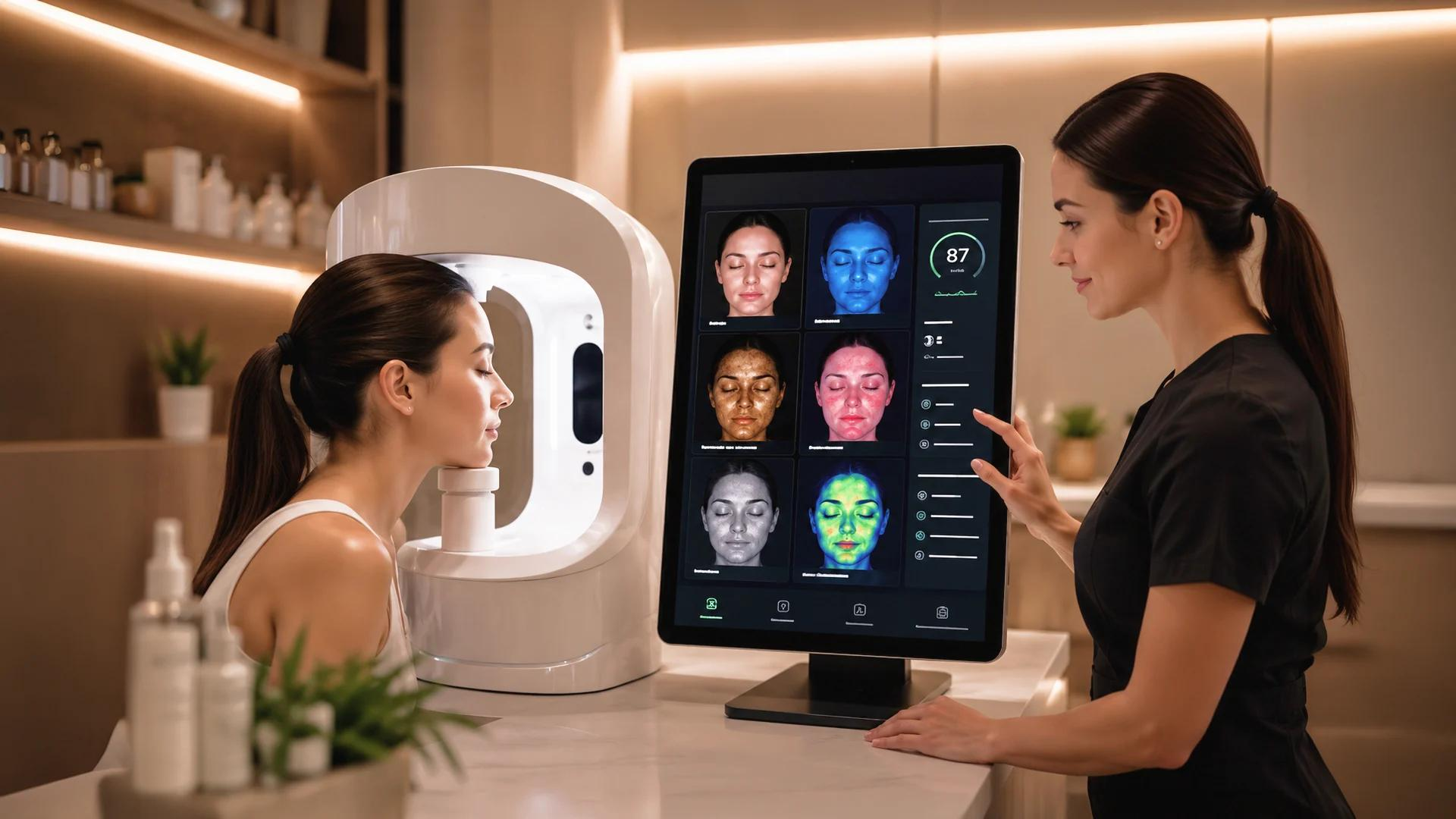
AI skin diagnostic systems generally combine high-resolution imaging, controlled lighting or multispectral imaging, image processing, and machine-learning algorithms.
Instead of relying only on what is immediately visible under ordinary lighting, advanced systems can analyze multiple characteristics of the face and skin.
Depending on the system, parameters may include:
- Fine lines and wrinkles
- Pigmentation and uneven skin tone
- Pores and skin texture
- Redness and vascular-related appearance
- Oiliness and hydration indicators
- Acne-related concerns
- Skin radiance
- Facial symmetry and contour
- Changes between before-and-after images
Some professional systems use multiple cameras and light spectrums to capture different types of skin information. Current commercial platforms, for example, advertise multi-spectral imaging, 3D facial analysis, AI-based assessment, and progress tracking for aesthetic clinics and MedSpas.
The important point is that AI does not replace professional judgment.
Instead, it can act as a decision-support and communication tool.
A practitioner can review the imaging results, combine them with the client's history, skin condition, goals, contraindications, and professional assessment, and then determine an appropriate treatment strategy.
That distinction is particularly important in aesthetic medicine: AI can help organize information, but treatment decisions should remain under qualified professional supervision.
From Skin Analysis to Targeted Energy
The real value of AI diagnostics becomes more apparent when it is connected to treatment planning.
Once a practitioner understands the client's primary concerns, the next question is how to address them using appropriate technology.
This is where energy-based aesthetic devices become important.
Different technologies deliver different forms of energy and interact with tissue in different ways.
Radiofrequency (RF) uses electromagnetic energy to generate controlled thermal effects in tissue. In aesthetic applications, RF systems are commonly used for skin tightening, collagen remodeling, and overall skin-quality improvement.
Focused ultrasound, including HIFU-based systems, uses concentrated acoustic energy at selected depths. Depending on the device and treatment protocol, it can be used for lifting, tightening, and body-contouring applications.
Laser and IPL technologies use light energy for applications such as pigmentation management, vascular concerns, hair reduction, skin resurfacing, and rejuvenation, depending on wavelength and device design.
LED phototherapy uses specific wavelengths of light for non-invasive skin treatments and is often incorporated into facial, acne-support, and post-treatment protocols.
The professional value comes from matching the technology to the treatment objective rather than simply applying the same device protocol to every client.
Advantages / Comparison: From Generalized Treatments to Precision Aesthetics
The combination of AI diagnostics and targeted energy technology changes the traditional treatment workflow.
1. More Structured Consultations
A skin analyzer can provide visual reports and measurable indicators that make consultations more structured.
Instead of simply telling a client that their skin appears “dry,” “pigmented,” or “aging,” the practitioner can use imaging results to explain specific areas of concern.
This creates a more educational consultation and gives the client a clearer understanding of why a particular treatment may be recommended.
2. More Personalized Treatment Planning
Different clients can require different combinations of technologies.
A client primarily concerned with pigmentation may need a completely different strategy from a client focused on laxity and facial contour.
AI-supported assessment helps practitioners organize these concerns before selecting an appropriate energy-based protocol.
This approach supports the broader trend toward personalized aesthetic medicine, where treatment plans are increasingly adapted to individual skin characteristics rather than standardized entirely around a single procedure.
3. Better Before-and-After Tracking
One of the most useful applications of digital skin analysis is longitudinal tracking.
A professional clinic can capture standardized images before treatment and compare them with images from subsequent sessions.
This creates a visual record of changes that may otherwise be difficult to recognize from memory alone.
For clients undergoing multiple treatments, progress tracking can also support treatment reviews and future protocol adjustments.
4. Stronger Client Communication
Aesthetic treatments are highly visual, but clients do not always understand what practitioners see.
An AI skin report can bridge this communication gap.
When clients can see their own skin analysis on a screen, the consultation becomes more interactive. Practitioners can explain why certain areas may require attention and how different technologies are designed to address different concerns.
This can be particularly valuable for clinics that position themselves around professional expertise and personalized care.
5. A More Premium Clinic Experience
Technology also influences how a clinic is perceived.
A professional skin analyzer placed within the consultation area can become part of the clinic's service experience. Combined with professional treatment equipment, digital records, standardized photography, and structured consultations, it can help create a more sophisticated workflow.
The goal is not to use technology simply because it looks advanced.
The goal is to use technology to make the entire client journey more professional.
Applications / Client Needs
AI diagnostics combined with targeted energy technologies can support a wide range of professional aesthetic applications.
Anti-Aging and Skin Tightening
Clients concerned about fine lines, loss of firmness, and early skin laxity may benefit from treatment planning that combines skin assessment with technologies such as RF, focused ultrasound, or other collagen-supporting energy systems.
Rather than automatically choosing the strongest available treatment, practitioners can assess the client's skin characteristics and aesthetic goals first.
This supports a more gradual and personalized approach to skin tightening and rejuvenation.
Pigmentation and Uneven Skin Tone
Pigmentation is another area where detailed assessment can be useful.
Visible-light photography may show obvious pigmentation, while advanced imaging systems can provide additional information about the distribution and appearance of different skin concerns.
Depending on professional assessment, suitable light-based technologies such as IPL or specific laser systems may then be considered.
The key is matching the technology, wavelength, treatment parameters, and client profile appropriately.
Acne, Redness, and Skin Quality
For clients concerned about acne, redness, enlarged pores, or uneven texture, AI analysis can help establish a baseline before treatment.
This can be especially useful for multi-session treatment programs.
Practitioners can combine appropriate professional technologies with skincare protocols and monitor changes over time instead of relying entirely on subjective impressions.
Texture and Pore Refinement
Skin texture is often one of the first things clients notice, but it can be difficult to describe precisely.
Professional imaging can help visualize texture-related concerns and establish a reference point.
Depending on the client's needs and professional assessment, clinics may incorporate technologies such as RF, fractional laser systems, microneedling-based energy platforms, or other skin-rejuvenation devices.
Personalized Maintenance Programs
Precision aesthetics is not only about one treatment.
It is also about creating a long-term relationship with the client.
For example, a clinic could establish a baseline skin analysis during the initial consultation, perform a targeted treatment program, reassess the skin after several sessions, and then develop a maintenance strategy.
This transforms the service from a single procedure into an ongoing skin-management program.
Why Professional Equipment Matters
The difference between professional aesthetic equipment and basic consumer devices is not simply power.
Professional systems are designed around controlled energy delivery, treatment parameters, ergonomic operation, workflow integration, and repeatable use in a professional environment.
For clinics and MedSpas, these characteristics matter because practitioners may treat multiple clients with different skin conditions and treatment objectives every day.
Professional platforms can also offer a broader selection of handpieces, adjustable parameters, larger treatment areas, integrated cooling or safety features, digital interfaces, and other functions depending on the technology.
This allows practitioners to build treatment protocols around client needs rather than forcing every client into the same treatment model.
At the same time, technology must be used responsibly. Energy-based treatments are not automatically suitable for every person or every skin condition. Proper training, device-specific protocols, contraindication screening, appropriate settings, and professional supervision remain essential.
Clinical surveys of energy-based aesthetic treatments also demonstrate why treatment parameters and practitioner expertise matter: devices such as RF and HIFU can provide valuable aesthetic applications, but inappropriate use can be associated with adverse effects.
Precision therefore means more than technological sophistication.
It means controlled technology + professional assessment + individualized treatment planning.
The Business Value for Modern MedSpas
For a MedSpa, the combination of AI diagnostics and professional energy-based equipment can also create operational advantages.
A structured consultation process can help staff communicate treatment recommendations more clearly.
Digital before-and-after records can help demonstrate progress.
Personalized treatment plans can support package-based services and long-term maintenance programs.
And a technology-driven consultation can differentiate a clinic in a competitive market where many providers offer similar treatments.
The strongest positioning is not:
“We have the newest machine.”
It is:
“We use advanced technology to understand your needs and build a treatment plan around you.”
That is the essence of precision aesthetics.
Conclusion
AI skin diagnostics and targeted energy technologies are changing the way modern MedSpas approach aesthetic treatment.
AI can help transform skin assessment from a primarily subjective process into a more structured, measurable, and visual consultation. Energy-based devices can then deliver targeted treatment according to the client's individual concerns, goals, and professional assessment.
Together, these technologies create a more connected workflow:
Analyze → Understand → Personalize → Treat → Track → Optimize.
For aesthetic clinics, this is more than an upgrade in equipment. It represents a shift toward a more intelligent model of professional skincare—one that combines data, technology, practitioner expertise, and personalized client care.
As the aesthetics industry continues to evolve, clinics that successfully integrate intelligent diagnostics with versatile professional treatment platforms will be better positioned to deliver consistent experiences, communicate value more effectively, and build long-term client relationships.
The future of aesthetics is not simply about stronger technology. It is about more precise technology, guided by better information
Founded in 2008, Guangzhou GLM Beauty Spa Equipment Factory specializes in research, development, manufacture and selling of beauty and slimming machines. Our production base is located in Guangzhou City, Guangdong Province, China. Since our foundation, we have introduced advanced technologies and equipment, to assure high quality and high performance of our products. With professional marketing guide and excellent after-sales service, our products have been exported to over 20 countries and regions, including Southeast Asia, the Middle East, Europe and the United States, won worldwide praises and gained a good reputation