Introduction
Over the past decade, light-based hair reduction has evolved from an exclusive dermatological procedure into one of the most sought-after aesthetic treatments worldwide. Yet for beauty salon owners, aesthetic clinic operators, and equipment distributors, the rise of consumer Intense Pulsed Light (IPL) devices has historically presented a frustrating paradox. On one side, clients demand convenient, budget-friendly ways to manage unwanted hair between appointments. On the other side, the global market has been flooded with ultra-cheap, uncooled IPL handsets that compromise skin comfort, deliver erratic energy output, and frequently leave users disappointed—or worse, dealing with avoidable epidermal irritation.
In 2026, that divide is rapidly closing. Advances in optical filtration, thermoelectric cooling modules, and intelligent skin-tone sensing have transformed modern portable IPL systems from rudimentary consumer gadgets into thoughtfully engineered aesthetic tools. By integrating active sapphire contact cooling with calibrated light delivery, next-generation portable devices now bridge the gap between clinical safety standards and affordable at-home maintenance. For professional beauty clinics and aesthetic brands, understanding how this technology works—and where it fits alongside high-powered clinical platforms—opens up new opportunities to elevate client outcomes, protect brand trust, and expand recurring revenue streams.
Background/Problem
To appreciate why modern cooling-equipped IPL systems represent a genuine leap forward, aesthetic practitioners need only look at the clinical flaws of early budget devices. For years, entry-level portable IPL units competed almost exclusively on low retail price points and exaggerated flash counts, cutting corners on the exact engineering components that govern tissue safety and follicular efficacy.
First, low-cost IPL devices typically rely on poorly filtered xenon flashlamps. Without precision optical cut-off filters, broad-spectrum light emits unnecessary short-wavelength radiation below 500 nanometers. These shorter wavelengths are heavily absorbed by superficial epidermal melanin and hemoglobin rather than penetrating deep into the dermis. Instead of heating the hair bulb, the energy scatters at the skin surface, causing sharp stinging sensations, erythema, and heightened risk of post-inflammatory hyperpigmentation (PIH)—particularly among clients with Fitzpatrick skin types III and IV.
Second, budget devices suffer from severe thermal accumulation. Generating repeated optical pulses creates substantial heat at the lamp housing and treatment window. Without an active heat-dissipation mechanism, the glass aperture of a cheap handset can quickly exceed 50°C to 60°C during a single leg or underarm session. Clients experience burning discomfort, involuntarily pull the handpiece away from the skin, or abandon treatment protocols after two or three sessions before follicles ever enter their target growth cycle.
Third, unstable power capacitors in low-tier hardware cause energy fluence—measured in joules per square centimeter ($\text{J/cm}^2$)—to drop inconsistently across consecutive flashes. When fluence falls below the therapeutic threshold required to coagulate follicular stem cells, hair simply sheds temporarily and regrows unchanged. For beauty salons and clinics, these poorly engineered devices create a secondary problem: frustrated consumers often assume that all light-based hair removal is painful or ineffective, making them hesitant to invest in professional aesthetic services.
Technology/Mechanism
Overcoming the limitations of conventional portable IPL requires solving two interconnected biophysical challenges: delivering sufficient thermal energy to disable the hair follicle while simultaneously keeping the overlying epidermis cool and intact. High-standard portable hair removal devices achieve this balance through three core engineering mechanisms.
1. Selective Photothermolysis and Precision Optical Filtering
Like professional clinical platforms, advanced portable IPL devices operate on the principle of selective photothermolysis. Broad-spectrum pulsed light passes through specialized dichroic optical filters that block harmful ultraviolet and short visible wavelengths, isolating a targeted therapeutic band—commonly between 530 nm and 1200 nm, or 590 nm and 1200 nm for darker skin tones. Within this window, photons are preferentially absorbed by eumelanin concentrated inside the hair shaft and dermal papilla during the active anagen growth phase. Upon absorption, optical energy converts into localized thermal energy, raising follicular temperature to roughly 65°C–70°C to denature germinative cells without damaging surrounding collagen structures.
2. Sapphire Contact Ice Cooling Architecture
The defining innovation separating clinical-grade portable devices from budget models is active contact cooling built around synthetic sapphire crystal and thermoelectric Peltier modules. Unlike ordinary quartz or plastic treatment windows, monocrystalline sapphire possesses exceptional thermal conductivity alongside superior optical transmission.
When paired with an internal thermoelectric cooler (TEC) and micro-fan heat sink, the sapphire contact surface rapidly draws heat away from the skin, maintaining an interface temperature between 3°C and 10°C even during continuous gliding flashes. Biologically, this leverages the difference in thermal relaxation time (TRT) between the epidermis and the hair follicle. Because the thin epidermal layer cools much faster than a thicker terminal hair bulb, pre-cooling and parallel contact cooling neutralize surface heat accumulation and numb superficial nociceptors. As a result, practitioners and end users can apply effective energy densities with virtually painless comfort and minimal epidermal thermal stress.
3. Real-Time Skin-Tone Sensors and Multi-Pulse Modulation
Safety in portable operation also depends on compensating for variations in user technique and skin pigmentation. Modern devices integrate photodiode skin-tone sensors directly beside the sapphire aperture. Before discharging a pulse, the sensor evaluates epidermal melanin reflectance in milliseconds, automatically calibrating fluence output or inhibiting flashes if the skin exceeds safe pigmentation thresholds. Furthermore, rather than firing a single high-peak spike that shocks the epidermis, calibrated control boards divide each flash into controlled sub-pulses separated by brief micro-delays, allowing superficial skin tissue to dissipate heat while the hair follicle retains cumulative thermal energy.
Advantages/Comparison
For beauty salon owners, clinic directors, and B2B aesthetic buyers, positioning portable ice-cooling IPL accurately requires viewing it within the broader hierarchy of hair removal technology. While advanced portable units dramatically outperform cheap consumer gadgets, they serve a distinct role compared to heavy-duty clinical diode lasers and medical IPL consoles.
| Evaluation Parameter | Budget Uncooled Home IPL | Advanced Ice-Cooling Portable IPL | Professional Clinical Diode Laser / Medical IPL |
| Cooling Architecture | None or passive air vents; window heats up rapidly | Active thermoelectric Peltier cooling + sapphire contact crystal (3°C–10°C) | High-capacity chiller/water + TEC sapphire contact cooling (-5°C to 5°C) |
| Optical & Wavelength Control | Unfiltered broad spectrum; high UV/short-wave leakage | Precision cut-off filters (530–1200 nm) with stable xenon emission | Dedicated coherent wavelengths (e.g., 755/808/1064 nm) or interchangeable medical filters |
| Fluence & Pulse Stability | Low, erratic fluence; drops significantly during rapid flashing | Calibrated moderate fluence with multi-pulse stability and smart sensors | High peak fluence ($\text{up to } 40\text{–}120\text{ J/cm}^2$) with customizable pulse width |
| Comfort & Skin Safety | High stinging sensation; elevated risk of redness and PIH | High comfort; strong epidermal protection via continuous contact cooling | Maximum clinical safety and efficacy across high-energy protocols |
| Recommended Skin Types | Narrowly limited to Fitzpatrick I–II | Suitable for Fitzpatrick I–IV with built-in skin-tone lockouts | Comprehensive coverage across Fitzpatrick I–VI (with 1064 nm / tailored parameters) |
| Primary Clinical Role | Unsupervised low-efficacy consumer use | Post-clinic maintenance, sensitive touch-ups, and retail add-on programs | Primary full-body permanent hair clearance and stubborn/coarse hair treatment |
This comparison highlights an essential truth for aesthetic professionals: professional clinic-grade equipment remains decisively superior for primary, permanent hair reduction. Clinical diode laser systems and medical-grade IPL platforms deliver significantly higher peak fluence, larger spot sizes for rapid full-body coverage, deeper dermal penetration for coarse or hormonally driven follicles, and customizable pulse durations tailored by licensed operators. A handheld portable device—regardless of how well engineered—cannot match the power supply, continuous duty cycle, or clinical clearance speed of a dedicated floor-standing clinic system.
However, when compared against budget consumer IPLs, sapphire ice-cooled portable devices represent an entirely different class of engineering. By eliminating thermal pain, stabilizing optical output, and preventing accidental over-treatment through skin sensors, they offer genuine, reliable follicular suppression in an accessible format that complements professional clinical care rather than undermining it.
Applications/Client Needs
In modern aesthetic practice, the highest-performing clinics and salons no longer view portable home devices as competitors to in-clinic treatments. Instead, forward-thinking operators integrate clinically vetted portable IPL systems into structured hybrid care models that address real client needs while strengthening clinic profitability.
1. Post-Treatment Maintenance and Hormonal Touch-Ups
Even after completing a comprehensive six-to-eight-session clinical laser or medical IPL package, clients routinely experience occasional sparse regrowth triggered by seasonal shifts or minor hormonal fluctuations. Booking a full clinical treatment room for five minutes of maintenance on the upper lip, chin, or knees is often inconvenient for the client and low-yield for the clinic. Recommending a clinic-approved, sapphire-cooled portable IPL allows clients to maintain smooth results effortlessly at home, boosting long-term satisfaction with their primary clinical investment.
2. Pain-Sensitive Clients and Intimate Zone Care
Many prospective clients delay starting hair removal because they fear treatment discomfort or feel self-conscious about exposing intimate areas such as the bikini line or underarms during initial consultations. Introducing an ice-cooled portable device—either as an introductory conditioning step or as a private at-home adjunct—lowers psychological and physical barriers. Because the chilled sapphire window numbs superficial nerve endings on contact, even sensitive clients tolerate sessions comfortably.
3. High-Margin Clinic Retail and Brand Retention
Clients will inevitably purchase at-home beauty devices; the only question is whether they buy unverified gadgets from anonymous online marketplaces or trusted, quality-tested devices curated by their aesthetic provider. By partnering with reputable aesthetic equipment manufacturers to offer OEM/ODM-customized or clinic-endorsed ice-cooling IPL units, salons and clinics capture high-margin retail revenue while safeguarding clients from burns caused by inferior hardware.
4. Boutique Studios and Mobile Aesthetic Services
For emerging beauty studios, spa suites, or mobile aesthetic practitioners operating without high-voltage clinic infrastructure, compact portable IPL systems with rapid flash repetition rates provide an affordable, low-overhead entry point into light-based services—allowing businesses to build a loyal client base before scaling up to full multi-wavelength clinical platforms.
Operator Best Practices: Whether used inside a boutique studio or recommended for home care, proper protocol remains vital. Clients should shave the treatment area 12 to 24 hours beforehand—never wax or pluck, which removes the melanin target from the follicle—keep skin free of oils or topical acids, start at conservative energy settings, and maintain strict broad-spectrum sunscreen use throughout the treatment cycle.
Conclusion
The conversation surrounding portable hair removal has moved decisively beyond the era of cheap, uncomfortable IPL gadgets. By uniting precision optical filtration, real-time skin-tone sensing, and active sapphire crystal ice cooling, modern portable IPL devices deliver a compelling combination of epidermal safety, user comfort, and cost-effective hair reduction.
For professional beauty salons, dermatology clinics, and aesthetic equipment distributors, this technological maturity creates a clear strategic advantage. While high-power clinical lasers and medical IPL platforms remain the gold standard for deep, rapid, and permanent hair clearance, sapphire-cooled portable devices serve as an indispensable companion—bridging post-treatment maintenance, serving pain-sensitive clients, and unlocking high-trust retail opportunities. Investing in scientifically engineered devices built around thermal safety and optical precision ensures that both practitioners and clients achieve consistent, lasting results without compromise
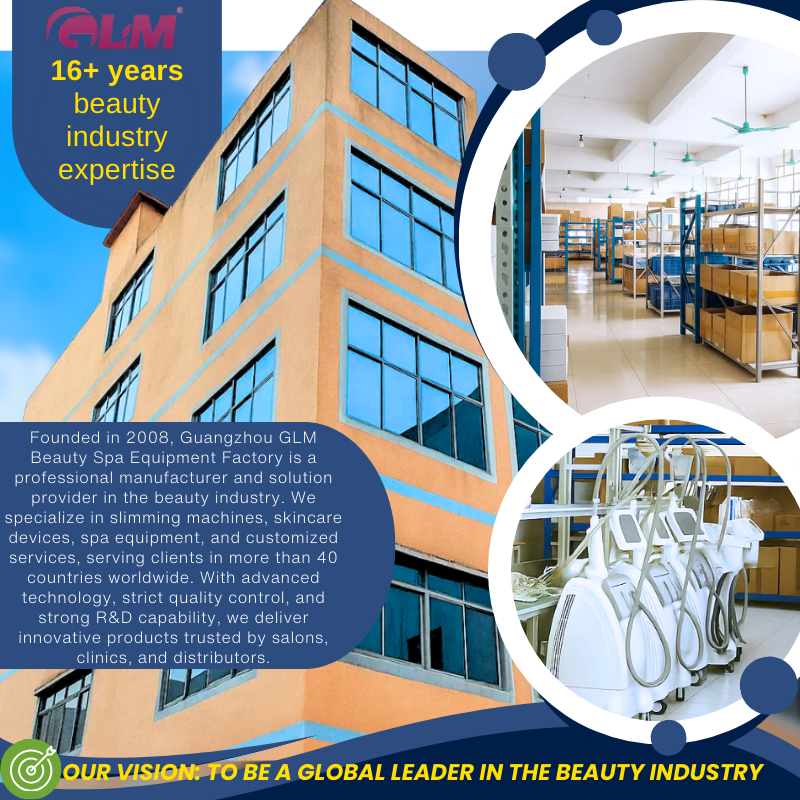
Founded in 2008, Guangzhou GLM Beauty Spa Equipment Factory specializes in research, development, manufacture and selling of beauty and slimming machines. Our production base is located in Guangzhou City, Guangdong Province, China. Since our foundation, we have introduced advanced technologies and equipment, to assure high quality and high performance of our products. With professional marketing guide and excellent after-sales service, our products have been exported to over 20 countries and regions, including Southeast Asia, the Middle East, Europe and the United States, won worldwide praises and gained a good reputation