Introduction
Electrical facial technologies have become an increasingly important part of modern aesthetic treatments. Among them, EMS (Electrical Muscle Stimulation) and microcurrent are two technologies that are often mentioned together—and sometimes even marketed as if they were the same.
They are not.
Both use controlled electrical stimulation, but they differ in electrical intensity, treatment sensation, target tissue, operating principles, and the type of facial treatment they are designed to support. EMS is generally intended to stimulate facial muscles and create controlled contractions, while microcurrent uses much lower electrical currents for a gentler form of stimulation.
For professional beauty salons and aesthetic clinics, understanding this difference is more than a technical exercise. It helps operators select appropriate equipment, design treatment protocols, explain procedures to clients, and build treatment menus around different customer needs.
As professional beauty equipment continues to evolve, the real advantage is not simply having an electrical facial device. It is having the right technology, suitable parameters, professional applicators, and a treatment protocol that matches the client's objectives.
Background: Why Are EMS and Microcurrent Often Confused?
The confusion is understandable.
Both EMS and microcurrent devices may use handheld probes, conductive gel, facial electrodes, or similar-looking treatment heads. Both are commonly associated with facial toning, lifting, firming, and contouring. As a result, a client—or even a new beauty therapist—may assume that they are simply two names for the same treatment.
In reality, the technologies operate differently.
The most fundamental distinction is the level of electrical current and the physiological response it is designed to produce. Microcurrent is generally delivered at very low current levels, typically in the microampere range, whereas EMS generally operates at stronger levels capable of activating motor nerves and producing muscle contractions. The exact output, waveform, pulse duration, and frequency vary considerably between devices, so current strength alone should not be treated as a universal measure of performance.
This distinction is particularly relevant in professional environments.
A salon may want a gentle facial treatment for clients who are primarily concerned with skin appearance and overall facial freshness. Another client may be more interested in facial muscle stimulation and a more noticeable toning sensation.
These are different treatment objectives—and the equipment should reflect that difference.
Technology & Mechanism: How Does Microcurrent Work?
Microcurrent uses an extremely low electrical current to interact with the skin and underlying tissues. Because the current is very subtle, clients typically experience little sensation, although a mild tingling or metallic sensation can occur depending on the device and treatment conditions.
Microcurrent treatments are commonly positioned around facial rejuvenation, skin conditioning, facial toning, and temporary improvements in the appearance of firmness and contour.
One commonly discussed mechanism is the interaction between low-level electrical stimulation and cellular activity, including theories involving ATP, cellular metabolism, and tissue function. However, professional operators should distinguish between a proposed biological mechanism and a clinically established cosmetic outcome. The available evidence for long-term aesthetic effects is still less robust than the marketing language surrounding some consumer devices might suggest.
From a treatment-room perspective, the biggest advantage of microcurrent is its gentle operating profile.
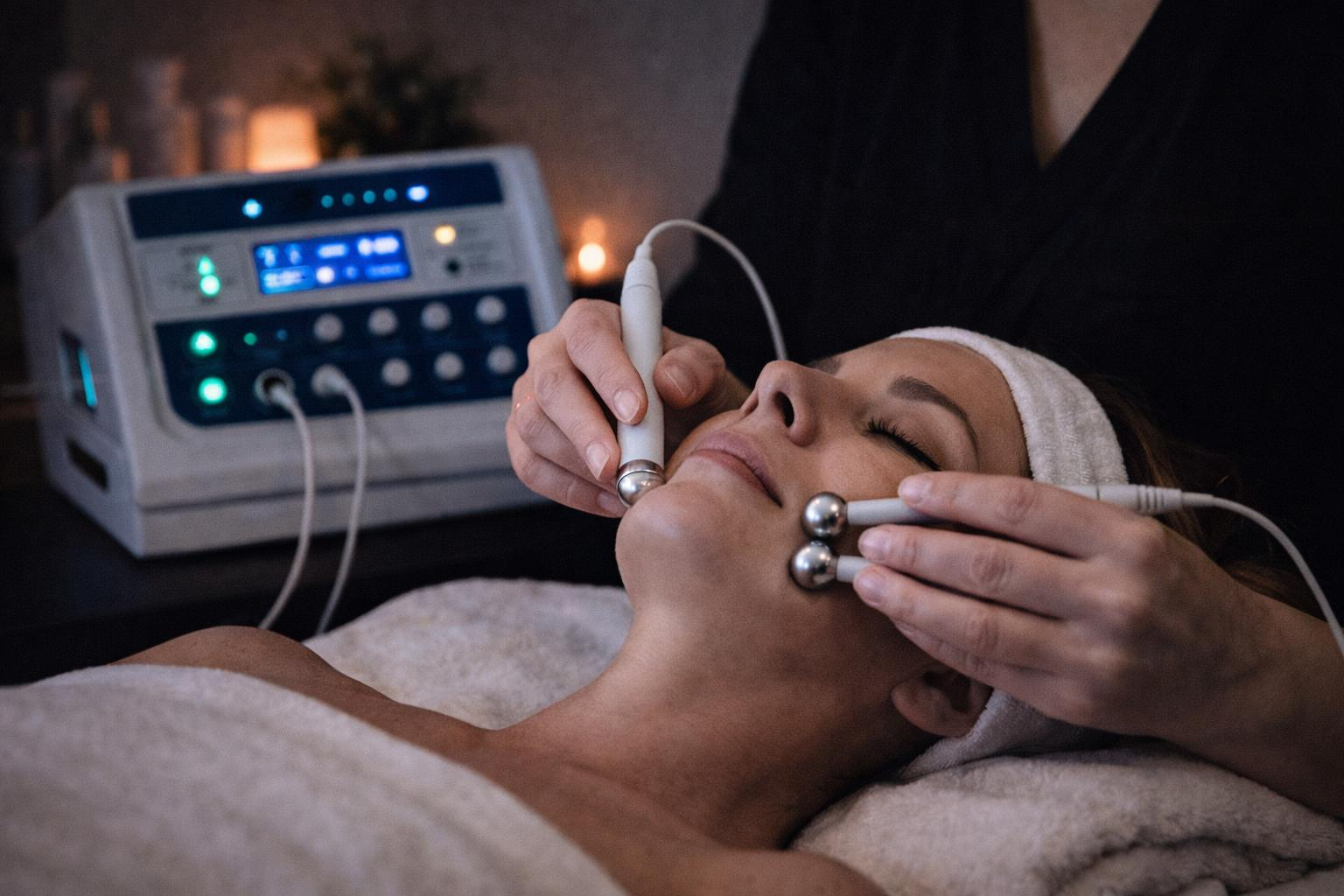
A professional device can use two conductive probes to guide current through selected facial areas while the operator controls movement, contact, intensity, and treatment sequence. This allows the treatment to be integrated into a broader facial protocol rather than functioning as a standalone electrical procedure.
For example, an operator may incorporate microcurrent after cleansing and preparation, using carefully controlled movements along the cheeks, jawline, forehead, or other appropriate areas.
The experience is typically subtle rather than dramatic. That makes microcurrent particularly attractive for treatment menus focused on relaxation, maintenance, facial conditioning, and non-invasive beauty care.
Technology & Mechanism: How Does EMS Work?
EMS stands for Electrical Muscle Stimulation.
Instead of focusing primarily on extremely low-level electrical stimulation, EMS is designed to activate motor nerves and produce controlled muscle contractions. This is the key feature that separates EMS from traditional microcurrent applications.
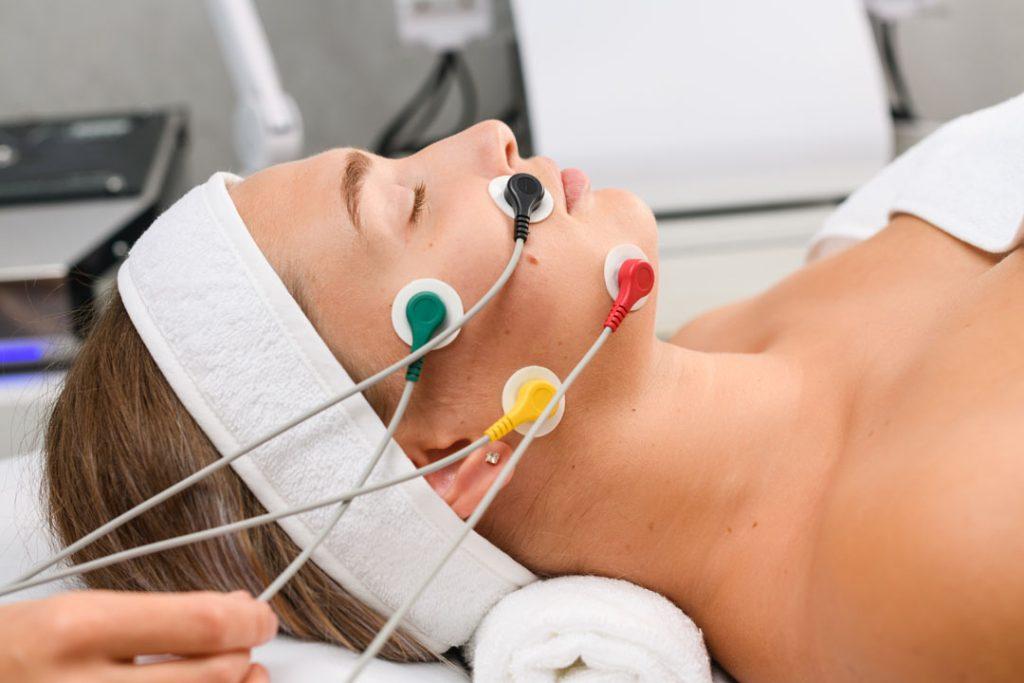
During an EMS facial treatment, the client may notice visible or palpable contractions as electrical pulses stimulate facial muscles. The sensation can therefore be considerably more noticeable than microcurrent.
Think of the distinction this way:
Microcurrent is subtle stimulation. EMS is active muscle stimulation.
EMS can be used to support facial toning and contour-focused treatments because the technology directly engages muscle activity. Professional EMS systems may use different waveforms, frequencies, pulse widths, electrode configurations, and intensity levels to create different treatment experiences.
This is also where professional equipment can offer an important advantage.
Rather than relying on a single fixed program, a professional system may provide adjustable parameters and dedicated applicators. The operator can then select a suitable treatment mode and intensity according to the treatment area, client comfort, and device protocol.
For a beauty clinic, this level of control can make EMS more adaptable to structured facial treatment programs
EMS vs Microcurrent: Key Differences at a Glance
| Feature | EMS | Microcurrent |
|---|---|---|
| Full name | Electrical Muscle Stimulation | Microcurrent |
| General current level | Typically stronger, often milliamp-level | Very low, generally microamp-level |
| Primary target | Facial muscles / motor nerves | Low-level cellular and tissue stimulation |
| Muscle contraction | Designed to produce contraction | Generally avoids visible contraction |
| Treatment sensation | More noticeable | Usually subtle |
| Common positioning | Facial toning and contour-focused treatments | Gentle facial conditioning and maintenance |
| Operator experience | Requires careful placement and intensity control | Requires controlled probe movement and contact |
| Best suited to | Clients seeking a more active muscle-stimulation experience | Clients seeking a gentler electrical facial treatment |
The table should not be interpreted as a universal specification for every machine. Professional equipment can vary substantially in output and treatment design. For clinics and distributors, it is therefore important to evaluate the actual device specifications rather than choosing equipment based only on the word "EMS" or "microcurrent."
Advantages & Comparison: Which Technology Is Better?
The better question is not simply "Is EMS better than microcurrent?"
The more useful question is:
Which technology is better suited to the treatment objective?
1. For Facial Muscle Stimulation: EMS Has the Advantage
When the primary objective is active facial muscle stimulation, EMS is the more directly relevant technology.
The visible contraction produced by EMS gives clients a clear indication that the muscles are being stimulated. This can also make the treatment easier for therapists to explain during consultation.
For facial contouring programs, EMS may therefore become a useful component of a broader professional treatment menu.
2. For Gentle Facial Maintenance: Microcurrent Can Be a Better Fit
Microcurrent offers a much subtler treatment experience.
For clients who dislike strong electrical sensations or who prefer gentle facial maintenance, microcurrent can be positioned as a comfortable addition to a regular beauty program.
Its subtle nature also makes it useful for treatment menus where the overall client experience is intended to feel relaxing rather than intense.
3. EMS Can Create a More Noticeable Treatment Experience
From a marketing perspective, this is another practical difference.
A client may not immediately understand what low-level electrical stimulation is doing. With EMS, however, the muscle contraction can often be felt or observed during treatment.
For professional salons, this creates an opportunity for better client education:
"This technology is designed to actively stimulate the facial muscles."
That explanation is simple, visual, and easier for clients to understand than abstract descriptions of electrical energy.
4. Microcurrent Supports a More Subtle Treatment Concept
Microcurrent can be positioned around maintenance, facial conditioning, and a refreshed appearance.
This makes it suitable for clients interested in regular facial treatments rather than aggressive procedures.
Instead of presenting EMS and microcurrent as competitors, professional clinics can treat them as two different tools within a broader facial technology portfolio.
Applications & Client Needs
A successful professional beauty device is not only about technical specifications. It must solve a practical treatment problem.
EMS for Facial Toning Programs
EMS may be considered for professional facial programs where the main focus is:
- Facial muscle stimulation
- Facial toning
- Contour-focused treatments
- Jawline-focused routines
- Cheek and lower-face treatment programs
- Clients who prefer a more noticeable stimulation experience
The operator's technique remains important. Electrode placement, skin preparation, conductive medium, intensity, treatment duration, and the manufacturer's recommended protocol all influence the treatment experience.
Microcurrent for Gentle Facial Programs
Microcurrent may be more appropriate for treatment programs focused on:
- Facial maintenance
- Skin-conditioning routines
- Gentle facial stimulation
- Mature-skin care programs
- Relaxing facial treatments
- Clients who prefer low-intensity procedures
Because microcurrent treatments are relatively subtle, they can also fit naturally into multi-step facial protocols.
A clinic could, for example, combine cleansing, exfoliation, hydration, serum application, microcurrent, massage, and finishing skincare into a structured facial service.
Professional Equipment vs Home Devices
This is where professional beauty equipment has an important commercial advantage.
Home-use devices are designed around convenience, portability, simplified operation, and consumer-friendly settings. Professional systems, by contrast, can be designed around treatment versatility and operator control.
Depending on the equipment, professional systems may offer:
- Multiple intensity levels
- Different treatment modes
- Dedicated facial probes or electrodes
- Larger treatment interfaces
- Adjustable treatment parameters
- More structured treatment protocols
- Integration with other professional facial technologies
For a salon or clinic, the value is therefore not simply stronger output.
The real value is control and repeatability.
A trained operator can evaluate the client's treatment objective, select the appropriate technology, adjust the treatment parameters within the manufacturer's guidelines, and integrate the device into a complete service.
This is particularly valuable for businesses that want to create standardized treatment packages rather than offering a device as a standalone gadget.
How Can Clinics Choose Between EMS and Microcurrent?
Before investing in an electrical facial device, professional buyers should look beyond the technology name.
Consider the Treatment Objective
Ask first:
What type of treatment do we want to provide?
If the treatment menu is focused on facial muscle stimulation and contour-oriented services, EMS may be a more relevant choice.
If the clinic wants gentle electrical facial treatments that can be integrated into maintenance facials, microcurrent may be more appropriate.
Consider Device Parameters
The technology label alone does not tell the whole story.
Professional buyers should examine:
- Output range
- Waveform
- Frequency
- Pulse duration
- Electrode design
- Treatment modes
- Intensity adjustment
- Safety features
- User interface
- Treatment protocol
- Certifications and regulatory requirements applicable to the target market
Two machines labeled "EMS" can provide very different treatment experiences.
Consider Operator Training
Electrical facial treatments require proper understanding of equipment operation.
Operators should know how to prepare the skin, establish suitable electrode contact, select appropriate settings, position applicators correctly, and monitor client comfort throughout the session.
Professional training is particularly important when working with stronger stimulation technologies such as EMS.
Clinics should also follow the manufacturer's contraindications, operating instructions, and applicable local regulations rather than assuming that every electrical facial technology is appropriate for every client.
Conclusion
EMS and microcurrent may appear similar because both use electrical stimulation in facial beauty treatments, but their fundamental treatment approaches are different.
EMS is designed to actively stimulate muscles and create controlled contractions, while microcurrent uses much lower electrical stimulation for a gentler treatment experience.
Neither technology is universally "better."
For professional beauty salons and aesthetic clinics, the better choice depends on the treatment objective, target client, device parameters, operator expertise, and overall service design.
More importantly, modern professional beauty equipment should not be evaluated simply by how many functions a machine has. The real value lies in whether the technology can be translated into safe, consistent, customizable, and commercially viable treatment services.
For clinics building advanced facial treatment menus, EMS and microcurrent can each occupy a distinct position. One can provide a more active muscle-stimulation experience; the other can support a gentler facial maintenance approach.
When the technology, equipment design, and professional protocol work together, electrical facial treatments become more than a device feature—they become a practical part of a modern beauty clinic's treatment portfolio
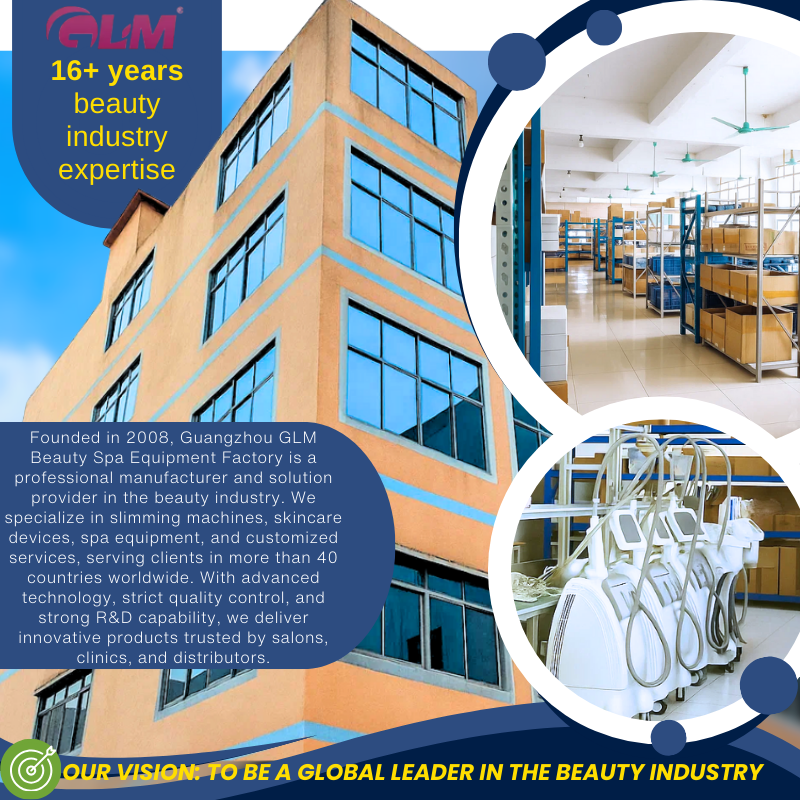
Founded in 2008, Guangzhou GLM Beauty Spa Equipment Factory specializes in research, development, manufacture and selling of beauty and slimming machines. Our production base is located in Guangzhou City, Guangdong Province, China. Since our foundation, we have introduced advanced technologies and equipment, to assure high quality and high performance of our products. With professional marketing guide and excellent after-sales service, our products have been exported to over 20 countries and regions, including Southeast Asia, the Middle East, Europe and the United States, won worldwide praises and gained a good reputation