
Introduction
A well-defined jawline has become one of the most requested facial aesthetic goals in professional beauty clinics. Clients increasingly want a sharper lower face, improved facial definition, and a more lifted appearance—without surgery or extended downtime.
This demand has made non-invasive skin tightening technologies an important part of modern aesthetic treatment menus. Among them, High-Intensity Focused Ultrasound, commonly known as HIFU, has gained attention for its ability to deliver focused ultrasound energy into targeted tissue layers beneath the skin.
Unlike conventional skincare treatments that primarily work at the surface, professional HIFU systems are designed to deliver energy at controlled depths. This allows practitioners to target specific tissue layers associated with skin firmness and facial support.
So, how exactly does HIFU improve the jawline and facial contours? The answer lies in the combination of focused energy delivery, controlled thermal stimulation, collagen remodeling, and professional treatment planning.
Background: Why Facial Contours Become Less Defined
A youthful facial contour is influenced by several factors, including skin elasticity, collagen density, soft-tissue distribution, and the structural support of deeper facial layers.
As people age, collagen and elastin production gradually decline. The skin may become less firm, while changes in soft-tissue volume and facial support can contribute to a less defined lower face.
Common concerns include:
- A softer or less visible jawline
- Mild skin laxity around the lower face
- Sagging along the cheeks or jaw
- A heavier-looking lower facial contour
- Loss of definition between the jawline and neck
Lifestyle factors can also influence facial appearance. Changes in body weight, sun exposure, environmental stress, and natural aging may all affect skin firmness and elasticity.
Traditional skincare products can support surface hydration and skin condition, but they cannot deliver focused energy into deeper tissue layers. This is one reason professional energy-based aesthetic equipment has become increasingly relevant in facial contouring treatments.
How HIFU Technology Works
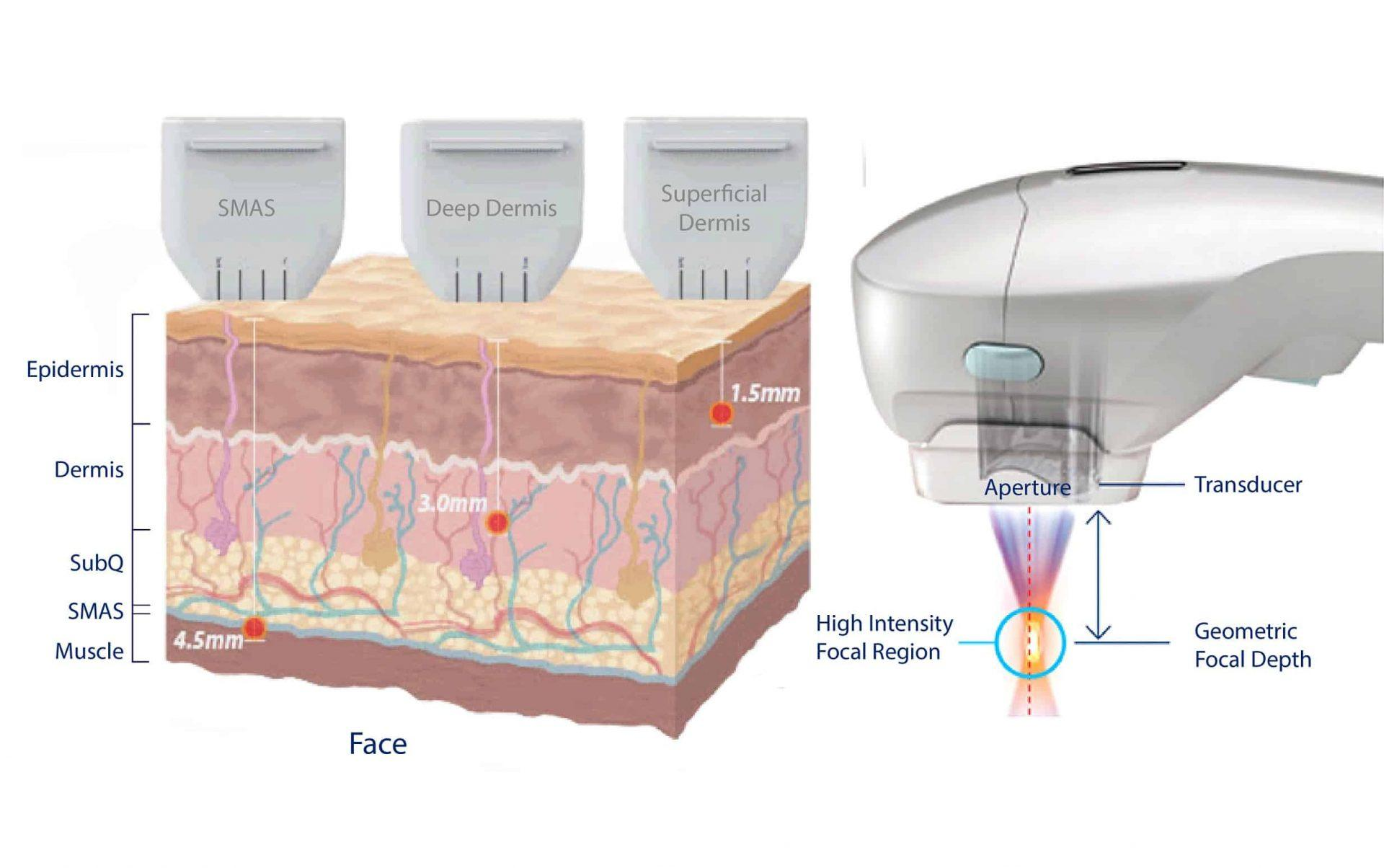
HIFU uses high-intensity focused ultrasound energy to create precisely controlled thermal points beneath the skin.
Rather than heating a large area of tissue uniformly, the technology concentrates ultrasound energy at selected depths. Depending on the device and treatment protocol, energy may be delivered to different tissue layers beneath the skin.
The controlled thermal stimulation can trigger a natural wound-healing response. As part of this process, the skin may gradually increase collagen remodeling and tissue contraction.
The result is not typically an instant transformation. Instead, facial tightening and contour refinement generally develop progressively as the skin undergoes remodeling.
This gradual mechanism is one of the reasons HIFU has become attractive for clients looking for a natural-looking improvement rather than a dramatic surgical change.
Targeting Different Tissue Depths
One of the key advantages of professional HIFU equipment is the ability to work at different treatment depths.
Different cartridges or transducers may be designed for different tissue levels. Depending on the system, practitioners can select appropriate depths for areas such as the forehead, cheeks, lower face, jawline, or neck.
This depth-based approach allows treatment protocols to be customized according to:
- Treatment area
- Skin thickness
- Degree of laxity
- Facial structure
- Client goals
- Practitioner assessment
Professional treatment is therefore not simply a matter of applying ultrasound energy to the skin. The quality of the treatment depends on appropriate energy selection, depth selection, treatment pattern, and operator technique.
How HIFU Helps Define the Jawline
The jawline is one of the most visible areas of the face, which makes it particularly important when clients want a more sculpted appearance.
HIFU may support jawline definition through several mechanisms.
1. Supporting Skin Tightening
When skin laxity is contributing to a softer jawline, controlled ultrasound energy can stimulate tissue remodeling and support a firmer appearance.
As collagen remodeling develops over time, the skin may appear tighter and more supported around the lower face.
2. Improving Lower-Face Definition
A less defined jawline is not always caused by excess tissue alone. Skin laxity can cause the lower facial contour to appear blurred.
By focusing treatment on appropriate areas around the lower face, practitioners can incorporate HIFU into a broader facial contouring strategy.
3. Supporting the Appearance of a Lifted Lower Face
Professional HIFU treatments are often used when clients want a subtle lifting effect without surgery.
The goal is not necessarily to create an extremely sharp or artificial contour. Instead, the objective is often to improve overall facial balance and restore a firmer-looking appearance.
4. Addressing the Jawline and Neck as a Connected Area
The jawline does not exist independently from the neck. When skin laxity extends below the jaw, treating only the face may not provide the desired visual balance.
For suitable clients, professional treatment planning may therefore consider the lower face, jawline, and upper neck as part of one contouring area.
HIFU and Facial Contouring: What Makes Professional Equipment Valuable?
Not all HIFU systems are designed in the same way. For professional beauty clinics and aesthetic practices, the equipment itself can have an important impact on treatment flexibility and workflow.
Controlled Energy Delivery
Professional systems are designed to provide controlled energy output. This allows practitioners to select treatment parameters according to the treatment area and client assessment.
Multiple Treatment Depths
Different areas of the face have different anatomical characteristics. A system offering multiple depth options can provide greater flexibility than a one-depth approach.
Treatment Precision
Jawline contouring requires attention to facial anatomy and treatment positioning. Professional operators can adjust treatment patterns according to the individual's facial structure rather than using an identical protocol for every client.
Consistent Treatment Workflow
For clinics, equipment should not only perform well technically; it should also support an efficient treatment process.
A professional HIFU platform with an intuitive interface, interchangeable cartridges, clear parameter controls, and ergonomic handpieces can make treatment planning and operation more convenient.
This is particularly valuable for clinics offering HIFU as part of a broader facial rejuvenation program.
HIFU vs. Conventional Facial Care
HIFU should not be viewed as a replacement for every skincare or aesthetic technology. Different technologies work through different mechanisms.
| Treatment Approach | Primary Focus | Typical Role |
|---|---|---|
| Skincare | Surface skin condition | Hydration and maintenance |
| Facial massage | Circulation and relaxation | Temporary appearance enhancement |
| RF | Controlled radiofrequency heating | Skin tightening and remodeling |
| HIFU | Focused ultrasound energy | Deeper targeted tightening |
| Surgical lifting | Structural surgical correction | Significant tissue repositioning |
The key distinction is that HIFU uses focused ultrasound energy to target selected tissue depths rather than simply treating the outer surface of the skin.
For professional clinics, this makes HIFU a useful technology to position alongside other aesthetic services rather than as a one-size-fits-all solution.
Applications in Professional Beauty Clinics
HIFU can be incorporated into different facial treatment strategies depending on client needs and practitioner assessment.
Jawline Definition Treatments
Clients who are primarily concerned about a softer jawline may be interested in treatments focused on improving the appearance of firmness and definition around the lower face.
Lower-Face Tightening
For clients experiencing mild to moderate skin laxity, practitioners may develop protocols focused on the cheeks, lower face, and jawline.
Face and Neck Treatments
When concerns extend from the lower face toward the neck, a combined treatment plan can help create a more balanced appearance.
Facial Rejuvenation Programs
HIFU can also be integrated into broader professional facial rejuvenation programs. Depending on the clinic's equipment portfolio, it may be combined with technologies such as RF, LED, microcurrent, or other non-invasive modalities.
The advantage of a multi-technology approach is that different technologies can address different aspects of facial appearance.
What Clients Should Expect from a HIFU Jawline Treatment
One of the most important points for clinics to communicate is that HIFU is generally a gradual treatment rather than an immediate surgical-style transformation.
During a professional session, the practitioner assesses the treatment area and selects suitable cartridges and parameters. Ultrasound energy is then delivered according to the planned treatment pattern.
Some clients may notice an initial feeling of firmness, but the more meaningful visual changes generally develop progressively as tissue remodeling takes place.
Results can vary depending on factors such as:
- Age
- Skin condition
- Degree of laxity
- Facial anatomy
- Treatment parameters
- Device characteristics
- Operator technique
- Individual response
This is why professional assessment remains important.
HIFU is also not intended to replace surgery when a client requires significant structural correction. Instead, it is generally more suitable for clients seeking non-invasive or minimally disruptive aesthetic options.
Why Practitioner Expertise Matters
Advanced equipment alone does not guarantee an effective treatment.
HIFU requires an understanding of facial anatomy, treatment depth, energy delivery, and appropriate treatment areas. Incorrect parameter selection or inappropriate treatment positioning can reduce the effectiveness of a treatment and may increase the risk of unwanted effects.
For professional clinics, operator training and standardized treatment protocols are therefore just as important as the device itself.
A well-designed HIFU system can provide the technological foundation, but practitioner expertise determines how that technology is applied.
This is also one of the major differences between professional aesthetic equipment and simplified consumer-oriented devices. Professional systems are typically designed around treatment customization, operational control, and clinical workflow rather than simply providing a basic energy output.
Building HIFU into a Professional Treatment Menu
For beauty clinics and aesthetic centers, HIFU can represent more than a single facial treatment. It can become part of a structured facial contouring and rejuvenation service.
A clinic may position HIFU around several customer needs:
“My jawline looks less defined.”
Focus the consultation on lower-face firmness and contour appearance.
“My skin feels less tight than before.”
Discuss professional skin-tightening options and whether HIFU is appropriate.
“I want a lifted appearance without surgery.”
Explain the gradual nature of non-invasive ultrasound-based treatments and set realistic expectations.
“I want a complete facial rejuvenation plan.”
Consider whether HIFU should be combined with complementary technologies or treatments.
This consultation-based approach allows clinics to sell a treatment solution rather than simply selling a machine session.
Conclusion
HIFU has become an important technology in the professional aesthetic industry because it combines focused energy delivery with a gradual skin-remodeling approach.
For jawline and facial contour treatments, its value lies in its ability to deliver controlled ultrasound energy to selected tissue depths, supporting collagen remodeling and a firmer-looking appearance over time.
The technology is particularly relevant for clients who want improved facial definition without undergoing surgery or committing to significant downtime.
For beauty clinics and aesthetic practices, professional HIFU equipment can provide greater treatment flexibility through controlled energy delivery, multiple treatment depths, customizable protocols, and efficient clinical workflows.
However, successful facial contouring depends on more than the technology itself. Proper client assessment, suitable treatment parameters, anatomical knowledge, operator training, and realistic expectations all contribute to a responsible and effective treatment experience.
Ultimately, HIFU is not about creating an artificial-looking jawline. Its professional value lies in helping practitioners deliver controlled, personalized, and gradual facial tightening treatments that support a more defined and balanced appearance
Founded in 2008, Guangzhou GLM Beauty Spa Equipment Factory specializes in research, development, manufacture and selling of beauty and slimming machines. Our production base is located in Guangzhou City, Guangdong Province, China. Since our foundation, we have introduced advanced technologies and equipment, to assure high quality and high performance of our products. With professional marketing guide and excellent after-sales service, our products have been exported to over 20 countries and regions, including Southeast Asia, the Middle East, Europe and the United States, won worldwide praises and gained a good reputation