Introduction
Laser hair removal has evolved from a premium cosmetic treatment into a core service offered by professional beauty clinics, aesthetic centers, and salons worldwide. As client expectations continue to rise, clinics are no longer evaluating hair removal devices only by their ability to reduce unwanted hair. Treatment speed, operator convenience, client comfort, consistency, and daily treatment capacity have become equally important.
For a professional clinic, an efficient laser hair removal system can influence much more than a single treatment. A device that covers larger areas efficiently, delivers controlled energy, incorporates effective cooling, and allows operators to adjust parameters according to different treatment needs can help create a smoother workflow and a more scalable service model.
Among professional technologies, diode laser systems are widely used for hair reduction because their wavelength, pulse parameters, spot size, repetition rate, and cooling technologies can be configured for different treatment strategies. Clinical research has also shown that parameters such as spot size and repetition rate can have a meaningful impact on treatment efficiency.
The real question for a modern beauty clinic is therefore not simply, “Does the device remove hair?” It is: How efficiently can the device help the clinic deliver a safe, consistent, and commercially viable treatment experience?
Background: Why Treatment Efficiency Matters
Traditional hair removal methods such as shaving, waxing, and plucking require frequent maintenance. Although these methods remain accessible, they can be time-consuming for clients and do not provide the long-term reduction associated with professional light-based hair reduction.
For clinics, the challenge is different. A treatment may involve a relatively large area such as the legs, back, arms, chest, or full body. If the device has a small treatment area, low repetition rate, limited cooling, or a cumbersome handpiece, treatment time can increase significantly.
Longer treatment sessions create several operational problems.
First, the operator may spend more time treating each individual client. Second, the client may experience greater discomfort or fatigue. Third, longer appointments reduce the number of services a clinic can schedule during a working day.
This makes treatment efficiency an important part of equipment selection.
Research on long-pulsed diode lasers has demonstrated the relevance of spot size to treatment performance. In one randomized study, a larger 805 nm treatment spot produced greater hair clearance than a smaller spot under otherwise similar treatment conditions. Larger spot sizes can also reduce the amount of operator movement required across large treatment areas.
For professional clinics, this translates into a simple operational principle: the right device should make every treatment step more efficient without compromising appropriate parameter selection or client safety.
Technology and Mechanism: How Laser Hair Removal Devices Work
Professional laser hair removal devices work primarily through selective photothermolysis. The laser emits controlled optical energy that is preferentially absorbed by melanin in the hair shaft and follicular structures. The absorbed energy is converted into heat, allowing the follicle to be thermally targeted while the surrounding skin is managed through appropriate treatment parameters and cooling.
Diode laser systems commonly use wavelengths around the 800–810 nm range, although modern platforms may incorporate multiple wavelengths to expand treatment versatility. The choice of wavelength and treatment parameters should depend on factors such as skin tone, hair characteristics, treatment area, and the device's intended clinical protocol.
A professional system typically provides control over several key parameters:
1. Wavelength
Wavelength influences how optical energy interacts with melanin and penetrates the skin.
For example, 808 nm diode laser technology is widely associated with professional hair reduction. Multi-wavelength platforms may combine wavelengths such as 755 nm, 808 nm, and 1064 nm to provide operators with greater flexibility for different skin and hair profiles.
The objective is not simply to offer more wavelengths, but to provide appropriate control and treatment flexibility.
2. Fluence and Energy Delivery
Fluence refers to the energy delivered per unit area. Professional operators need to adjust energy according to the client's skin characteristics, hair thickness, treatment area, and treatment response.
A well-designed device therefore needs stable energy delivery and an intuitive parameter interface rather than simply high maximum output.
3. Pulse Width
Pulse duration affects how energy is delivered to the target.
Different hair densities and characteristics may require different pulse strategies. Modern diode systems allow operators to adjust pulse duration so that treatment parameters can be better matched to the individual client.
4. Spot Size
Spot size is one of the most important factors affecting treatment speed.
A larger spot allows more skin area to be treated with each pulse. This becomes particularly valuable when treating legs, arms, backs, chests, or other large areas.
Studies have found that larger spot sizes can improve treatment efficiency and, under controlled conditions, may also improve hair clearance.
5. Repetition Rate
Repetition rate determines how quickly successive pulses can be delivered.
High-repetition-rate treatment modes can help operators move continuously across larger treatment areas. Research comparing low-fluence, high-repetition-rate 810 nm diode treatment with high-fluence, lower-repetition-rate treatment found effective hair reduction with the high-repetition approach, alongside lower reported pain scores in that study.
This is particularly relevant to clinics where treatment speed is directly connected to appointment capacity.
6. Cooling Technology
Cooling is another critical component of professional laser hair removal equipment.
Contact cooling, sapphire cooling, or other integrated cooling systems can help manage epidermal heat during treatment. Effective cooling can improve client comfort and support consistent treatment delivery.
In professional settings, cooling should not be viewed simply as a comfort feature. It is part of the overall treatment system that helps operators manage energy delivery appropriately.
How Professional Devices Improve Treatment Efficiency
The value of a professional laser hair removal device becomes clearer when viewed from the perspective of daily clinic operations.
Faster Coverage of Large Treatment Areas
Large treatment areas are where equipment efficiency becomes particularly visible.
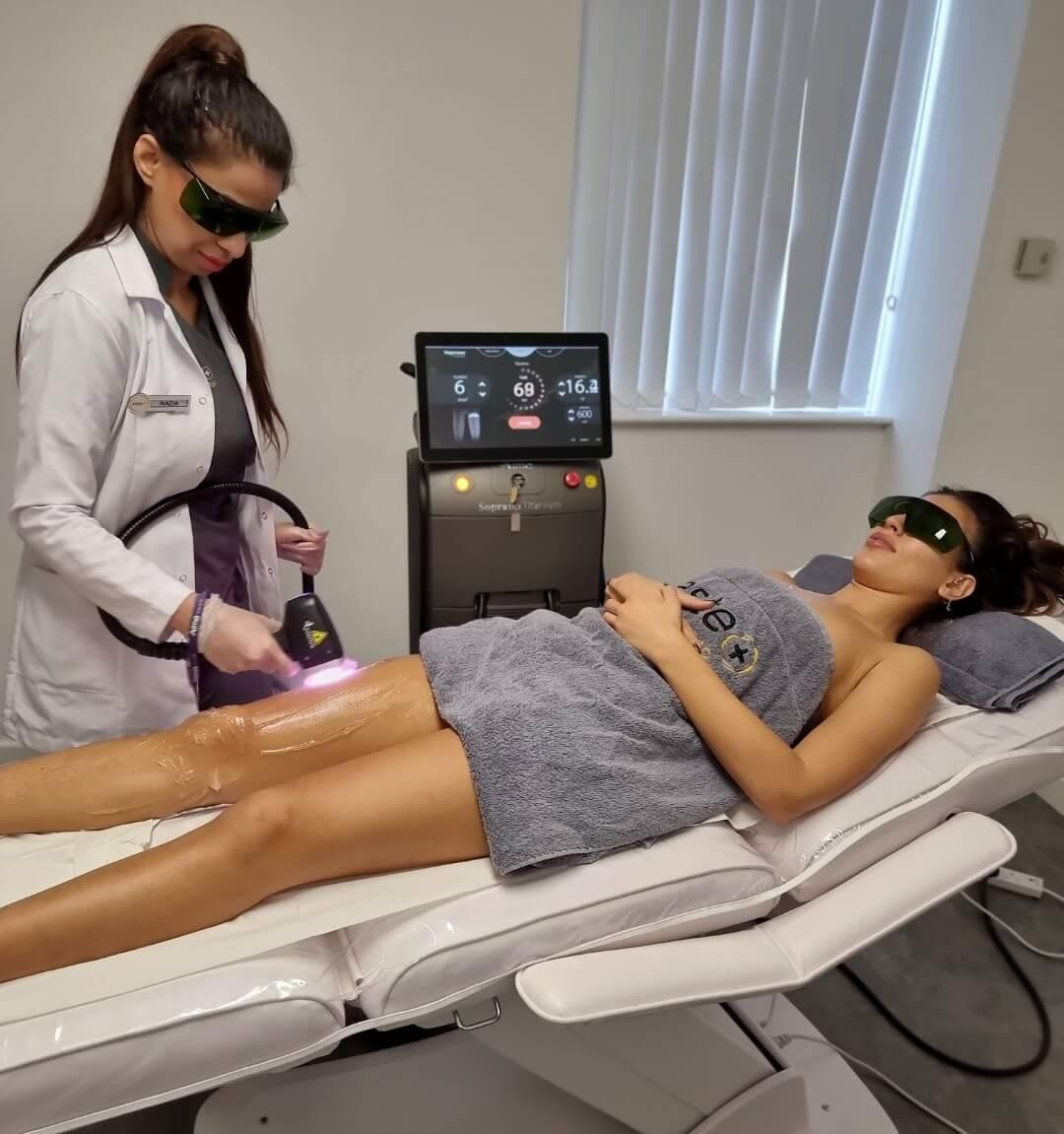
Treating an upper lip requires very different workflow considerations from treating both legs. For small areas, precision and maneuverability are important. For large areas, spot size, repetition rate, handpiece ergonomics, and cooling become increasingly important.
A system designed for rapid coverage can reduce unnecessary hand movements and shorten the time required for each session.
For a clinic, saving several minutes on every large-area treatment can become meaningful over the course of a full working day.
Improved Operator Workflow
A treatment device is used repeatedly throughout the day. Therefore, ergonomic design matters.
A lightweight handpiece, responsive controls, clear parameter display, and easy-to-adjust settings can reduce unnecessary interruptions. Operators can move more naturally from one treatment area to another instead of repeatedly stopping to adjust the equipment.
Professional equipment should support the operator rather than make the operator adapt to the machine.
More Consistent Energy Delivery
Consistency is essential for professional beauty services.
If energy output varies significantly from pulse to pulse, treatment management becomes more difficult. Stable energy delivery, controlled pulse parameters, and reliable cooling can help operators follow established treatment protocols more consistently.
This is particularly important for clinics that employ multiple operators. A well-designed interface and repeatable treatment parameters can help standardize workflows across the team.
Better Client Comfort
Client experience strongly influences repeat bookings.
Laser hair removal naturally produces sensations of warmth, snapping, or discomfort depending on the treatment parameters and individual sensitivity. Device technologies such as cooling systems and high-repetition, lower-fluence treatment approaches can help improve tolerability when appropriately used.
A more comfortable treatment can make it easier for clients to complete recommended treatment schedules and remain satisfied with the overall service.
However, comfort should not be pursued by simply reducing energy without considering treatment effectiveness. Professional operators must balance efficacy, comfort, skin response, and safety for each client.
Higher Daily Treatment Capacity
Clinic productivity is closely related to treatment time.
Consider a clinic that performs multiple large-area hair reduction sessions every day. If each appointment can be completed more efficiently, the clinic may be able to accommodate additional bookings without simply extending operating hours.
This is one reason professional buyers should evaluate laser equipment based on workflow efficiency, not just technical specifications.
A device with a suitable spot size, efficient repetition rate, integrated cooling, ergonomic handpiece, and intuitive interface can contribute to a more productive treatment environment.
Professional Laser Devices vs. Home Hair Removal Devices
Home-use hair removal products have expanded consumer access to light-based hair reduction. However, professional clinic equipment serves a different purpose.
Home devices generally prioritize simplicity, portability, consumer usability, and lower operating complexity. Professional systems, by contrast, are designed around trained operators, adjustable treatment parameters, repeated daily use, larger treatment areas, and professional workflow requirements.
The distinction is particularly important when treating large areas.
A professional clinic may need to treat legs, backs, arms, chests, or multiple body areas within a scheduled appointment. Professional handpieces and larger treatment spots can make these workflows considerably more practical.
Professional equipment also allows trained operators to evaluate the client's skin and hair characteristics before selecting appropriate parameters. This personalized approach is fundamentally different from a simplified consumer workflow.
For clinics, therefore, the advantage of professional equipment is not merely stronger output. It is greater control over the entire treatment process.
Applications Across Different Client Needs
Laser hair removal services can be incorporated into a wide range of professional beauty and aesthetic programs.
Facial Hair Reduction
Areas such as the upper lip, chin, jawline, and sideburns require precision because they are relatively small and may contain different hair densities.
A maneuverable handpiece and precise parameter control can help operators treat these areas efficiently while maintaining careful coverage.
Underarm Treatments
The underarm is a common treatment area because it is relatively compact and frequently has dense, coarse hair.
Efficient spot coverage combined with appropriate cooling can help streamline treatment sessions.
Arms and Legs
Large areas require a different workflow.
Here, treatment speed becomes particularly important. A suitable spot size and high repetition rate can reduce the number of passes required across the treatment area.
Back and Chest Treatments
Male clients increasingly seek professional body hair reduction for the chest, back, shoulders, and arms.
These areas can be significantly larger than facial treatment zones, making handpiece ergonomics, treatment speed, and consistent energy delivery especially valuable.
Customized Treatment Programs
Not every client has the same hair color, thickness, density, or skin type.
Professional clinics can use consultation and skin assessment to develop individualized treatment plans rather than applying one fixed setting to every client.
This is where adjustable professional systems provide practical value: the equipment becomes a platform that can support different treatment strategies rather than a single-purpose appliance.
What Clinics Should Look for When Choosing a Laser Hair Removal Device
When evaluating equipment, clinic owners should consider more than maximum power.
A practical evaluation can include:
- Wavelength configuration: Does the system match the clinic's target client base and treatment strategy?
- Spot size: Is it suitable for both small and large treatment areas?
- Repetition rate: Can the device support efficient large-area treatments?
- Cooling: Is cooling integrated and consistent throughout treatment?
- Handpiece ergonomics: Can operators use it comfortably during repeated sessions?
- Parameter control: Can trained operators adjust settings according to individual treatment needs?
- Interface: Are treatment parameters easy to monitor and manage?
- Reliability: Is the system designed for repeated professional use?
- Maintenance: Are consumables, cooling systems, and service requirements manageable?
- Training and support: Does the supplier provide adequate technical and operational support?
The best machine for a clinic is not necessarily the machine with the highest specification on paper. It is the system that combines appropriate technology with practical workflow efficiency.
Conclusion
Laser hair removal devices have become an important part of modern professional beauty services because they combine technology with a repeatable treatment workflow.
For beauty clinics, efficiency means more than delivering laser energy quickly. It means covering treatment areas effectively, maintaining consistent energy delivery, managing client comfort, supporting operator performance, and creating a workflow that can scale with demand.
Technologies such as adjustable wavelengths, optimized spot sizes, high repetition rates, integrated cooling, ergonomic handpieces, and flexible parameter control can all contribute to this goal. Clinical research supports the importance of factors such as spot size, repetition rate, and treatment parameters in determining treatment performance.
As competition in the professional beauty market continues to increase, clinics need equipment that does more than perform a treatment. They need systems that help them deliver a consistent client experience while making better use of operator time and treatment capacity.
That is ultimately where the value of professional laser hair removal technology lies: not simply in reducing unwanted hair, but in making the entire treatment process more efficient, controlled, and suitable for a modern professional clinic
Founded in 2008, Guangzhou GLM Beauty Spa Equipment Factory specializes in research, development, manufacture and selling of beauty and slimming machines. Our production base is located in Guangzhou City, Guangdong Province, China. Since our foundation, we have introduced advanced technologies and equipment, to assure high quality and high performance of our products. With professional marketing guide and excellent after-sales service, our products have been exported to over 20 countries and regions, including Southeast Asia, the Middle East, Europe and the United States, won worldwide praises and gained a good reputation