1. Introduction
Organic skincare continues to attract attention in the beauty industry as consumers become more selective about the ingredients they apply to their skin. In 2026, the conversation is evolving beyond natural formulations and clean beauty claims. Clients increasingly want products that support skin barrier health, provide a comfortable treatment experience, and fit into personalized skincare routines.
For professional estheticians, this shift creates an opportunity to combine botanical skincare with evidence-informed treatment protocols. Plant-derived ingredients such as aloe vera, oat extracts, green tea, and selected botanical oils can contribute to moisturizing, soothing, and antioxidant-focused formulations. However, natural origin does not automatically mean that an ingredient is safer, more effective, or suitable for every skin type.
Professional skincare is also becoming more comprehensive. Rather than relying on products alone, salons and aesthetic clinics can integrate skin analysis, gentle cleansing, appropriate cosmetic formulations, and carefully selected aesthetic devices into a coordinated treatment plan.
The key is to understand what botanical ingredients can realistically achieve, how the skin barrier functions, and where professional equipment can support a more structured treatment experience.
2. Background and Problem: Why Skin Barrier Health Matters
The skin barrier is the outermost protective system of the skin. The stratum corneum, consisting of corneocytes and intercellular lipids, helps limit excessive water loss while protecting the body from external irritants and environmental stressors.
When this barrier is compromised, clients may experience dryness, tightness, flaking, rough texture, redness, or increased sensitivity. These symptoms can be associated with excessive exfoliation, unsuitable products, harsh cleansing, environmental exposure, or underlying skin conditions.
A common mistake in skincare is to focus exclusively on visible concerns, such as dullness, fine lines, and uneven texture, without first considering barrier function. Aggressive exfoliation or excessive use of active ingredients may worsen discomfort when the skin is already irritated.
This is particularly relevant in professional treatment settings. A client requesting a brightening facial or anti-aging procedure may first need a gentler approach that prioritizes comfort and skin tolerance.
Botanical skincare can be useful within this approach, but formulation quality matters. The concentration of an ingredient, extraction method, complete formula, fragrance content, preservatives, and individual sensitivities all influence how a product performs. Essential oils and plant extracts can cause irritation or allergic contact dermatitis in some individuals, even when marketed as natural or organic.
Estheticians should therefore assess the client's skin condition and product history rather than treating “organic” as a guarantee of safety.
3. Technology and Mechanism: How Botanical Skincare and Professional Devices Work Together
3.1 Botanical Ingredients and Their Skincare Functions
Different botanical ingredients serve different formulation purposes. Understanding these differences helps estheticians select products that complement a treatment protocol.
Aloe vera: Aloe-based formulations are commonly used in moisturizing and soothing products. Their performance depends on the specific formulation, ingredient concentration, and product quality. They may be appropriate in selected calming routines, provided the client tolerates the formula.
Oat extracts: Colloidal oatmeal is used in products designed to moisturize and soothe dry or sensitive skin. Certain oat components can support skin comfort, although suitability depends on the individual and the complete formulation.
Green tea: Green tea contains polyphenols, including catechins, that have antioxidant properties in laboratory research. Topical formulations may help support antioxidant-focused skincare, but laboratory findings should not be interpreted as proof that every green tea product delivers a particular clinical result.
Centella asiatica: Also known as cica, this botanical is widely used in formulations intended for sensitive or stressed skin. Specific compounds have been studied for their effects on inflammatory pathways and skin repair, but evidence varies by formulation and intended use.
Jojoba and other emollient oils: Selected plant oils and emollients can help soften the skin and reduce moisture loss by supporting the surface lipid layer. However, the texture and suitability of an oil depend on the formula and the client's skin characteristics.
Botanical ingredients should be selected according to the intended outcome rather than the popularity of a particular plant. A well-formulated product with appropriate humectants, emollients, and barrier-supportive lipids may be more useful than a highly botanical product with an unsuitable fragrance or irritating ingredients.
3.2 Skin Barrier Repair: A Formulation-First Approach
Skin barrier support generally involves three complementary strategies.
First, humectants such as glycerin help attract and retain water in the outer layers of the skin. Second, emollients improve softness and smoothness by filling spaces between surface cells. Third, occlusive ingredients help reduce transepidermal water loss by forming a protective film.
Ceramides, cholesterol, and fatty acids are particularly relevant because they are components of the skin's intercellular lipid structure. Products containing appropriately formulated barrier-supportive ingredients can help maintain hydration and improve the appearance and feel of dry skin.
For estheticians, the practical lesson is simple: botanical ingredients can complement a barrier-supportive formula, but they do not replace the need for an effective formulation. Consistent home care, gentle cleansing, appropriate moisturization, and daily broad-spectrum sun protection remain central to maintaining skin health.
3.3 The Role of Professional Aesthetic Devices
Professional aesthetic equipment can support the delivery of a structured facial service, but the device must match the client's skin condition and the treatment objective.
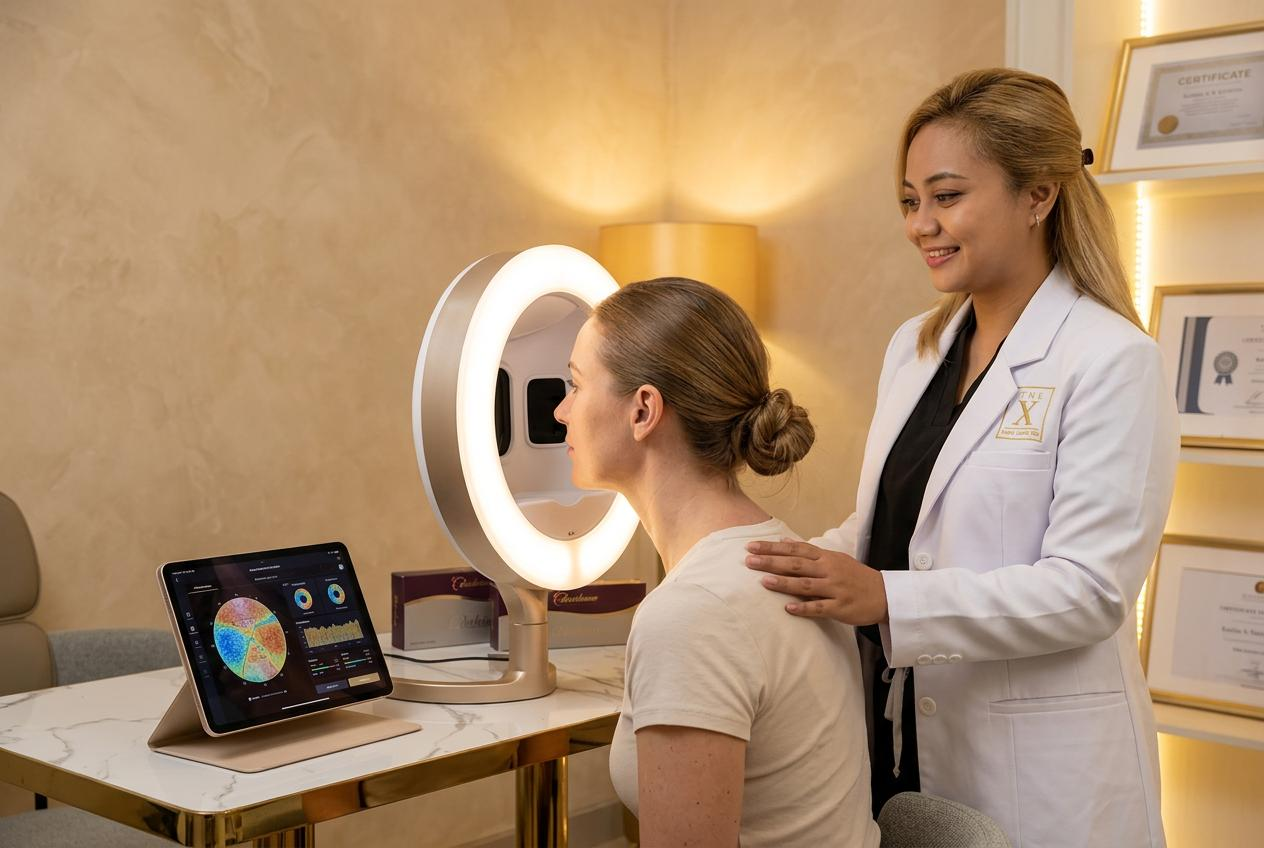
Professional skin analysis systems use combinations of visible-light imaging, specialized illumination, magnification, or other measurement technologies, depending on the model. They can help practitioners document visible concerns such as uneven tone, surface texture, pores, and some forms of redness. Results are most useful when images are captured under consistent conditions and interpreted alongside a consultation. Imaging alone cannot diagnose every skin disorder or directly measure all aspects of barrier function.
Hydrodermabrasion and hydradermabrasion systems typically combine fluid-based cleansing with exfoliation and, depending on the device, suction. They can help remove surface debris and provide a cleansing-focused facial experience. However, stronger suction, abrasive settings, or excessive treatment frequency may irritate compromised skin. Practitioners should reduce intensity or postpone exfoliating procedures when the skin is visibly inflamed, painful, or unusually reactive.
Ultrasonic skin spatulas and cleansing devices use mechanical vibration to assist with surface cleansing and product removal. Their effects depend on the device design, technique, and skin condition. They should not be presented as proven methods for repairing a damaged barrier or delivering botanical ingredients into deeper skin layers without product-specific evidence.
LED phototherapy devices deliver light at selected wavelengths. Different wavelengths interact with tissue in different ways, and the intended outcome depends on wavelength, irradiance, exposure time, device specifications, and treatment protocol. Some professional LED applications have been studied for selected skin concerns, but results cannot be generalized to every device or condition. LED treatment is not a substitute for barrier-supportive skincare or medical assessment when symptoms persist.
The professional advantage is not that a device automatically makes a treatment more effective. It is that suitable equipment, standardized settings, documented procedures, and trained operation can make the service more consistent and easier to personalize.
3.4 A More Thoughtful Treatment Sequence
For a client with dry, sensitive, or easily irritated skin, a conservative sequence may include:
-
A consultation covering current products, recent procedures, sensitivities, and relevant skin history.
-
Visual assessment and, where appropriate, standardized skin imaging.
-
Gentle cleansing with a suitable, low-irritation formulation.
-
A decision on whether any exfoliation or device-based step is appropriate that day.
-
Application of compatible moisturizing and barrier-supportive products.
-
Broad-spectrum sunscreen during daytime services, where appropriate.
-
Clear aftercare instructions and follow-up to assess tolerance.
This sequence is not a universal protocol. Clients with persistent redness, painful inflammation, suspected infection, or unexplained skin changes may need assessment by a qualified healthcare professional before receiving cosmetic treatments.
4. Advantages and Comparison: Professional Treatments Versus Home Skincare
Home skincare and professional treatments serve different purposes. Neither should be positioned as a complete replacement for the other.
Home Skincare: Consistency and Daily Maintenance
Home care allows clients to maintain hydration, protect against UV exposure, and use suitable products regularly. It is usually the foundation of a long-term skincare plan.
Its limitations include inconsistent application, difficulty identifying ingredient sensitivities, and uncertainty about whether a product is appropriate for a particular skin condition. Consumers may also overuse exfoliating acids, retinoids, or fragranced botanical products when trying to achieve faster results.
Professional Salon and Clinic Services: Assessment and Personalization
Professional services offer an opportunity for a more structured consultation, informed product selection, consistent treatment documentation, and access to equipment that may not be practical for home use.
For example, a trained esthetician can use skin analysis images to discuss visible concerns, select an appropriate cleansing method, and decide whether a device-assisted step is suitable. Professional equipment can also support repeatable workflows when settings, hygiene procedures, and operating techniques are standardized.
However, professional treatment does not automatically guarantee superior results. Outcomes depend on practitioner training, equipment quality, appropriate client selection, product formulation, and adherence to safety protocols. Some clients may benefit most from a simple, gentle facial rather than a multi-device treatment.
Organic and Conventional Formulations: What Really Matters?
The word “organic” generally refers to how certain ingredients are produced and certified under the applicable standards. It does not automatically establish that a finished product is hypoallergenic, clinically superior, or more sustainable in every respect.
Estheticians should distinguish between organic certification, natural-origin claims, ingredient transparency, and demonstrated product performance. They should also consider fragrance allergens, preservation systems, packaging stability, and the product's intended use.
A balanced professional approach prioritizes the complete formula, reliable evidence, client tolerance, and realistic expectations over marketing labels alone.
5. Applications and Client Needs: Building Professional Botanical Facial Services
A botanical-focused facial should be designed around the client's needs rather than a fixed combination of products and devices.
For Dry or Dehydrated Skin
The priority is to improve hydration and reduce discomfort. A gentle cleansing routine, humectant-rich serum, moisturizer, and selected emollients may be more appropriate than intensive exfoliation.
Skin analysis can help document visible flaking or uneven texture, while a professional device should be used only when it is compatible with the client's current skin condition. Where the barrier appears compromised, postponing suction-based or abrasive procedures is often the more prudent choice.
For Dullness and Uneven Texture
Clients concerned about dullness may benefit from consistent sun protection, appropriate moisturization, and carefully selected exfoliation when their skin can tolerate it. Green tea and other antioxidant-oriented botanical ingredients may complement the routine, but they should not be marketed as guaranteed solutions for pigmentation or photoaging.
A cleansing or exfoliation device may be considered for suitable clients, with treatment intensity determined by professional assessment. More aggressive treatment is not necessarily better, particularly when the skin is sensitive.
For Clients Seeking a Calming Facial Experience
A soothing facial can combine gentle cleansing, a compatible botanical mask or serum, and a barrier-supportive moisturizer. Some clinics may incorporate an appropriate LED device as part of a broader service, provided the device's intended use and the client's suitability have been assessed.
Practitioners should avoid promising that a calming product or device will eliminate inflammation or treat a medical skin condition. Persistent or severe symptoms warrant appropriate medical evaluation.
For Premium Salons and Aesthetic Clinics
For business owners, botanical skincare and professional equipment can be combined into a clearly defined service menu. Examples include a hydration-focused facial, a gentle cleansing treatment, or a consultation-led skin maintenance program.
The value lies in the complete service: consultation, appropriate product selection, device operation when indicated, hygiene, aftercare, and follow-up. Professional-grade equipment may support a more standardized workflow, while customized formulations allow practitioners to adapt the experience to different client preferences.
When selecting equipment, clinic owners should evaluate the device's intended use, technical specifications, training requirements, cleaning procedures, maintenance costs, manufacturer support, and applicable regulatory requirements. A device should be chosen for its suitability and documented capabilities, not simply because it is marketed as advanced or compatible with organic skincare.
6. Conclusion
Organic skincare in 2026 is best understood as part of a broader movement toward ingredient transparency, individualized care, and healthier skin-barrier practices. Botanical ingredients can contribute to moisturizing, soothing, and antioxidant-focused formulations, but their value depends on product quality, appropriate use, and individual tolerance.
For estheticians, the most effective approach is to combine sound skincare fundamentals with informed product selection and careful treatment planning. Professional skin analysis systems and selected aesthetic devices can support assessment, cleansing, or specific treatment objectives when their capabilities are understood and their use is appropriate.
The objective is not to use the greatest number of products or devices. It is to deliver a consistent, safe, and personalized service that addresses the client's actual needs.
By combining botanical formulations, barrier-supportive home care, professional expertise, and suitable equipment, salons and aesthetic clinics can create more credible treatment experiences and build stronger long-term client relationships
Founded in 2008, Guangzhou GLM Beauty Spa Equipment Factory specializes in research, development, manufacture and selling of beauty and slimming machines. Our production base is located in Guangzhou City, Guangdong Province, China. Since our foundation, we have introduced advanced technologies and equipment, to assure high quality and high performance of our products. With professional marketing guide and excellent after-sales service, our products have been exported to over 20 countries and regions, including Southeast Asia, the Middle East, Europe and the United States, won worldwide praises and gained a good reputation