Fractional Carbon dioxide laser Treatment for Acne Scars: A Comprehensive Analysis of Principles, Classification, Methods and Postoperative Care
In the clinical practice of dermatology, acne scars are a relatively common skin problem that affects patients' appearance and mental health. Acne scars can mainly be classified into three types based on their morphological characteristics: atrophic scars, hypertrophic scars and keloids. Among them, atrophic scars are the most common, which are also known as acne pits in our daily life. They have a significant impact on the facial appearance of patients and often bring them considerable psychological burden.
Detailed classification of acne pits
Icdominoid acne scars
Icicle-shaped acne pits are a type of acne pit that is relatively difficult to treat. Clinically, they can be further classified into deep and shallow types. The formation mechanism of icicle-shaped acne pits is usually associated with less severe inflammatory responses. When the larger comedone contents are discharged, the skin will leave vertical tunnel-like defects, thereby forming this special acne pit morphology. Its main clinical manifestation is the appearance of small defects on the skin surface. These defects are like the marks left by ice cones on the skin, relatively small and of varying depths, which brings certain challenges to the treatment.
Rolling acne scars
Rolling acne pits are more common in the male population and are often found on the temporal and cheek areas. The main cause of its formation is that the deep tissues of the skin are damaged by inflammation, resulting in changes in the local tissue structure. Unlike the manifestations of severe skin atrophy, rolling acne pits are mainly characterized by large-scale subsidence changes, with the skin surface presenting a wavy or undulating appearance, which seriously affects the smoothness and beauty of the facial skin.
Acne scars on van models
Acne depression in box models is the most common type of atrophic scar. In clinical practice, according to their size, depth and boundary characteristics, there exist various variations and atypical forms. Acne depressions in box models are generally formed by the combined effect of full-thickness inflammation and local skin damage. Its main manifestation is atrophic changes in the skin, accompanied by truncated depressions. The edges of these depressions are relatively clear and the shape is similar to a box, hence the name. Different types of acne pits vary in appearance and formation mechanism, which also determines the choice and effectiveness of treatment methods.
The principle and advantages of fractional carbon dioxide laser treatment for acne scars
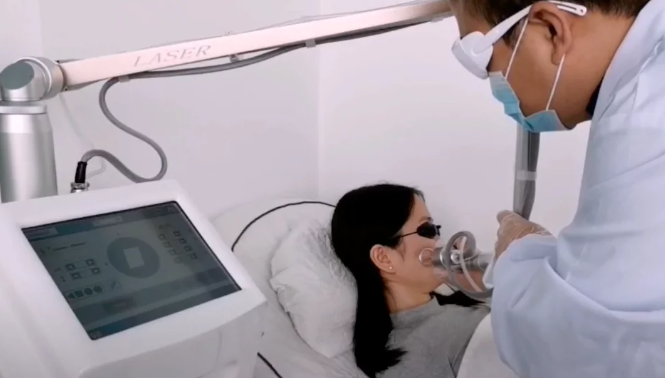
Exfoliating fractional lasers (represented by 10,600 nm fractional CO₂ lasers)
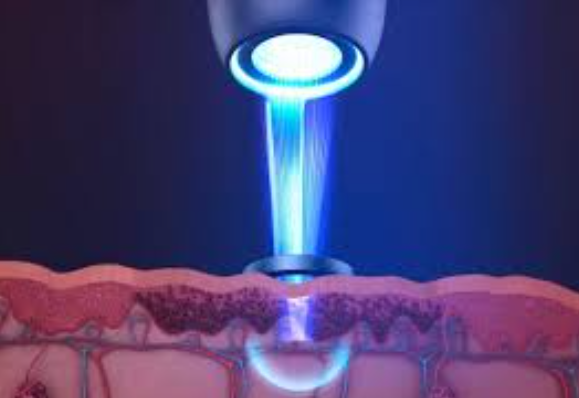
Exfoliating fractional laser has a remarkable therapeutic effect in the treatment of acne scars, especially acne pits (atrophic scars) and mild hypertrophic scars. Its mechanism of action is mainly based on the photothermal effect of exfoliating lasers. When laser is applied to specific areas and layers of the skin, it can cause a certain degree of damage to the skin tissue, and this damage will stimulate the activation of the body's own repair mechanism. During the repair process, the body will produce a large amount of collagen and elastin fibers. These fibers will gradually fill the sunken areas where the skin is missing, promoting skin regeneration and repair.
In terms of technology, the exfoliating fractional laser adopts the super-pulse technology. The application of this technology can significantly shorten the duration of thermal damage and be able to control the range of thermal damage more precisely. By precisely controlling thermal damage, the pain of patients during the treatment process can be effectively alleviated, and the comfort of treatment can be improved. Meanwhile, this device also offers a wide range of treatment mode options. Doctors can precisely control the energy, depth of action and treatment range of the laser based on the specific conditions of the patients, thereby being able to solve more complex skin problems and meet the personalized treatment needs of different patients.
Treatment course and postoperative reactions
Under normal circumstances, exfoliating fractional laser treatment for acne scars requires 2 to 4 sessions, with an interval of 4 to 12 weeks between each treatment. Such treatment intervals are designed to give the skin sufficient time to recover and repair, allowing the therapeutic effect to gradually manifest. During the treatment process, punctate scabs may appear in the treated area, which is a normal phenomenon in the skin's self-repair process. These scabs will fall off by themselves in about 1 to 2 weeks, so patients need not worry too much.
Key points of postoperative care
Postoperative care is crucial for maintaining the therapeutic effect and restoring the skin. The first 24 hours after the operation is the period when the inflammatory response is most obvious. At this time, the skin may show slight exudation, which is a normal phenomenon and patients need not be overly alarmed. Within 3 to 5 days after the operation, patients should pay attention to cooling the skin surface. Cold compresses and other methods can be adopted to alleviate the inflammatory response and discomfort. At the same time, avoid wearing masks as they may rub against the skin and affect wound healing. It is also necessary to avoid contact with raw water. If contact with raw water occurs accidentally, it should be wiped dry immediately with a clean towel to prevent infection.
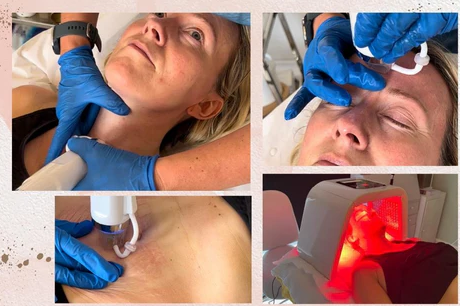
Starting from the first day after the operation, patients can choose to apply medical repair dressings for three consecutive days. Medical repair dressings have the functions of promoting epidermal repair, reducing inflammatory responses, and keeping the skin moist, and can accelerate the healing process of the skin. During the first week of treatment, patients should avoid using cosmetics and strictly refrain from applying makeup, as the chemical components in cosmetics may irritate the skin, affect wound healing, and even cause infection. In addition, sun protection work must be done well. As the skin is more sensitive after the operation, at this time, physical sun protection methods such as wearing a hat and carrying an umbrella should be the main approach. These methods are effective, safe and convenient, and can effectively prevent the damage of ultraviolet rays to the skin and the occurrence of complications such as pigmentation.
Other methods for treating acne scars
Non-ablative fractional lasers (represented by 1550nm lasers)
Non-ablative fractional laser is a minimally invasive treatment method that lies between invasive and non-invasive approaches, and its therapeutic principle is based on local photothermal effects. When the laser acts on the skin, it creates a series of micro-stimulation columns within the skin. The characteristics of these micro-stimulation columns are to maintain the integrity of the stratum corneum while causing coagulation and degeneration of the epidermis and dermis. Columnar dermal collagen can also be denatured by heat stimulation. During the repair process, the stimulated collagen tissue is replaced by new and orderly collagen, thereby achieving the reconstruction and repair of the skin.
Because non-ablative fractional laser treatment only covers part of the skin tissue while preserving the rest of the normal skin, the recovery speed of the skin is relatively fast. After the treatment, patients can quickly return to normal life, requiring less recovery period, being relatively safe, and any part of the body can be treated. For different treatment needs, most non-ablative fractional lasers require multiple treatments, with treatment intervals generally ranging from 3 to 6 weeks. Usually, a total of 4 to 8 treatments are needed to achieve the best results.
Gold microneedle radio frequency
The gold microneedle radio frequency technology employs gold microneedles coated with insulating substances. During the treatment process, the needle tip penetrates the epidermis and reaches the dermis layer, while the epidermis layer is protected by insulating substances and is not subject to thermal stimulation. Radiofrequency and laser act on the collagen in the dermis, causing it to heat up. Relying on the body's self-repair function, the collagen in the dermis is rapidly regenerated and reconstructed under the stimulation of radiofrequency energy.
The application of gold microneedles has multiple advantages. First of all, it can quickly break through the skin barrier. Dense microneedles form an absolutely uniform puncture channel in a short time, precisely targeting the dermis, effectively stimulating the reconstruction and regeneration of new collagen, thereby making the skin tighter, smoother and more elastic. Secondly, this technology can achieve precise treatment targeting for different needs. The gold radiofrequency microneedle has stable energy, high precision, and adjustable energy and depth. The adjustable depth range is 0.3mm to 3.0mm. Doctors can freely adjust the treatment parameters according to the skin thickness of different treatment areas to improve the accuracy of the treatment. In addition, gold microneedle treatment causes less trauma, less pain and no risk of pigmentation. During the treatment process, all the pain was within the patient's tolerable range. After the treatment, the skin may show slight redness and swelling, but there will be no blood spots or scabs, truly achieving minimally invasive treatment. Due to the protection of the epidermal gold insulating layer, it avoids irritation to the epidermis and eliminates the risk of pigmentation, thus being deeply loved by white-collar women.
Picosecond laser
Picosecond laser uses focal technology (honeycomb mode), which can evenly concentrate 100% of the energy on the skin to achieve deeper treatment. Meanwhile, the high-intensity double-layer focused laser acts on the epidermis and dermis respectively, stimulating the regeneration and rearrangement of collagen and elastin fibers, thereby awakening the youthful vitality of the skin. Through this mechanism of action, picosecond laser can effectively improve acne scars, making the skin smoother and tighter.
The importance of the restoration stage and nursing measures
In fact, whether it is fractional carbon dioxide laser or other photothermal treatment methods, they all cause certain trauma to the skin during the treatment process. Some small wounds will appear on the skin, and the barrier function of the skin will also be damaged. If skin care is not paid attention to after the operation, the skin will remain in a dry and dehydrated state for a long time, becoming very sensitive and fragile. This not only affects the therapeutic effect but may also lead to the occurrence of various complications, such as pigmentation caused by inflammatory responses.
Therefore, during the repair stage, it is necessary to use postoperative repair products that have a repair effect, are mild and non-irritating. These products can promote wound healing, provide the skin with necessary nutrients and moisture, and help the skin restore its normal barrier function. At the same time, they can also prevent inflammatory reactions from causing pigmentation, maintain postoperative effects, and enable the skin to better recover its health and beauty.
In conclusion, fractional carbon dioxide laser and many other treatment methods all have significant application value in the treatment of acne scars. Different treatment methods have their own principles, advantages and applicable scopes. Doctors should formulate personalized treatment plans based on the specific conditions of patients, such as the type, severity and skin characteristics of acne scars. Meanwhile, during the treatment process, patients should actively cooperate with the doctor's guidance, do a good job in preoperative preparations and postoperative care, so as to improve the treatment effect, reduce the occurrence of complications, and restore smooth and healthy skin as soon as possible
GLM is a specialized beauty instrument factory that produces instruments for a variety of functions, including weight loss devices. We have vacuum negative press, radio frequency fat blasting equipment, frozen fat dissolving machine and EMS body shaping machine. GLM is a 14 year old supplier of beauty instruments with guaranteed quality.https://gdglmbeauty.com/