
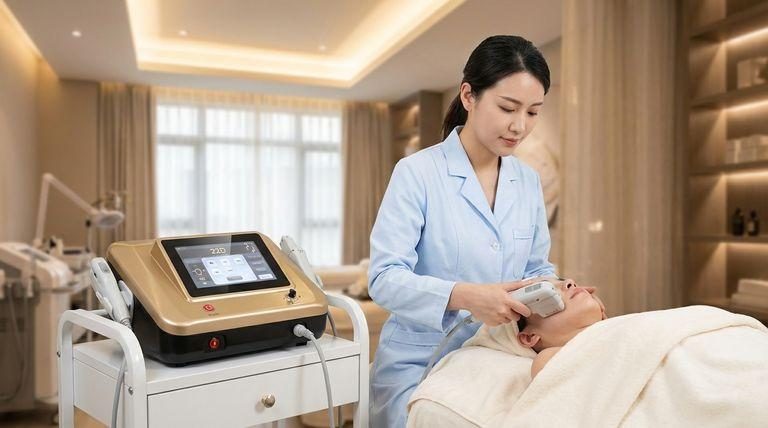
Introduction
The aesthetic industry has increasingly moved toward non-surgical treatments that can deliver visible skin tightening, contouring, and rejuvenation with limited downtime. Among the technologies supporting this trend, High-Intensity Focused Ultrasound (HIFU) has become an important energy-based treatment option for professional beauty clinics and aesthetic practices.
Unlike conventional ultrasound used primarily for imaging or general tissue treatment, HIFU is designed to concentrate acoustic energy at a specific focal point. The energy travels through the tissue and produces a controlled effect at the selected depth. This ability to focus energy beneath the skin is one of the key reasons ultrasound technology has attracted so much attention in professional aesthetics.
For clinics, the value of HIFU is not simply that it uses ultrasound. Its real significance lies in how precisely an appropriately designed system can deliver energy, select treatment depths, manage parameters, and support consistent professional treatment protocols.
Understanding the science behind HIFU therefore helps clinic owners and practitioners better evaluate equipment, treatment applications, and patient expectations.
Background: Why Deeper Skin Tightening Matters
Skin aging is a complex biological process. As people age, collagen and elastin structures gradually change, skin elasticity decreases, and the supporting tissues beneath the skin can become less firm. These changes may contribute to loose skin, less-defined facial contours, fine lines, and visible laxity.
Traditional topical skincare mainly works at or near the skin surface. Many non-invasive technologies also focus primarily on superficial or dermal tissue. However, certain aesthetic concerns involve structures located deeper beneath the epidermis.
This creates an important challenge for professional treatment: How can energy reach a specific deeper tissue layer without unnecessarily affecting the skin surface?
Focused ultrasound offers one approach.
Research on focused ultrasound-based aesthetic technologies has shown that energy can be concentrated at selected tissue depths, creating localized thermal coagulation points while leaving intervening tissue relatively unaffected. Depending on the technology and treatment protocol, commonly discussed focal depths include approximately 1.5 mm, 3.0 mm, and 4.5 mm. These depths correspond broadly to different layers of the dermis and deeper supporting tissues.
This depth-based approach is particularly relevant in professional clinics because practitioners can select treatment parameters according to the treatment area, tissue characteristics, and desired aesthetic objective.
Technology and Mechanism: How HIFU Works
The simplest way to understand HIFU is to imagine a magnifying glass focusing sunlight onto a small point.
The ultrasound transducer performs a comparable function with acoustic energy. Instead of concentrating light, it generates and focuses ultrasound waves. The waves can pass through superficial tissue before converging at a designated focal zone.
At the focal point, acoustic energy is converted into localized biological effects, primarily through thermal mechanisms. When sufficient energy is delivered, tissue temperature at the focus can rise rapidly, producing controlled thermal coagulation. Studies of focused ultrasound describe focal temperatures around or above 60°C in certain treatment conditions.
The surrounding tissue is not exposed to the same concentration of energy. This is what gives focused ultrasound its distinctive treatment principle: controlled energy concentration rather than uniform heating of the entire skin surface.
1. Focused Acoustic Energy
A HIFU handpiece contains a transducer that converts electrical energy into acoustic energy.
The transducer generates ultrasound waves at a selected frequency. Instead of allowing those waves to disperse broadly, the optical design of the transducer causes them to converge at a particular focal region.
The focal point is where the acoustic intensity becomes substantially higher than in the surrounding tissue.
This allows the device to create localized treatment zones beneath the surface rather than relying exclusively on surface heating.
2. Thermal Coagulation
When ultrasound energy is absorbed by tissue, molecular movement increases and heat is generated.
At an adequately controlled temperature and exposure level, proteins within the targeted tissue undergo structural changes. In aesthetic applications, this thermal response can create small zones of controlled tissue injury.
The body's natural healing response then becomes an important part of the treatment process.
The initial thermal effect can cause contraction of existing collagen structures. Over time, tissue remodeling and new collagen formation may contribute to gradual improvements in firmness and skin quality. Focused ultrasound literature describes this combination of immediate collagen contraction and longer-term remodeling as a major component of its skin-tightening effect.
3. The Role of Collagen Remodeling
Collagen is one of the main structural proteins responsible for skin strength and firmness.
When controlled thermal energy affects collagen-rich tissue, collagen fibers can contract and change their configuration. This produces an immediate tightening component. The subsequent wound-healing and remodeling process can stimulate the production and reorganization of collagen and extracellular matrix components.
This explains an important characteristic of ultrasound-based skin tightening: results do not necessarily depend only on what happens during the treatment session.
Instead, the biological response can continue after the procedure.
For clinics, this creates an opportunity to position HIFU treatments as part of a longer-term skin management program rather than simply a one-time surface treatment.
4. Thermal and Mechanical Effects
Although thermal action is central to aesthetic focused ultrasound, ultrasound energy can also generate mechanical effects.
Ultrasound waves repeatedly compress and decompress tissue. At sufficiently high intensities, these pressure changes can contribute to mechanical stress and, under certain conditions, acoustic cavitation.
In HIFU literature, thermal and mechanical mechanisms are discussed together as part of the broader biological response to focused acoustic energy. However, the exact contribution of each mechanism depends strongly on the device, frequency, intensity, pulse structure, tissue characteristics, and treatment objective.
This is why professional equipment should not be evaluated simply by asking whether a device is labeled “HIFU.” The actual technical configuration matters.
Advantages and Comparison with Other Energy Technologies
HIFU is not the only technology used for non-invasive aesthetic treatments. RF, laser, LED, cryotherapy, and other energy-based systems each have different physical mechanisms and treatment targets.
HIFU vs. Radio Frequency
Radio frequency primarily generates heat through the interaction of electromagnetic energy with tissue.
HIFU, by contrast, uses focused acoustic energy to create a defined focal zone.
This distinction is important for treatment planning.
RF can be highly useful for broader tissue heating and skin-conditioning applications, while focused ultrasound is particularly attractive when the treatment strategy requires energy delivery at selected deeper tissue planes.
Some modern professional platforms may even combine different technologies to address multiple treatment objectives.
HIFU vs. Conventional Ultrasound
Conventional ultrasound and HIFU both use acoustic waves, but their applications and energy delivery strategies are different.
Conventional ultrasound is often designed for imaging or broader therapeutic applications. HIFU uses focused acoustic energy to create a concentrated effect at a specific location.
Therefore, the phrase “ultrasound treatment” alone does not adequately describe the capabilities of a professional HIFU system.
HIFU vs. Surface-Based Skincare
Creams, serums, masks, and other topical treatments primarily interact with the outer layers of the skin.
HIFU belongs to a completely different category. Its purpose is to deliver controlled acoustic energy beneath the skin surface.
This does not mean HIFU replaces skincare.
In a professional clinic, the two approaches can complement one another. A practitioner may combine energy-based treatment with an appropriate skincare program to address different aspects of skin appearance.
Applications in Professional Beauty Clinics
The versatility of focused ultrasound makes it relevant to several professional aesthetic treatment categories.
Facial Skin Tightening
One of the best-known applications is facial skin tightening.
Areas such as the lower face, jawline, cheeks, and neck can show visible signs of skin laxity as collagen support changes over time.
Professional HIFU treatments can be designed around different tissue depths, allowing practitioners to create treatment plans according to the anatomy of the treatment area.
Recent systematic-review evidence reported improvements in skin laxity across facial treatment areas, particularly the lower face, neck, and periorbital regions, although outcomes vary according to device, protocol, patient characteristics, and study design.
Jawline and Facial Contouring
Facial contouring has become an important demand in aesthetic clinics.
Clients may not necessarily want a dramatic change. Instead, they may be looking for a more defined jawline, firmer cheeks, or a refreshed facial profile.
This is where controlled energy delivery becomes valuable.
Rather than treating the entire surface uniformly, professional practitioners can design treatment patterns around specific areas and anatomical considerations.
Neck and Décolletage
The neck and décolletage are often among the first areas where changes in skin laxity become noticeable.
Focused ultrasound technologies have been investigated for improving lines and skin laxity in these areas. Professional treatment allows practitioners to adjust treatment parameters and coverage according to the characteristics of each area.
Body Contouring
Focused ultrasound is also associated with body-contouring applications.
At suitable energy levels and depths, ultrasound can affect subcutaneous adipose tissue. Some HIFU systems are specifically designed for body-contouring protocols rather than facial tightening.
Clinical research has reported reductions in body circumference in selected treatment areas, including the abdomen and thighs, although outcomes depend heavily on device parameters, patient selection, and treatment protocol.
For this reason, clinics should clearly distinguish between systems intended primarily for facial skin tightening and systems engineered for deeper body-contouring applications.
Why Professional HIFU Equipment Matters
The technology behind HIFU may sound straightforward, but delivering focused energy safely and consistently is considerably more complicated.
For professional clinics, several equipment factors deserve attention.
Adjustable Treatment Depth
Different areas of the body have different tissue structures.
A facial treatment may require a different focal depth from a body-contouring treatment. Multi-depth cartridges or transducers can therefore provide greater flexibility for professional operators.
Controlled Energy Delivery
Energy level, pulse duration, treatment spacing, and treatment pattern all influence the biological response.
Professional equipment should provide practitioners with sufficient control to adapt treatment protocols rather than forcing every client into the same settings.
Ergonomic Handpieces
Treatment quality is also affected by usability.
A well-designed handpiece can make it easier for practitioners to maintain consistent contact, follow treatment lines, and work efficiently across different anatomical areas.
For clinics performing multiple treatments per day, ergonomics can become an important operational consideration.
Treatment Consistency
Professional aesthetic businesses need repeatable treatment protocols.
A device that allows practitioners to monitor and control key parameters can support more standardized treatment delivery. This is particularly important for clinics with multiple operators or growing treatment volumes.
Training and Operator Expertise
Technology alone does not determine treatment quality.
Professional HIFU treatments require appropriate training, knowledge of anatomy, understanding of contraindications, correct parameter selection, and proper treatment technique.
Equipment manufacturers therefore play an important role beyond supplying the hardware. Clear operating instructions, training resources, technical support, and reliable after-sales service can all contribute to a clinic's ability to use the equipment effectively.
What Clients Are Really Looking For
From a client's perspective, the technical explanation is usually less important than the treatment experience and expected outcome.
Most clients are asking practical questions:
Will it help my skin look firmer?
Can it improve facial definition?
How long does the treatment take?
Will I need significant downtime?
Is the treatment suitable for my skin and treatment area?
Professional clinics can use these questions to build a more responsible consultation process.
Instead of promising dramatic or immediate transformation, practitioners can explain that focused ultrasound works through a combination of controlled tissue effects and the body's subsequent remodeling response.
This helps establish realistic expectations.
It also reinforces the value of professional treatment. A clinic is not simply selling an energy device; it is providing assessment, treatment planning, technical execution, and follow-up.
The Future of Focused Ultrasound in Aesthetics
As aesthetic technology develops, the focus is moving toward greater precision, customization, and treatment consistency.
Recent literature distinguishes conventional HIFU from microfocused ultrasound and microfocused ultrasound with visualization (MFU-V), highlighting differences in energy delivery, focal depth, and visualization capability. MFU-V systems can provide real-time visualization of tissue layers, whereas conventional HIFU systems generally do not provide the same imaging capability.
This distinction is important for equipment buyers.
A clinic should evaluate a device based on its actual technology rather than treating every product carrying the HIFU label as equivalent.
Future professional systems are likely to place increasing emphasis on customizable treatment parameters, improved handpiece ergonomics, more precise energy delivery, integrated treatment guidance, and multi-technology platforms.
For equipment manufacturers and distributors, this creates opportunities to develop systems that are not only technically capable but also practical for daily clinical workflows.
Conclusion
The science behind HIFU is based on a simple but powerful principle: focus acoustic energy where it is needed.
By concentrating ultrasound energy at selected tissue depths, professional systems can create localized thermal effects that may trigger collagen contraction, tissue remodeling, and, in specific body-contouring applications, effects on subcutaneous fat.
Its appeal in aesthetics comes from the combination of depth, controlled energy delivery, and a non-surgical treatment approach.
However, HIFU should not be viewed as a single standardized technology. Different devices can vary significantly in frequency, energy, focal depth, cartridge design, visualization capabilities, treatment protocols, and intended applications.
For beauty clinics and aesthetic practices, choosing the right professional system means looking beyond the word “HIFU.” The most valuable equipment is equipment that combines appropriate technical performance with practical treatment control, ergonomic design, reliable operation, and support for professional workflows.
As demand for non-surgical aesthetic treatments continues to grow, focused ultrasound is likely to remain an important part of the professional energy-based treatment landscape. For clinics seeking to expand their treatment portfolio, a well-designed HIFU platform can provide another technology-driven approach to skin tightening, facial contouring, and selected body-contouring services—when used appropriately by trained professionals
Founded in 2008, Guangzhou GLM Beauty Spa Equipment Factory specializes in research, development, manufacture and selling of beauty and slimming machines. Our production base is located in Guangzhou City, Guangdong Province, China. Since our foundation, we have introduced advanced technologies and equipment, to assure high quality and high performance of our products. With professional marketing guide and excellent after-sales service, our products have been exported to over 20 countries and regions, including Southeast Asia, the Middle East, Europe and the United States, won worldwide praises and gained a good reputation