
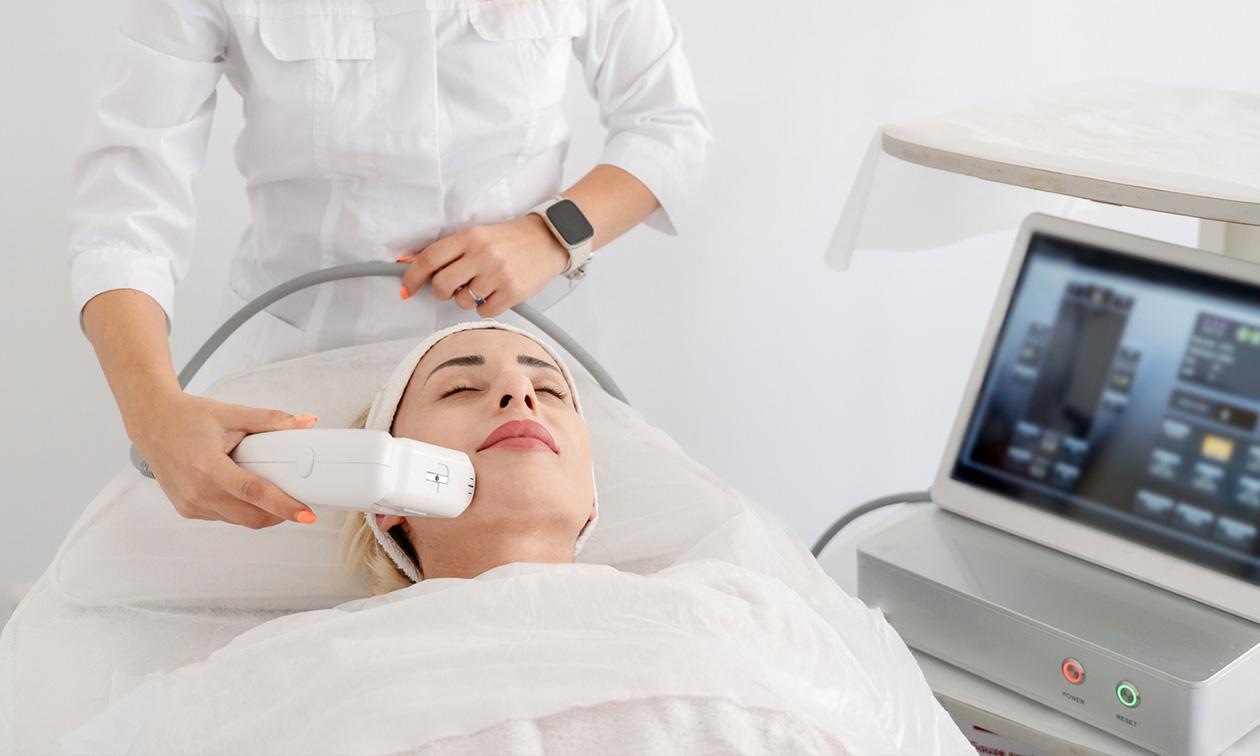
Introduction
The aesthetic industry is moving toward treatments that offer visible results without requiring surgery, prolonged downtime, or complicated recovery. Clients increasingly expect professional treatments that can address skin laxity, facial contouring, and signs of aging while allowing them to return to their normal routines quickly.
For modern beauty clinics and aesthetic centers, this shift creates a demand for technologies that are effective, versatile, and commercially practical. Among the many technologies available today, High-Intensity Focused Ultrasound (HIFU) has become an important option for professional skin tightening and body contouring.
Unlike conventional skincare treatments that primarily work on the skin surface, HIFU uses focused ultrasound energy to deliver controlled thermal energy at selected depths beneath the skin. This allows professional operators to work with deeper tissue structures while keeping the treatment non-invasive. Clinical literature has reported applications including skin tightening, facial rejuvenation, and body contouring.
For clinics, however, the value of HIFU is not simply its technology. Its real advantage lies in how it can become part of a broader treatment portfolio: facial lifting programs, skin-firming services, contouring treatments, and customized anti-aging plans.
Background: Why Modern Clinics Need Versatile Treatment Technology
Aesthetic clients today are more informed than ever. They often compare different procedures before booking an appointment and want to understand not only what a treatment does, but also how it works, how long recovery takes, and whether it can fit into their lifestyle.
This has changed the role of professional beauty equipment.
A clinic can no longer rely only on basic skincare treatments. Clients may want solutions for several concerns at the same time: loose skin around the jawline, reduced facial firmness, visible wrinkles, a less-defined contour, or localized body concerns.
This is where multifunctional professional technologies become valuable.
HIFU provides clinics with a treatment platform that can be incorporated into different service categories. Depending on the specific device, cartridge, treatment depth, energy parameters, and professional protocol, focused ultrasound can be used for facial tightening, lifting-focused treatments, and selected body-contouring applications. Research reviews have identified HIFU as a versatile non-invasive modality for skin tightening, facial rejuvenation, and body contouring.
For a clinic owner, this versatility matters. One professional system can support multiple treatment plans instead of being limited to a single cosmetic concern.
Technology and Mechanism: How HIFU Works
HIFU stands for High-Intensity Focused Ultrasound. Instead of distributing ultrasound energy broadly across the surface, the technology focuses acoustic energy at a selected point beneath the skin.
The principle is relatively straightforward.
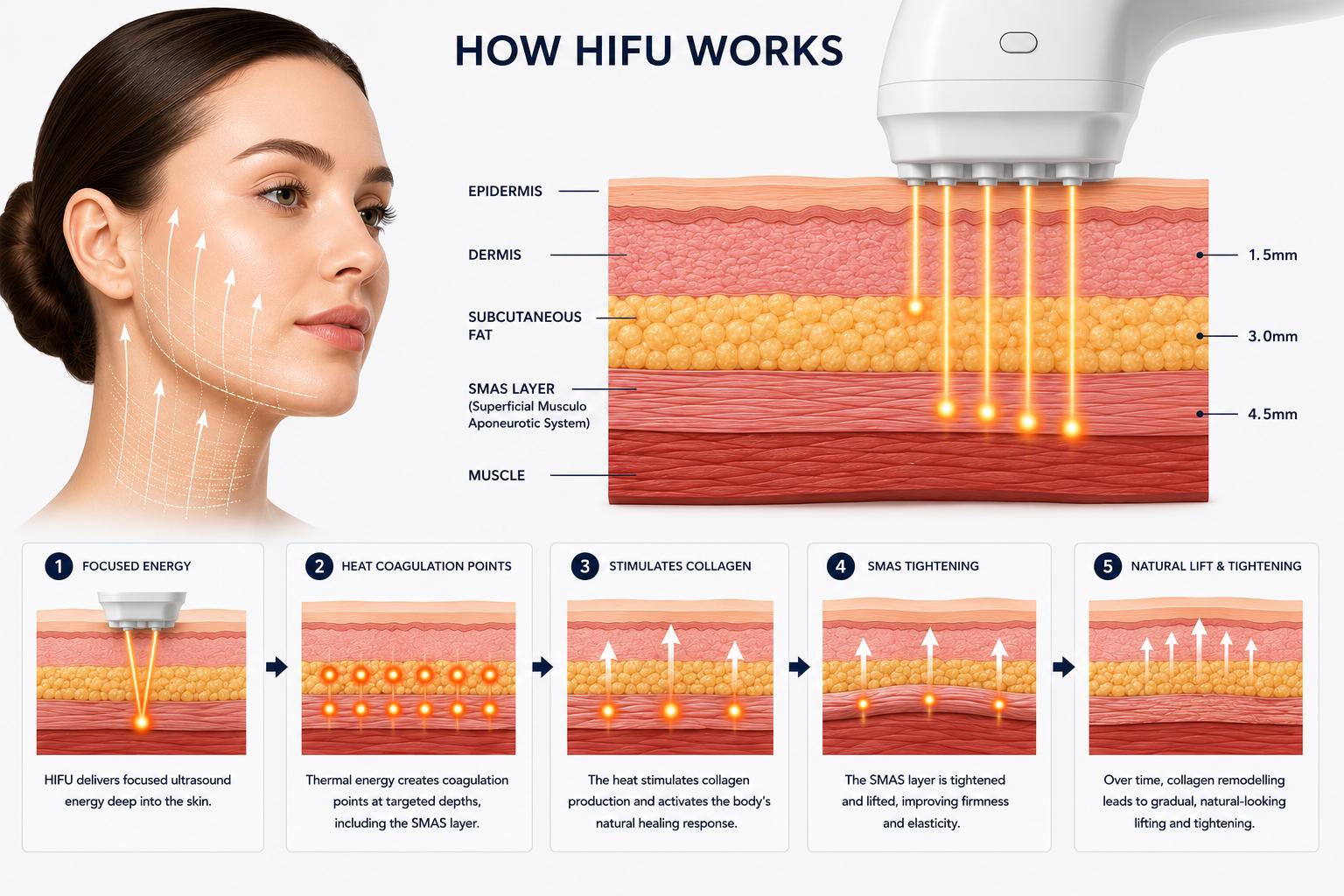
A professional HIFU handpiece uses a transducer to generate ultrasound waves. These waves travel through the tissue and converge at a specific focal depth. At the focal point, acoustic energy is concentrated, producing a controlled thermal effect.
Depending on the device and treatment protocol, different cartridges can target different tissue depths. Common aesthetic HIFU systems may work at depths such as 1.5 mm, 2.0 mm, 3.0 mm, or 4.5 mm, although exact specifications vary between devices.
At the focal area, the concentrated energy can create small zones of controlled thermal injury. Temperatures in focused ultrasound treatments can reach approximately 60–70°C at the treatment focus, triggering collagen contraction and a subsequent tissue-remodeling response.
The important point is that HIFU is not simply “heating the skin.”
It is focused heating at a selected depth.
This distinction is particularly important for professional aesthetic treatments. By controlling treatment depth and energy delivery, practitioners can design treatment protocols according to the client's facial anatomy, skin condition, treatment goals, and the specifications of the device
From Thermal Energy to Skin Remodeling
The thermal effect generated at the focal point can cause collagen fibers to contract and stimulate a wound-healing and remodeling response.
Over time, the body can produce and reorganize new collagen as part of this remodeling process. This helps explain why HIFU results are often progressive rather than limited to an immediate cosmetic effect.
A systematic review of focused ultrasound literature reported improvements in skin laxity, particularly in areas such as the lower face, neck, and periorbital region.
This makes HIFU particularly interesting for clients who are looking for a firmer, more defined appearance without immediately choosing an invasive procedure.
For professional operators, the technology also creates an opportunity to move from generic “anti-aging” services toward more structured treatment programs based on anatomy, depth, energy selection, and treatment objectives.
Advantages and Comparison: Why HIFU Stands Out
1. It Targets Deeper Tissue Layers
One of HIFU's most important characteristics is its ability to focus energy beneath the skin surface.
Many conventional aesthetic technologies primarily interact with the epidermis and superficial dermis. Focused ultrasound can deliver energy deeper into tissue, including deeper dermal and fascial structures depending on the device and cartridge used.
This gives HIFU a different position within a clinic's technology portfolio.
Rather than competing directly with every superficial skincare treatment, it can complement technologies such as RF, LED, microneedling, and other skin-rejuvenation systems.
2. Non-Invasive Treatment Approach
Modern clients often want noticeable aesthetic improvements but are reluctant to undergo surgery.
HIFU provides a non-surgical option that can be incorporated into professional aesthetic treatment plans. Clinical reviews have generally reported favorable safety profiles, although temporary redness, swelling, discomfort, and other treatment-related effects can occur.
For clinics, this can make HIFU suitable for clients who want a professional treatment experience without the recovery requirements associated with surgery.
At the same time, “non-invasive” should not be interpreted as “risk-free.” Correct patient selection, appropriate energy settings, anatomical knowledge, device training, and adherence to manufacturer instructions remain essential.
3. Multiple Treatment Possibilities
Another reason clinics invest in HIFU is versatility.
Facial applications may include:
- Jawline and lower-face tightening
- Skin-firming treatments
- Neck tightening
- Brow-area lifting-focused treatments
- Facial contour refinement
- Wrinkle and laxity management
Depending on the specific equipment and regulatory positioning, HIFU may also be used in selected body-contouring programs.
This range of applications gives clinics greater flexibility when designing treatment menus.
4. Professional Equipment Offers Greater Control
There is an important difference between professional aesthetic equipment and consumer-oriented beauty devices.
Professional systems are designed around controlled energy delivery, treatment parameters, replaceable cartridges or handpieces, operational protocols, and practitioner use. The operator can select appropriate treatment depths and parameters according to the treatment area and the device's specifications.
This is particularly important with focused ultrasound because energy delivery is highly dependent on treatment depth, intensity, spacing, and technique.
A professional HIFU system therefore should not be evaluated only by its appearance or the number of functions displayed on its screen. Clinics should also consider transducer design, available depths, energy control, treatment consistency, ergonomics, safety features, training support, and after-sales service.
Recent comparative research has highlighted substantial differences between HIFU/MFU devices in areas such as frequency, energy levels, treatment depths, treatment points, and visualization capabilities.
Applications and Client Needs
Facial Skin Tightening
Facial tightening remains one of the most recognizable applications of HIFU.
As skin ages, changes in collagen, elastin, tissue structure, and fat distribution can contribute to reduced firmness and changes in facial contour. Clients may notice sagging around the cheeks, jawline, or neck.
A professional HIFU treatment can be incorporated into a clinic's facial rejuvenation program to address selected areas of laxity.
The goal is not to replicate a surgical facelift. Instead, HIFU offers a non-surgical approach for clients seeking gradual improvement in firmness and contour.
This distinction is important when communicating with clients. Professional clinics should set realistic expectations and explain that results depend on factors such as age, skin laxity, anatomy, treatment parameters, and individual response.
Jawline and Lower-Face Contouring
The lower face is another area where HIFU can fit naturally into a clinic's service portfolio.
A less-defined jawline can result from skin laxity, changes in soft tissue, or other age-related factors. By incorporating appropriate focused ultrasound protocols, practitioners can create treatment plans aimed at improving the appearance of firmness and contour.
For clinics, this can also be positioned as part of a broader “facial contouring” or “non-surgical lifting” program rather than selling HIFU as a single isolated treatment.
Neck Treatments
The neck is often one of the first areas where clients notice changes in skin firmness.
Because focused ultrasound can reach selected deeper tissue layers, it can be incorporated into professional neck-firming protocols where appropriate.
A clinic may combine facial and neck treatments into a single rejuvenation plan, creating a more comprehensive service and improving the consistency of the client's overall aesthetic goals.
Body Contouring
Some HIFU systems are also designed for body applications.
Focused ultrasound can be used to target selected subcutaneous tissues for body-contouring purposes, although indications, protocols, and regulatory status vary significantly by device and market. Reviews have reported applications involving areas such as the abdomen and thighs.
For equipment providers and clinic operators, this creates another potential service category. However, body applications should always be based on the specific device's approved or intended use rather than assuming that every facial HIFU system is suitable for body treatments.
Why HIFU Can Be a Valuable Investment for Modern Clinics
The strongest reason to add HIFU is not simply that it is a popular technology.
It is that the technology can support a structured professional treatment business.
A clinic can develop different service levels around the same platform:
Entry treatment:
Basic skin-firming or facial rejuvenation sessions.
Advanced treatment:
Customized facial contouring and deeper tightening programs.
Comprehensive treatment:
Face and neck rejuvenation combined with complementary technologies such as RF, LED, or other skin-treatment systems where clinically appropriate.
This approach turns a piece of equipment into part of a larger treatment strategy.
For equipment manufacturers and distributors, this also means that HIFU machines should be presented around practical clinic value rather than technical specifications alone. A professional buyer is interested in questions such as:
- What treatment areas can the device support?
- Which depths and cartridges are available?
- How easy is it for an operator to use?
- Can the device support different treatment protocols?
- What training is provided?
- How reliable are the handpieces and consumables?
- What technical and after-sales support is available?
These questions are often more important to a clinic than simply asking how powerful the machine is.
Conclusion
HIFU has become an important technology in modern aesthetic clinics because it combines focused energy delivery, deeper tissue targeting, non-invasive treatment, and multiple potential applications.
Its value comes from more than the ability to tighten skin. A well-designed professional HIFU system can become part of a clinic's broader approach to facial rejuvenation, contour refinement, neck treatments, and selected body-contouring services.
For operators, the technology provides another way to create customized treatment programs rather than relying on one-size-fits-all skincare. For clinic owners, it can expand the treatment menu and support higher-value professional services.
At the same time, choosing the right HIFU device requires more than comparing machine appearance or headline specifications. Treatment depth, energy control, handpiece design, safety systems, operator training, consistency, and after-sales support all influence the practical value of the equipment.
As focused ultrasound technology continues to develop, improvements in energy focusing, treatment precision, imaging, and intelligent operation are likely to further expand its role in aesthetic medicine.
For modern clinics looking to build a professional, technology-driven treatment portfolio, HIFU is therefore not simply another beauty machine. It can serve as a core platform for non-invasive lifting, firming, and contour-focused services
Founded in 2008, Guangzhou GLM Beauty Spa Equipment Factory specializes in research, development, manufacture and selling of beauty and slimming machines. Our production base is located in Guangzhou City, Guangdong Province, China. Since our foundation, we have introduced advanced technologies and equipment, to assure high quality and high performance of our products. With professional marketing guide and excellent after-sales service, our products have been exported to over 20 countries and regions, including Southeast Asia, the Middle East, Europe and the United States, won worldwide praises and gained a good reputation